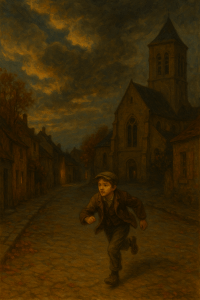
On an autumn evening in Juvigny, Aisne, when the huddled houses were already nodding off to sleep and gigantic, phosphorescent cloud banks hauled themselves across the darkening sky, a young ragamuffin suddenly dashed out from a backstreet onto the Church Square at about eight o’clock.
The lad, barefoot and shaven-headed, swaddled in a pitiful long coat that hung to his ankles, first scanned the darkness intently, then began to roam about, periodically crying out “Cacheux!… Cacheux!” with vaporous breath, sniffling every so often; but seeing no sign of the person he was hunting for—not under the porch close by, nor behind the hefty pile of beams lined up against the cemetery wall—he quickly made for a sheltering overhang and froze in place, his back hunched, watching an illuminated shop front where, ghostly pale and stick-thin, between flowerpots of geraniums, the lone tailor in the area—a small man with a beard—was pulling ever-dwindling needlefuls of thread.
From somewhere in the village, someone was stumbling through a melody on a bugle; just past the cemetery railings sprawled a muted whiteness: beds of chrysanthemums; the ancient church had a forlorn look to it; and, standing sentinel over a sudden drop in the terrain, beyond rooftops lacquered with flickering light, a jagged row of poplar trees rocked back and forth, frittering away their final leaves.
From his watch-post, the little ragamuffin appeared to be mulling over erratic thoughts, for suddenly overcome with cold and weary of immobility, he launched himself into a handstand with legs dangling loosely, and in this upended posture, happily meandered about with well-practised dexterity, as the oversized flaps of his long coat slid away from his hips.
The moment the bugle ceased, the sound of someone trudging along muffled the quivering silence.
Suddenly a second lad came into view, stopped in his tracks, and sent his eyes roving through the murky blackness.
Clad in old tattered slip-ons and equally ill-dressed in rough canvas knickerbockers and a wool jerkin, the lad approached his friend and, upon reaching him, asked:
“Blimey, Amable, is everything still a go?”
At once, the other boy sprang upright:
“C’mon! Off to see that bloke, by thunder!
Mouth pinched tight, Cacheux declared:
“After all, we ain’t planning to nick his greens… It’s merely to have a peek, innit…”
Without wasting another moment on preliminaries, the mischievous duo slipped away from the church grounds.
They crept past the cheerless window where the tailor was hard at work, made it to the rough-edged line of poplar trees, zigzagging along past ramshackle houses, walled plots, and small factories, which finally led them to a proper carriageway. Moving at a steady clip, quite preoccupied, their minds filled with anticipation of the adventure ahead, barely speaking except for the odd useless grunt now and then, it wasn’t long before they came to a bridge, and sprawling beyond it—walled in on the road side but with only a broad brook defending its right flank—stood what had once been a grand park, now a wild wood, largely stripped of leaves, shadowy and heaving, enormous and fortress-thick, where the evening wind whirled with carefree abandon.
Rolling up his coat to his knees, Amable prepared himself:
“We’ve got to go in from this bit here, blondie!”
Cacheux kept mum, yanking his trousers higher. He took off his battered slip-ons and packed them tightly into his wool vest pockets; but when it came to the point of wetting his feet, his jaw quivered anxiously and, struck with second thoughts, he muttered shakily:
“Better not be any mutts lurking around to attack us, not at this late hour!”
With a contemptuous shrug, Amable retorted: “If there were any dogs about, d’you think I’d have brought us here?” Cacheux registered the soft plop of alarmed little frogs, the secretive gurgling of the stream, and its bell-like reverberations; then, deciding to go the whole hog, he led the way into the water and was first to haul himself up onto the park’s riverbank.
Plucking up their courage, they forced a path into the woodland, fighting through a bewildering maze of thorns, brambles and untamed shrubbery.
No sign remained of the former paths or open spaces; only enormous trees, gloomy stumps, a disorderly riot of twigs and boughs, a teeming mass of withered plants and bushes: hazels, filberts, spindle trees, and willows, all dappled with flickering shadows.
Strong currents of air swayed the treetops in the long-abandoned grounds; leaves tumbled sorrowfully onto the thickets below; all of which generated an eerie, bone-chilling susurration.
Their hands and feet were being ripped to shreds; they kept getting caught in the brambles; and now and then they would trip and fall flat.
“D’you reckon we’ll ever reach the place, at this rate?” Cacheux complained over and over.
Amable scarcely bothered to answer.
Then without any warning they caught sight of a gleam. Sickly and latticed by small twigs though it was, it nevertheless cut sharply through the night.
The pair of troublemakers made a beeline for the glow.
Coming upon a cluster of pine trees, they stopped dead and held their breath; then, drenched in sweat and breathless, they were finally able to examine the back of a lavish mansion which at first gave them the bizarre impression of moving backwards relative to the scudding clouds.
All was quiet and dark in the building, except for a single ground-floor window—high-set with a balustrade, a tranquil window emitting a uniform light, which was continually bisected by the rapid, zigzagging path of a darting bat.
The lads could make out a group of statuary, four large oval vases marking the corners of a lawn, stable blocks, and swaying walls of trees; feeling reassured by the absence of any threatening signs, they edged their way towards the enigmatic window. Complete silence reigned from inside.
Clutching at the balustrade and driven by overwhelming curiosity, they had barely begun hoisting themselves upward — when a menacing voice suddenly burst out right beside them:
“So! Little brigands, you wretched spawn… Jean! Prosper! At once, to His Lordship’s window!”
Cacheux spun back in a flash; Amable, on the other hand, tried to make a hasty escape; but they were blocked by a servant, an old domestic in a yellow livery with silver braiding, who stood before them, arms spread wide, brandishing a cane.
“If you so much as twitch…” he warned menacingly.
Cacheux was the first to crumble into tears:
“Don’t beat us, mister… Please don’t beat us…”
“And just what might you be up to here?”
“We weren’t up to anything, M’sieur.”
“Nothing, you say?”
“We swear, M’sieur.”
“That’s absolutely—”
Breaking off mid-sentence, the manservant glanced upward to the window above the trespassers, who instinctively mirrored his action, and through an opening that grew larger in awkward, stuttering movements, they watched as there emerged inch by inch, by the dusky light of a candelabrum with trembling glass guards and flames that writhed against the air, a haggard, wobbling, time-worn face; a lifeless face, criss-crossed with wrinkles; a face with extinguished, blue-tinged pupils, distinguished by fine white moustaches curled at the tips and thick, undulating white hair that, like two waterfalls, came to rest against the rich burgundy velvet of a sumptuously decorated dressing robe.
And as the trees of the park stirred in brief and violent commotion, a hunched and balding gardener hurried over, followed at his heels by a sexagenarian woman with glasses sitting astride her nose, and then, hobbling behind, wrapped in a coachman’s coat, one last retainer whose mouth constantly worked in pointless mastication.
“Monsieur le Marquis…” the yellow-clad valet cried out at once.
Then, upon being directed to tone it down;
“Quieter! Jérôme… not so loud.”
He proceeded with reduced animation:
“Two young lads, Monsieur le Marquis, prowlers of some sort, whom I’ve just this minute captured.”
The curious elderly man replied in a shaky tone:
“Children!… children!”
His thoughts appeared to drift astray for a moment, engulf him, retreat into the past, perhaps ebbing towards some never-forgotten soul-wrenching agony; then, as if the cold snap pulled him back to himself—all the while the bat kept circling in its habitual pattern—he asked:
“Right then! What’s to be done with these youngsters?”
The question raised no difficulties.
“I say we drag them off to the gendarmes this very minute,” volunteered the gardener, with a distinct nasally twang.
“Speaking for myself,” announced the manservant in the many-caped coat, “I think they should be fined a good sum.”
“In my opinion, they’ve earned themselves a proper whipping,” the plump woman shrieked.
And the entire group stared at their master, their stances betraying exhaustion. He, meanwhile, kept nodding his head back and forth.
“Now then!” he interjected suddenly, “I think the wisest course is simply to see these children off the premises, wouldn’t you agree?… no punishment needed… They’re so terribly young, mere infants compared to ourselves!… How old might they be?”
“Thirteen,” answered Amable.
“Twelve,” Cacheux blubbered.
A short, bitter laugh came from the old fellow:
“Twelve!… thirteen!… Good heavens, can it be?… Let me look at you!”
The multi-branched candelabrum reached out beyond the baluster, driving the darkness back to the parkland, setting the statuary aglow, and tinting the grass with brilliant ribbons of emerald.
However, a biting blast of air snuffed it out all at once, completely altering the scene, and now, silhouetted against the mellow illumination from a hearth, the man stood—increasingly unsteady, shrouded in shadows, his robe’s lavish details obscured—the very man whose appearance had been staged with such bizarre pomp.
“Jean, do come and get these candles burning again,” he demanded then.
And with no further comment, he withdrew, taking an inordinate amount of effort to pull his window closed.
 Léon Hennique Novel