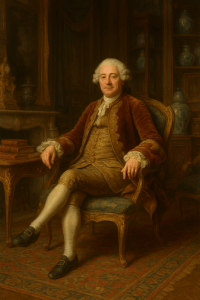
Louis-Euchariste-Agénor de Cluses was born in London on the 4th of November 1799, six days before the 18th Brumaire(1), to Jenny Gainsborough, third daughter of Lord Gainsborough, Earl of Warder, and to the Marquis Robert de Cluses, an erstwhile Lieutenant Colonel in the Crown Regiment(2), celebrated as one of the handsomest men to have fled revolutionary France.
Blessed with unfailing vigour, an iron will, utter fearlessness, and descending from a bloodline in which passionate fidelity to the royal house was revered as the noblest of virtues, he had stood amongst that select coterie of gentlemen—Montmorency, Saint-Maurice, Pons, Marsan, Rochefort, Sombreuil, de la Guiche—who, commanded by Baron de Batz(3), through unwavering allegiance and perhaps knightly, idealised adoration, had conspired to save Marie-Antoinette.
Following the beheading of the Queen, since nothing but the seductive thrills of peril remained to keep the group united—and this proved insufficient—they had gone their separate ways, freeing each man to venture wherever he fancied, after delivering a final act of defiance to the denouncers of the Committee of Surveillance(4).
One morning, having been pursued for months, with scarcely a penny to his name, a figure of misery, utterly spent, and alarmingly emaciated, the Marquis de Cluses concluded his seemingly endless month-long journey by arriving in London.
With nothing but the sole shilling daily allowance that the English authorities granted to each émigré, he had, in the beginning, carried his forced idleness, deep-seated resentments, constantly rumbling stomach, and suppressed melancholy, from one gathering to another, down specific thoroughfares, along the breezy banks of the Thames, peculiarly buoyant at no longer needing to dissemble or lurk in shadows, yet utterly dumbfounded by the unexpectedly peaceful quality of his destitution. Later, surrounded by the distinguished company of fellow Frenchmen he had drawn together, and old acquaintances he had reconnected with, amidst which the ladies had unabashedly established themselves as haberdashers, perfumers, shopkeepers, and sales assistants, while the men had reinvented themselves as thespians, lemonade sellers, woodturners, and lamplighters, all with a sardonic gaiety, it occurred to him that he had once taken several violin lessons from Leclair(5), and that, on many occasions at the royal Court, people had praised the nimbleness of his knees and the masterful fashion in which he performed a minuet or a chaconne.
Acting with remarkable haste, he soon acquired a pochette(6); his lodgings, a spacious chamber on the street level, were quickly repurposed as a practice studio; and, with daring self-assurance, a placard on his door announced: Marquis de Cluses, Dancing Master; all while his estates were being auctioned away on the French side of the Channel.
There was no shortage of students beating a path to his door. Be it the low dances, earthbound dances, courtly dances, or high dances, he instructed his pupils in every conceivable step from the most basic to the most demanding leaps, his popularity steadily growing, his demeanour unfailingly dignified, teaching everything from the passacaglia and rigadoon to the lively bourrées of Auvergne and the spirited branles of Poitou(7).
His aristocratic rank, combined with several intriguing escapades, the striking good looks he had managed to recover, and his visible devotion to matters of elegance, swiftly secured him a position of favour among the fashionable set, attracting that special kind of fascination which gravitates towards those blessed with genuine physical beauty and possessed of a past steeped in eventful history.
Gossip began making the rounds one day, nevertheless—gossip about a rather more significant liaison, gossip concerning an unforeseen thunderbolt of passion striking him between two contra dances. When questioned, prodded, and pressed for details, he had simply chuckled; but before long it was beyond question that Lord Gainsborough had betrothed one of his daughters to him, and that from a lowly dance teacher, he was about to become lord and master of one of London’s most blue-blooded and well-endowed young heiresses.
Such was the least muddled of the memories predating his birth—narratives passed down, static fragments of history—that lingered in the mind of the belated scion of the ex-colonel, the present Marquis de Cluses, in these twilight hours when such merciless incidents had forged his character, when old age had speckled him with shadowy voids, when his soul had grown heavy with countless exclusively personal recollections.
Scarcely able to lisp anything but unintelligible babble, brought to France, to Paris, as July of 1802 drew to a close in the wake of the amnesty, he had without delay taken up quarters in an ancient hôtel particulier in the Saint-Germain neighbourhood. From dawn till dusk, encircling his parents, a sizeable retinue of servants decked out in yellow liveries embellished with silver braiding began to bustle about.
After some time had elapsed, Lord Gainsborough departed this world; the Duke of Enghien(8) was put before a firing squad; Napoleon, the foe, the man whose name was on every European lip, had had himself crowned Emperor; and in 1805, as the Peace of Pressburg(9) was being sealed, when acclaim for the victory at Austerlitz could be heard from all quarters, the Marquis Robert, his wife, and his young son had vacated their Paris home to establish themselves at Juvigny, taking possession of the family’s hereditary castle, a property that remained furnished, a splendid stronghold, surrounded by its age-old parkland, an estate which, through an unexpected twist of fate, the vagaries of a sale had recently delivered back to its rightful custodians.
The image of his mother remained perfectly clear in Agénor de Cluses’s mind, just as she had appeared in Year 13(10); a tall, graceful woman with a complexion that mingled rose and cream, whose accent was gentle and beguiling, whose smile revealed exquisite lips and slightly prominent teeth, a beautiful woman whose hair was nearly auburn, a gleaming metallic red. She always gave off the delicate perfume of alabaster cream, dressed consistently in white gowns, kept her hair clipped short at the back but curled upon her brow, and typically wore quilted coats trimmed with swan’s down, half-gloves extending up the arm, and slippers in either rich gold or azure blue, earrings designed like basket handles, caps resembling bonnets made of either sparterie(11) or velvet and festooned with ribbons; and draped from her shoulders—glorious shoulders whose flesh subtly shaded through the delicate gauze fichus(12)—hung cashmere shawls in red, green, or wine-coloured varieties, each bordered with elaborate, multicoloured floral patterns.
Twice monthly, a courier galloped at breakneck speed between the capital and Juvigny, delivering the Marquise’s ensembles and beauty requisites. Profoundly enamoured, the Marquis Robert willingly catered to every opulent whim with gentlemanly grace. Nearly always decked out in a coat of either blue or mauve cloth, sporting a mandarin-yellow waistcoat trimmed with pink, trousers of either black or light grey cashmere, and small, elegant shoes, he only ever parted from her to inspect his lands, on which occasions he would pull on his boots, don leather breeches and a Hamburg riding coat, mount one of the frisky steeds from his stable, and set forth with either a pair of greyhounds or his gun dogs, shotgun at the ready. Dispensing with the outdated custom of powdered hair, he now carefully tended to his short side whiskers, in keeping with the fashionable taste of the period.
Upon his son’s seventh birthday, the Marquis engaged a tutor for him, Abbé Robiquet, a non-conformist priest whom he had first encountered in London before rediscovering him in Paris, staunchly opposed to the Concordat and utterly immovable in his convictions. The priest was an ascetic of sorts, a tiny man with a florid complexion, skinny, scholarly, and unbending, whose large, continuously bobbing Adam’s apple accentuated a face characterized by elongated features and penetrating, auger-like eyes, overarched by wild, unkempt eyebrows. The child took to him immediately.
And all the while, Napoleon climbed ever higher, the man himself indefatigable, haughty, and ruthless, casting an ever-longer shadow across a Europe seething with discontent.
He had been declared King of Italy and appointed Protector of the Confederation of the Rhine; next, as part of his ambitious program of royal handouts, Joseph Bonaparte was bestowed the kingship of Naples and Sicily; Louis was given Holland; Elisa took possession of the Duchy of Lucca; and Pauline Borghèse received Guastalla. Murat was made Grand Duke of Berg; Berthier, Sovereign Prince of Neuchâtel; Bernadotte, Prince of Pontecorvo; and from the sites of butchery where dismal blood still fumed, from the shadowy lairs of diplomacy and policing, sprang forth a new nobility, whose vestments were especially adorned with gold from the Venetian States. At the same time, Prussia, Russia, England, and Sweden were banding together to counter the rise of a man who appeared determined to swallow everything whole. War broke out(13).
“This time, the usurper has met his match,” pronounced Abbé Robiquet to Robert de Cluses one evening in late September when, in the grounds of Juvigny, not a breath of air stirred, when the statues formed ranks of shadowy whiteness, and when the trees, completely still, appeared to be fashioned from iron and copper in the dying light of dusk.
With listless arms hanging by his sides, with eyes tracking the glimmer of a star that he caught sight of, then lost, then glimpsed once more between the lofty trees, the Marquis said softly:
“I sincerely hope you’re right… But I hardly dare believe it…”
Then, as the cheerful melody of a harpsichord rose from the château, they fell silent to listen to Agénor who, in a thin, piping tone, was singing and amusing himself in his mother’s company.
The resonant victories at Schleitz, Saafeld, Jena, and Auerstedt furnished the answer to their speculation. Napoleon was bringing the continent to heel.
It was in the midst of this cultured tranquillity, the blockade already in effect, in the aftermath of Eylau, Friedland, and the Treaty of Tilsit, at the moment when, through the Emperor’s determination, the precarious throne of Westphalia was taking shape, that the Marquise de Cluses felt the first symptoms of the condition that would ultimately prove her undoing(14).
She began to cough now and then; the bloom drained from her cheeks; her joyful spirits waned; and, with consumption announcing itself, a distinguished physician was summoned from the capital. Upon his arrival, he devoured his meals like a ditchdigger, slept with the heaviness of a beast, scratched out some nondescript prescription, and departed with his mouth firmly shut; but following that visit, the Marquis Robert no longer indulged in his customary hunting parties; and the château, before its time, assumed the character of an immense, soundless crypt, its oppressive silence broken only by the unwitting exuberance of a child.
August and September of 1807 unfolded in magnificent sequence: not a single raindrop descended. Juvigny had transformed into something akin to those southern climes where a constant and headily warm sun forever shines.
Notwithstanding this pleasant spell, as soon as early October arrived, a harsh chill scattered itself throughout the region in just a day’s time, the effects of which the Marquise rapidly began to feel.
By now entirely restricted to her chaise-longue, she continued to dress elegantly and maintained her loveliness, despite her fatal pallor and the way her russet-gold tresses escaped from under the tulle of her bonnets; and drained of energy, her hands either listlessly inactive or busying themselves with an amber necklace underneath her comforter, she took pleasure in conjuring up memories of London, her two sisters, a wealth of small occurrences, and wayward recollections, with such a preciously delicate accent, so doleful and insubstantial, that her husband would at times flee their bedroom to taste the bitter tears of widowhood that had not yet come.
Harrowing episodes would also occur from time to time. She would cling desperately to the wretched man, eyes unfocused and wet with tears, caressing him with tremulous hands, chattering, endlessly chattering with a frenzied verbosity; and she would make him swear to honour her memory afterward and never wed again.
Every morning, at approximately the same time, Abbé Robiquet would call to check on her condition and to ready her in stages for the spiritual aspects of his clerical duties; but she would greet him with studied amiability, never mentioning her growing infirmity, deliberately avoiding sharing her despondency with him, partly due to a distinct sense of shame, partly from the self-centred perception of a woman in love who sensed that, in this instance, she could not stir a heart to beat in harmony with her own.
Her flame was extinguished one wintry evening that showed no mercy to the trees or the whitewash of the walls, her strength completely spent, without uttering a word of complaint. Her young son, Agénor, was occupied with building houses from playing cards, while in the glow of an Argand lamp(15), the Marquis Robert was absorbed in reading the Moniteur.
“I say!” he exclaimed suddenly, “the Portuguese campaign hasn’t been a long one… Junot is already in Lisbon.(16)“
And hoping for a reply, entirely unsuspecting, he turned toward the bed where his wife had just slipped into slumber, her mouth open, her eyes fixed and unmoving, a terminal slumber of remarkable tranquillity. With a desperate lunge, he reached her bedside:
“Jenny—!”
Agénor turned his head, not grasping what was happening.
“Jenny!” the Marquis called again, his voice strangled with emotion.
He hurled himself toward the deathbed, dropped to his knees, producing an agonized, tear-choked rattle through which unintelligible words struggled to emerge.
Agénor stood frozen in shock. But when his father staggered to his feet, leaning down to kiss the forehead of his dead wife, looking deranged with grief and his features contorted in agony, the boy was overwhelmed with fear and, in an instant, began to shriek piercingly.
A crowd assembled in haste: first the lady’s maids, then Abbé Robiquet; and then, moments later, the remaining servants of the château, who crammed themselves into a corner of the room. All this time, Agénor’s screams persisted without interruption.
“Quickly!… someone take him away,” stammered the Marquis.
With the boy taken out—his frenzied cries slowly subsiding—the Abbé began to pray aloud. Only one servant joined in the responses.
A calèche(17)was sent off to summon nuns from the nearby town of Juvigny; and the time had come to attend to the Marquise’s final toilette.
With a modicum of self-possession restored, Robert de Cluses decreed that she would be placed for viewing in one of the château’s formal drawing rooms.
And presently, as he sat ensconced in his armchair, his thoughts dwelling on scenes from the past, his gaze fixed upon the carved beading of a frame or the fluctuating gleams of a piece of goldsmith’s work, whenever Agénor retraced the stream of years through which he had passed, the ceremonial bed where his mother had lain wasting away during two nights and two days would frequently loom before him, illuminated with a sinister intensity.
A garland of violets had been set upon her brow; her ears were embellished with agatized palm leaf earrings; and ghastly pale, dressed in a white gown, her delicate ankles encircled by silk hosiery— whilst the stables reverberated with the neighing of numerous horses, and, having turned up with terrible timing only the day before, the black-crested helmets and green and red uniforms of a transient company of dragoons moved busily through the main courtyard—she was laid out, her feet adorned with plum-coloured shoes, with a rosary between her fingers, a cross placed on her chest, stretched out upon the grey fur of an elaborate Polish-style coat. — Agénor shook his head.
Living in solitude, chilled by advancing age, habitually seated by the fire, dressed in an Armenian-style dressing gown, echoing the evening habits of Louis XIV, even amidst the sweltering heat of summer, his spirit fluttering in the countless gusts of his former life, his mind pensive, shaped by a refined stream of education, his determination clear-cut, as unbending as the golden emblems of his heraldry, he appeared as a man shaped by two distinct histories: one in which he had loved, suffered, and lived, and another—immensely venerated, lavish, dazzling, and sun-bright—which had given birth to the impressive treasures of art and patient craft with which he persisted in surrounding himself.
Had he known, Abbé Robiquet would have swelled with pride at his pupil, for in his innermost being—though unexpectedly cast adrift from Catholic ways—he had become, by and large, exactly what his tutors had aspired to create: a man of unquestioning royalist allegiance who, in literary sensibilities, was thoroughly infused with Bossuet(18).
Agénor felt he could still hear the priest’s voice as he intoned with parched throat: “Look around you on every side: behold what grandeur and piety have managed to create in honour of a hero; titles, inscriptions, meaningless tokens of what is no more, figures that seem to mourn around a tomb, and brittle images of a sorrow that time will carry away together with all else; columns that seem to strive to elevate to the heavens the grand testament to our insignificance, and in the end, nothing is missing from all these tributes save the one to whom they are paid.” He would place emphasis on every single word, and with his slender arms tried to make grandiose gestures, becoming, on certain afternoons, so gripped by emotion that he could not finish reading, snapping shut the Funeral Orations with an abrupt movement, and stammering:
“That, my boy, comes from a bishop! That, I tell you, is true greatness! That, indeed, is history itself!”
His Adam’s apple heaved up and down like a piece of driftwood.
 Léon Hennique Novel