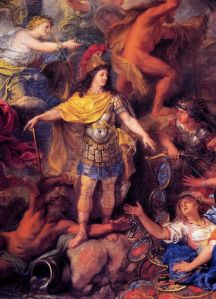
To Abbé Robiquet’s mind, Louis XIV alone had stood as the authentic incarnation of earthly majesty, a figure whom divine providence had favoured with its most sublime gifts, forging his character through stern lessons of adversity, refining him to such a degree that he could coolly observe his own elevation to godlike status, whilst surrounding him with courtiers as deserving of his greatness as he was able to inspire their merit. “Historical chronicles were barely sufficient to contain the accounts of his magnificence and splendour—a unique splendour, a pontifical magnificence. His benefactions rained down like torrential downpours; all his royal prerogatives, he had completely understood. Protestants driven from the realm to ensure that faith would be unified, flourishing, and beyond dispute; the revival of state finances; looters of the treasury overthrown; France enlarged and victorious; hospitals erected through perfect generosity; a police force properly equipped to serve; trade and industry defended; a navy both powerful and numerous; colonies poised to flourish; the continuous establishment of warehouses, manufacturing centres, and academies; the skill of drawing talented individuals to his court regardless of their nationality—what magnificent claims to recognition! Who, if not Louis XIV, ever kingly, ever magnificent, had better harnessed the concepts of honour, healthy competition, and patriotic fervour to galvanise whatever nobility persists in human ambition? Modelling himself after the dignified gallantry of his mother Anne of Austria(19), had he not revolutionised his court, instilling propriety into the outward expression of conduct? Grand fêtes, days filled with wonderment, nights alight with fireworks and flames, fleeting delights—these never caused him to neglect his duties as a Christian. Napoleon was nothing more than a mimic, a mere reflection, a mundane copycat.”
Little Agénor eagerly absorbed his tutor’s every utterance, admiring and internalising the Great Century, swiftly kindling his imagination, whether he pictured the resplendent Sun King dramatically posed in mythological ballets, during tournaments, in gleaming armour, riding beasts caparisoned with festive garlands, or whether he imagined encountering him throughout the years, at spectacles, at Versailles, in every possible setting, bedecked with plumes, ribbons, sashes, elegant doublets of satin or velvet, and his majestic, leonine flowing tresses.
In the wider world, Pope Pius VII was being held captive in Savona. Joseph Bonaparte had been installed as King of Spain; Napoleon had vanquished the Austrians at Essling and Wagram, forced the Treaty of Vienna upon them, and married Marie-Louise; the King of Rome had come into the world; France had expanded to include 138 departments and the seven provinces of Illyria. But, shaking off their heavy stupor, the oppressed nations—pushed around, handed over, or carved up like mere cattle—were starting to harbour hatred for their vanquisher. Kings were cautiously raising their heads from the shadows; the Iberian War dragged on interminably, a disgraceful wound festering in the side of imperial glory. Then came the Russian campaign(20).
Robert de Cluses was in an unending state of indignation. He had put on weight; his skin had been weathered by country air; grey had begun appearing in his hair. With age, in addition to a timorous devotion to his departed wife’s memory, the fire in his blood had cooled. With his wife no longer present to hold him back, he had become something of a centaur, wearing out two horses daily, feeling fulfilled only at the dinner table after returning utterly fatigued from outings during which he had liberally spat upon the tyrant’s name and fervently wished to see him fall.
Each morning, with a hundred scented tapers alight in the small domain church near the Marquise’s burial vault, Abbé Robiquet, draped in a funereal chasuble embroidered with royal lilies, conducted a Mass in which he beseeched Providence for the Bourbon restoration and the triumph of Tsar Alexander. Both father and son attended these services—Robert de Cluses properly attired in coats of thornbush-grey or lapis-blue, trousers fashioned from yellow cloth or nankeen with slits at the ankle, and striped waistcoats; Agénor slender and dreamy, with the heavenly eyes inherited from his mother, a fair, delicate complexion, and garments that already betrayed his approaching adolescence.
Orderly, deeply loving, and rarely tumultuous, Agénor was becoming exceedingly fond of his bedroom, where, under precise orders, even the most insignificant items hardly ever moved from their assigned places. Adorning the wall, which was dressed in simple purple-patterned paper between high borders, hung the equestrian portrait of Louis XIV as a child. The horse, a large piebald mount with a ram-like head, was embellished with a frontal piece and a wealth of tassels at the temples, chest, and bridle; cherry ribbons flowed abundantly from its mane, crupper, and tail. Atop its square saddle cloth bordered with long fringes, a triumphant depiction of a godlike youth posed grandly, his torso encased in armour, his hair crimped, wearing soft boots and lace-trimmed gloves, with enormous spurs twisted near the rowels.
It had been a birthday gift from Marquis Robert to his son, and the boy had been so overcome with nervous excitement that he’d barely slept that night.
 Léon Hennique Novel