And the season slipped away, then an autumn, then a winter, during which Napoleon, ever watchful from the isle of Elba, witnessed the Bourbons’ mounting blunders and their spreading loss of favour.
Agénor knew no perfect freedom during evening hours; but he was promised that come next year, he would be able to attend the playhouses and avail himself of countless fashionable invitations.
Until then, each morning, whether it rained cats and dogs or whether February’s first fierce hailstorms scourged the air, a fencing master banged the heavy knocker of the Hôtel de Cluses.
Fresh tastes had taken possession of Agénor, developed from his scrupulous reading and from delving into Louis XIV’s century—tastes which Marquis Robert teased him about. He became a collector; amid the monotony of indistinguishable weeks, he would often spend a fortnight’s worth of hours hunting for peculiar treasures.
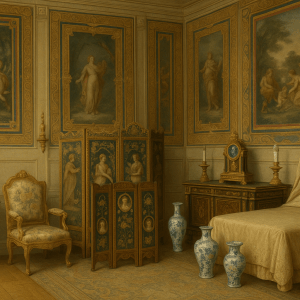
Four Gobelins(26) tapestries after Mignard’s(27) designs, trimmed with ornamental borders and leafy scrollwork, finished at the corners with spiral decorations, already clothed his bedchamber walls. A four-panel Savonnerie(28) screen, embellished with foxes, birds, cornucopias, fruit and blossoms, kept company with carved wooden furniture, gilt at the cross-braces, executed in the delicate needlework known as that of the Saint-Cyr ladies(29), displaying portrait roundels. There stood a pier table whose pedestal bore a female head, its green antique marble resting upon carved foliage; a Boulle(30) cabinet inlaid with brass and tortoiseshell; torch-holders with ovolo mouldings raised on acanthus-leaf supports; a timepiece wherein paired genii upheld the medallion of his beloved king; weighty candlesticks; vessels from Japan and China blooming with peonies and chrysanthemums, white, violet and blue, sprouting from chiselled bronze pedestals decorated with shells and coral sprays.
One morning, with hurried step, the library door thrust open, the Marquis de Cluses appeared—agitated, bitter, thrown off balance.
“That wretch Napoleon has come ashore at the Gulf of Juan(31)… Soldiers are about to march… Farewell! I have orders to distribute.”
That was all. Agénor and Abbé Robiquet eyed each other for a moment, bewildered. They broke off their customary lesson, called for their hats, and dashed outside.
Nothing stirred in the streets. The calamitous news had not yet spread. Only towards the church of the Madeleine, a regiment of brown hussars passed by, inscrutable, at a canter, in full military tackle.
A handful of spectators had watched them depart, but there was no tumult, no ovations.
Agénor and his tutor continued their walk, heading towards a military installation they had spotted. There, across a vast courtyard, cannoneers in blue and red, plumed colbacks(32) on their heads, assembled, mounted, ready to march. When approached, however, a sentry with greying whiskers knew nothing about the cause of such upheaval.
Abbé Robiquet suggested returning to the de Cluses mansion. They crossed paths with infantry of the line, packs on their backs, and further ahead some chasseurs(33). There was no denying it—the king was taking stern measures. With pensive eye, watching the heavens tear wispy clouds moment by moment, they were about to glimpse their dwelling’s roofline when suddenly, through a deserted alley—they had chosen it to shorten their route—a shout of joy struck the two royalists: “Long live the Emperor, for God’s sake!”
It came from a sturdy fellow in a waisted tailcoat, booted, straight-backed, bearded, with the air of a half-pay veteran(34). He stood at a coffee-house entrance.
“Listen, Pharoux, old fellow,” called a voice, “if you keep shouting like that, mind yourself! Napoleon’s still a long way off.”
Pharoux shrugged dismissively.
The abbé quickened his pace, followed by Agénor, whose face flushed deep red. Soon the door of the Hôtel de Cluses swung open, then closed again with a dull thud. Agénor, crestfallen, increasingly thoughtful, trembling with agitated weariness, climbed to his quarters and sat down. He pictured again the pensioned veteran, his weathered face, his imposing frame; he heard the shout; and suddenly remembered the conspicuous red ribbon, overly wide, that the fellow had displayed at his lapel.
Seventeen days later, on 20th March, Napoleon slept at the Tuileries, in Louis XVIII’s very bed(35).
Not a drop of blood spilt! With willing hearts, the people and the soldiery had surrendered themselves anew to Bonaparte.
“Is there someone amongst you who wishes to kill his Emperor?” he had asked the troops sent to oppose him, near Grenoble.
He had stood quietly, tall, ready to be shot, a few paces from his feeble escort.
And seeing him again—all those from the bygone struggles, the shared hardships, the mighty triumphs, the calamities, all those whom his glory had touched, all those whom his genius and his failings had made famous—they hailed him with jubilant cries and crushed their white cockades underfoot.
Aghast at this treacherous defection, the Marquis de Cluses hastily packed off his son and Abbé Robiquet to Juvigny.
From this castle, in allied territory, Agénor witnessed the Hundred Days blaze up, Waterloo erupt, Saint Helena rise from the Atlantic, and suddenly, a monarchy that contrary winds had so swiftly blown away restore itself once more(36).
Robert de Cluses, who had thrown himself into the Vendée(37), returned to Louis XVIII’s service; but this time—entirely absorbed in the amorous intrigues of a potential marriage, which he wished to keep secret and undisturbed—wary of his son, he left him stationed at Juvigny.
Under the Paris accord(38), a hundred and fifty thousand foreigners were commissioned for three years to patrol restless France, to occupy its carved-up, desecrated soil. Agénor had to billet Danish and Prussian infantry, Russian uhlans(39), Austrian carabiniers(40), Scotsmen—one group after another.
He hosted them as best he could, as liberating forces. He amused himself with their uniforms, showed the officers about, rode their mounts. But he grew fond of the Scottish soldiers, virtual kinsmen whose tongue and history he understood, whose ways fascinated him.
They executed Marshal Ney(41), Generals Fauchet, Labédoyère, Mouton-Duvernet, Bonnaire, Chartran. And one night, the Marquis de Cluses arrived at the château of Juvigny in a post-chaise(42), without having sent word.
Brooding, his expression sombre, he promptly retired to his chamber. However, when distant cockerels hailed the dawn, when the wistful din of houses stirring gradually swelled, he sent for his son. Moved to see him so changed, he then announced bluntly:
“I have significant news to share… I plan to take another wife… I trust this will not trouble you.”
They stood in the drawing room where, in days past, the Marquise de Cluses had been laid out—a hallowed space, a commemorative space. Agénor crossed its threshold only with grief.
A dreary drizzle blurred the windowpanes; outside, one trod heavily upon sodden earth; harsh wind knocked down the yellowing leaves. While his eyes remained motionless, dimmed with unease, his father prattled on, perhaps to stupefy himself, to stifle a guilty conscience. Agénor, his ears throbbing, felt himself dissolving into hostile emotions.
At length the Marquis fell silent and produced a miniature portrait, which the boy took and stared at in utter disbelief. It showed merely an ordinary girl with auburn hair, caught mid-laugh. Her laughing expression maddened him utterly. He spoke not one word, yet drained of colour and visibly trembling, he fixed a glacial eye upon the miniature before turning it towards the stately painting of his beloved mother that graced the wall between two windows nearby. She was depicted as she had been: so beguiling, with neatly braided hair, wearing a flowing muslin gown over a pink underskirt, her feet shod in cream leather. He thrust the miniature back and quit the drawing room without another moment’s pause.
“You’re nothing but a scoundrel!” thundered Robert de Cluses.
It was the last time Agénor would ever see him.
Scarcely a fortnight had passed, his widowerhood almost at an end, when the Marquis met with disaster in a riding accident on the Champs-Élysées. His skull was shattered and he died within the hour in flat, unrelieved agony.
News of so sudden a death struck the household at Juvigny like a thunderbolt. Agénor wept bitter tears and gave way to grief—furious with himself for his rebellion, blaming himself harshly for not having borne his father’s rod. But presently, with the funeral rites completed and the cherished corpse safely entombed in the family vault, when all the tedious inheritance matters were settled, time worked its slow magic, as time invariably does, offering comfort and gently coaxing the heart towards forgetfulness. So it was that Agénor—his guardian cousin having left him essentially master of a yearly income of five hundred thousand francs, with the Abbé Robiquet handling the management—returned to his settled ways and peculiar fancies, his spirited nature, and that quite unreasonable, homebody’s delight in the mere fact of living.
 Léon Hennique Novel