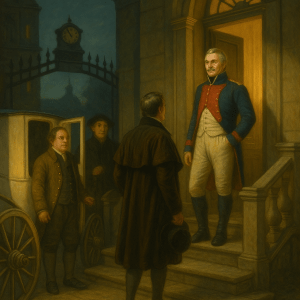
A fortnight had passed when Agénor finally succumbed to the urgings of his guardian, the Comte de Montégrier. On a particular evening, weary with grief and feverish, troubled already by thoughts of his lonely future, he climbed aboard the post-chaise bound for Paris.
Juvigny, he had abandoned without the slightest pang of remorse, his thoughts absorbed initially by this guardian of his—a cousin who held a colonelcy in the Royal Guard’s mounted grenadiers—while his spirits lifted at the memory of little Thérèse, his guardian’s daughter, whom he recalled as headstrong and wonderfully promising. “She must be quite the woman now!” Yet barely an hour into his journey, a storm broke with such fury that it startled his horses and sent thunder crashing close by, while wind and lightning and hail battered the windows of his carriage for what seemed an age—and he almost returned home then and there, overcome by sudden disgust, by yearning for his time-honoured ways, for his estate, for the graves he was deserting there, and by a superstitious fear that this tempest might be warning him of something.
Still, when stars began to prick the darkness one by one, he drifted into sleep, and from one posting house to another he hardly opened his eyes until the very first light of dawn revealed the greenish eastern sky, slate-dark and almost nocturnal still, where flesh-coloured clouds hovered and a few larks had started up their effervescent song.
At a firm trot went the horses; the carriage thrummed with its monotonous drone; the postillion was whistling hunting tunes; and Agénor, enchanted by this unaccustomed way of waking, discovered he could observe and listen without ever growing weary. Every detail drew him in: the early hour with its shifty character, the folk about, the grinding call of ploughs toiling across the flatlands, the far-off shapes outlined against the heavens, and the layered, ever-brightening glory of sunrise.
The light expanded and set fire to the horizon; then up came the sun with its crisp, vivacious, magnificent illumination, immediately tinging the world with new shades.
As the route dragged on, Agénor, paying no heed to the familiar villages and towns from his youth, became deeply melancholy again; yet he was drawn back to the present moment when his manservant, from his perch on the driver’s seat, suddenly exclaimed: “Paris, monsieur! Look, there’s Paris!”—and authentic joy possessed him as his chaise drew up to the La Chapelle toll-gate. Through this same gate Louis XVIII had returned to reclaim his capital back in May 1815(61).
The throngs of people, the illuminated shopfronts, the hubbub, the streets where lanterns swayed and squeaked in the wind over shining pools of light—it all carried the young man back to those times when he used to come home from his calls, his rambles, his scholarly pursuits, with his tutor who was now gone. His brain fogged and hearing abuzz, he felt as though his entire being had concentrated behind his eyelids, entirely caught up in the human bliss of inhaling yesteryear, in the genuine relief of having moved to new surroundings, in the minor gratification of recognising certain businesses whose shopfronts seemed to have dwindled now that he was grown.
Nervously, his pulse quickening, he made his way across the Place du Carrousel with the Tuileries in view, sending his allegiance through darkness and uncertainty toward the prince billeted there; then he crossed the Pont-Royal and rapidly pulled up at a porte-cochère(62)—the gateway of the Hôtel de Montégrier in the Rue du Bac. The bells struck ten.
Through the gates they entered a spacious courtyard of raked sand; a bell chimed twice with silver sweetness, and no sooner had it fallen silent than a portly footman appeared in his house livery, just as the post-chaise, white as moonbeams, drew up to the foot of the staircase, then the establishment’s porter, and finally, framed in the mansion’s doorway, a gentleman of considerable presence, grey-haired but with whiskers still brown, cutting a fine figure in blue and red regimentals.
“Bless my soul, Agénor!” he burst out as the young Marquis de Cluses presented himself in all his slender, springlike bearing. “What a fine figure you’ve become, and such a handsome cavalier! I hope the roads treated you kindly?”
It was Colonel de Montégrier himself, who drew his protégé into a warm embrace.
As the young marquis asked after the Countess and Thérèse—
“They’re waiting inside for your arrival. Come along, we mustn’t keep them,” he was told.
When he made excuses about being conducted straight to them, feeling he ought first to make himself more presentable:
“Don’t give it another thought, my lad,” the colonel insisted. “Anyone would swear you’d just stepped from the hands of Burle and Pomadère themselves.”
With touching naïveté, Agénor told how he was indeed attended by one of these very tailors, who made the journey to Juvigny biannually.
When brought into the presence of his cousins—each charmingly dressed in rose, seated in an inviting boudoir of mahogany furniture against yellow satin wall hangings worked with patterns of heavenly blue—the visitor’s attention was instantly seized by a remarkable wall clock executed in Boulle marquetry, its intricate patterns of tortoiseshell and brass enhanced by elaborate gilded bronze mounts, the entire piece crowned with a magnificent sculptural group of four prancing steeds emerging from stylised waves, all dominated by the majestic presence of Phoebus. A thrill of amazement coursed through him: “Good Lord, I have precious little that could rival such a masterpiece!”
Only with the greatest effort did he pay attention to their grief-stricken recollections of the lately departed Abbé Robiquet, a man unmatched in service and friendship alike.
Decorative genii flanked the clock face, whilst a pair of sculpted children upheld the whole. “It has to be the work of Mynuel(63),” Agénor thought to himself. And his eyes, though they roamed from the Count to the Countess, from her to Thérèse, noting the elusive moods that tinted the girl’s eyes, kept returning to metallic reflections, the clash and sparkle of brass and light.
“I hope it goes without saying,” the Colonel remarked, “that you are to make yourself completely at home here… Indeed, the more extended your visit, the more delighted we shall be.”
A few bashful words of appreciation escaped the young marquis, but in his own mind he pronounced with unwavering certainty: “If the movement of such a splendid clock is indeed by Lambert, these Montégriers have in their possession a jewel fit for the nation’s greatest collection!”
“Well I never, cousin dear,” the Countess proclaimed without warning—a blonde whose beauty had passed its prime, near-sighted, her eyelids habitually three-quarters shut—”I should dearly love to comprehend why you have chosen to bury yourself so entirely in provincial life, paying such scant attention to the advantages of your birth and fortune.”
Agénor launched into an extended discourse on his love of collecting bric-à-brac and rare pieces. With her delicate head poised in amazement, she would from time to time produce a smile of charming triviality, her mannerisms so deliberate, so remote, so invariably the same, that they seemed to mirror the decorative tracery worked into the room’s silk-covered walls.
“I daresay then,” she presently commented, nodding towards the clock with her petite, somewhat mincing fan, “you must surely be drawn to pieces like that?”
“Was he drawn to such things!” For one thrilling moment, gripped by frantic, covetous longing, the unworldly young marquis thought he saw behind such an unremarkable question the possibility of that glorious object—desired since setting foot in the house—falling like manna from heaven into his very grasp. But nothing further passed her lips, gave no hint whatsoever of considering whether to make him such a generous offer. He mentally dispatched the Countess to the nethermost regions.
“That clock shall belong to me… it has to belong to me!” he determined all the same, so fierce was the trembling of his desire. At once he began scheming to possess it, inattentive to all else yet carefully discreet, even as the Colonel launched into talk of practical affairs and the Countess prattled about the stage, entertainment, and the doings of polite society. Of Thérèse, his cousin, only her thick, lustrous hair had caught his attention.
The evening meal was taken, and with the lateness of the hour as excuse, all parties agreed to delay more intimate conversation.
Quite giddy from such cordial treatment, Agénor was shown to a room where, having rapidly arranged himself for the night, he sent his personal attendant away.
The sounds of the mansion died away by degrees, while the traveller remained absorbed in his thoughts, his joints shooting with pain. A wealth of sensations—some known to him, others completely new—had set his nerves on edge; having stayed awake much later than was his habit had left him strangely heightened in his awareness; and as his eyelids burned with fatigue, the small specks dancing before his vision seeming to peer out like the hundred eyes of Argus(64), he stared through the golden drapery at that splendid clock—one of a kind, princely, gleaming like the sun—and took up once more his thoughts of how to secure it for himself.
Different approaches suggested themselves. Some were crude and ungentlemanly, others clumsy in execution, and still others so nebulous and ill-formed that he couldn’t even begin to flesh them out. But by dint of wrestling with the question relentlessly—in a twisting, convoluted manner at first, then with all the infinite potency of intellectually conceived phantasms—an insane, ridiculous notion, sprouting quite out of nowhere, took hold of him, weaving together dubious cravings with his previous fixations: “Suppose I were to marry Thérèse? The cartel would be mine!”
He inflated this fancy, spinning it out at length—only to laugh out loud when a moment of practical wisdom showed him its complete absurdity. However, much like those fragments of music that stay lodged in the mind complete and whole despite our never intending to learn them, so now his cousin’s allurements began to glimmer into view one after another: eyes of dusky shadow, lips in full bloom, skin of blinding beauty.
Thérèse de Montégrier was hardly his ideal woman—not that fleeting embodiment of perfection once glimpsed at Juvigny along a country lane, that blazing vision which Abbé Robiquet’s death had cast into far-off banishment. She struck the young Marquis de Cluses as tender, lovely, and well enough—for dreamers are all unfaithful by nature. And with that, he sank into restful sleep.
 Léon Hennique Novel