Following Abd-el-Kader’s defeat(119), Thiers(120) and his cabinet finally manoeuvred themselves into power—pardoning their fiercest adversaries and shamelessly stirring political ambition with their grovelling plea for the Emperor’s hateful remains. Europe, meanwhile, embroiled in an Eastern crisis(121), found its diplomats once again indulging in petty intrigue—for this rabble so relishes sowing future wars under the guise of peacetime.
The Treaty of London(122) cast France out, yet again, from the circle of nations—only for these same powers to renew their favour soon after, without a shot fired, through the Treaty of the Straits(123).
It was late November 1840, and Monsieur Guizot had just completed his first month at the helm of Soult’s cabinet(124). Paris bristled with fortifications. Reports came of snow across several regions.
Juvigny lay buried in white—village, fields, hillsides alike hidden beneath low clouds tinged with a sickly yellow glow.
Agénor’s pen lay still.
A trove of darkened papers—leafed through endlessly, laden with unearthly secrets and vivid recollections from beyond the grave—remained locked in a writing cabinet, its key always with him. No one must ever discover them. The right to such knowledge was his alone.
He might have continued in gentle seclusion—lost in his flamboyant fixation with Louis XIV, numbed to worldly affairs—had he not been haunted by persistent premonitions. Any day now—perhaps tomorrow—Thérèse would vanish once more, summoned for some mysterious task.
To serve what purpose? The question clouded his thoughts for hours at a stretch. He avoided the outdoors, uneasy with the chill.
But at last, tiring of his own dread, he donned sturdy boots, wrapped a heavy cloak around his shoulders, took up his cane, and ventured into the park after his midday meal.
Snow fell in scattered flakes. The ground crackled beneath each step. A biting wind had whitened the trees. The air stung his nostrils. To his own surprise, the Marquis felt rather cheerful at having abandoned his fireside.
He strode out with long, distracted steps. He marvelled at the birds—such fragile creatures!—bundled like tiny balls high in the branches. He turned back to observe his tracks… one, two, three, four… They curved and stretched, like waterfowl soaring across a billowed heaven.
Not a breath of wind. Distant colonnades shimmered in bleached light, mottled by drifting flakes. Bushes and boughs whispered silently, ribboned in ermine. Rabbits—upright and alert like miniature men—gathered near the path’s edge, stirred, and bolted at the slightest sound.
Agénor muttered childishly to himself:
“Poor beasts—they must be famished this winter. We should have grain and lucerne brought out this evening… Dear me! That old beech—I’d quite forgotten it… How old would Mother and Father be now?… Mother! Let’s go visit Robiquet’s place…”
He conjured the scene of that tragic accident—restored the leaves, darkened the hedge, pierced the shadows with shafts of sun—less in mourning than in need of distraction. Then he continued onward, still amused by his trail across the pristine snow.
At the glade, where the ground stretched like vellum and the statues stood blank-eyed, dusted in crystalline sleep, his cane slipped from his grasp.
He bent to retrieve it. Yet somehow, the stick slid away, then etched in bold, unwavering lines into the snow:
A daughter shall be born to Berthe… I have lost possession of myself…
Though he’d braced for signs each day, a surge of anguish seized him. His heart thumped, paused, thumped again.
“Farewell… Farewell.”
It was a voice—soft, spectral—echoing across the park.
“Farewell.”
“She vanishes so quickly!”
“Farewell.”
The words scattered into the falling snow.
Thérèse was gone—her departure as inscrutable as her arrival, as brief as her utterances, as enigmatic as her entire existence. And yet, her absence ushered in a strange calm. A veil lifted from Agénor’s senses. Sight, nerve, energy returned. He was unburdened.
He inspected his stick, then rubbed out the cryptic message with deliberate care—smeared, struck through, obliterated.
Two footprints pressed into the snow outside the château. Steps echoed across distant flagstones. From the vast hallway came the rustle of fabric. A hand knocked at his door.
“Come in!… Ah, evening, Caristy! A moment earlier and you’d have caught me outdoors.”
Still flushed and trailing the damp scent of winter, Agénor had barely settled back into his armchair—the seat of so many startled reflections.
“Won’t you sit?”
The Chevalier took a nearby chair, ramrod straight, silent, boots newly polished. His face, though, lit up with mischief. His blue frock coat rippled with cheerful tension. One pocket overflowed with a bright buttercup-yellow handkerchief. In his hand, a polished cornelian snuffbox caught the light as it danced.
“Nasty weather, wouldn’t you say?”
“Brrr…”
“Farewell! Farewell!” The words surged again in Agénor’s mind, irrepressible.
Caristy rubbed his cheeks briskly.
“I bring news.”
“Oh?”
“Yes…”
No birds sang outside.
“I ought to have said something earlier,” the Chevalier continued. “Solitude… perhaps the old desire for a son… a thousand things. But I wasn’t certain… Devil take me, I never thought a wreck like me!… Anyway, I asked yesterday, and I’ve just had the reply. Here—read it yourself. I’m beside myself.”
“Farewell! Farewell!”
Half-deaf to the world, Agénor took the folded note. He read slowly, word by word.
Monsieur le Chevalier,
Take our Emilienne, whenever suits you. Her mother and I consent. At first, I did wonder—if I may say so—whether Emilienne might be a little young. Evidently not. She likes you, and she’ll make a good wife. God has given us but one child, and we’ve no wish to make her unhappy. You do us great honour.
My wife invites you to supper tomorrow evening.
Guillaumot, farmer.
“Farewell!”
“So I bring you the happy news of my forthcoming marriage to Mademoiselle Guillaumot,” announced Monsieur de Caristy, taking back the letter.
Agénor remained silent. It wasn’t displeasure at the oddity of the match—nor did he begrudge the girl’s love for an older man. No, what unsettled him was the thought of losing his steward, after already losing Thérèse.
“Farewell!” Those weary syllables returned again, a relentless refrain like the tide.
“You’re not leaving me as well, I trust?”
The Chevalier, nostrils twitching from snuff, pledged his loyalty:
“To the house of Cluses I am true—true I remain, and shall remain.”
The cornelian box bobbed in emphasis.
“Could anyone doubt it?… Have malicious rumours spread?… Never—never have the Caristys shown ingratitude or forgotten their debt of service. And if severance were required—”
“No, I wouldn’t want that. No, no,” Agénor interrupted, quietly regaining his composure.
He increased the Chevalier’s salary.
And when the latter began describing his bride-to-be as eighteen, dark-eyed, with noblewoman’s poise, Agénor tuned him out. Such details—these vanities—mattered nothing to him.
“Farewell! Farewell!” That was all that held sway.
He dined. He retired to his room. He dreamed of the quiet moment when Thérèse had left him.
At three o’clock, sleep overtook him fully. The vapours that had possessed him slipped away, while the greater part of his mind remained intact. The pealing of Juvigny’s bells for a christening stirred him—his forehead unburdened, his body refreshed, his nerves calm once more, just as nature had intended. No trace remained, not even a shadow of obsession. Only scattered, bewildered reveries.
Once again, the Marquis de Cluses found himself living—taking an interest in the world, thinking as other men do—though he could not say exactly why. Perhaps it was relief, almost fanatical, at feeling well again; or the joy of restful sleep; or simply a capricious change of heart. Whatever its cause, an irresistible impulse compelled him to pace through his home, reappraising the beauty of his furniture, ornaments, and the myriad objects that delighted his taste—as if he were a traveller newly returned, as if for months or years these things had dwelt only in memory.
The writings from beyond the grave—still physically present—were the only thing keeping him from believing he’d merely emerged from morbid hallucination. Such is mankind’s urgent desire to dismiss the extraordinary. So swiftly, this time, had Thérèse cured him of herself.
Taking his time with the morning ritual, Agénor felt an unexpected thrill. Not since his soul had entwined with another had the everyday comforts—water, fragrance, the small indulgences one grants oneself—bestowed such vivid wellbeing. Catching sight of his reflection, he smiled—amused not to see a weary old man, despite the furrows upon his brow, his thinned nose, and the autumnal streaks in his hair.
Buoyant, he moved about restlessly, finding delight in trifles—even laughing at the mundane mishap of knocking into the edge of a table.
With his old fondness for dress restored, he peered out through the window. Sunlight had rendered the snow a warm buttery gold, and the rowan trees, the statues by the pool, and the fringe of the park all gleamed damply beneath it.
He stepped into the rooms where his treasures were kept—rare jewels, delicate curiosities, displayed behind gleaming cabinets—and felt a surge of pleasure as his eyes danced across them with the unabashed joy of sole possession.
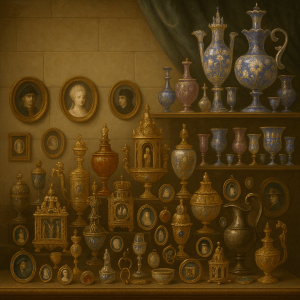
Here stood silver, bronze, and copper caskets; gilded pitchers, frosted crystal goblets; sacred vessels, incense burners, figurines carved from onyx, lapis and porphyry; reliquaries crowned with angels, embellished with depictions of children and maidens. Here were miniature portraits of assassins and courtly ladies wearing Fronde-style headpieces, tricorns(125) or towering wigs; snuffboxes inscribed with mottoes and medallions; timepieces, ceremonial necklaces of religious orders, and rings—including one exquisitely carved from a single ruby cabochon(126).
His Venetian glass collection towered to one side: castellated, intricate pieces adorned with lilies and wild roses, traced with braids, handles and leafy flourishes. Brilliantly lit, the glass came alive with threads of topaz, gleams of diamond, emerald and amethyst, flashes of purple and gold, quiet embers of fire glimmering in milky depths.
Overcome by appetite, Agénor summoned his luncheon, then returned immediately to his beloved trinkets.
Some objects recalled faint memories; others startled him with how rare they now appeared. And those with a patina grown more beautiful over time, rich in artistry, paraded before him like silent opulence.
That clock, with twin genii lifting Louis XIV’s medallion, bore Gallien’s mark(127) ; the ebony cabinet was Montigny’s(128); the girandoles(129) crafted by Antoine Morand; and from Levasseur’s workshop came a pair of pedestals inlaid with tortoiseshell and tin(130).
Sluggish gleams sparked fire across metallic surfaces, while the celestial light trembled across velvet, silk, polished woods, royal red and Turquin blue marbles(131), and mosaics fashioned from every kind of stone.
Yet even as he admired his collection, Agénor’s thoughts drifted to his granddaughter. Surely she had already been born—or was soon to arrive. What would she become?… What had she been before?
He rearranged ornaments delicately. Something urgent and radiant stirred within him—minutes passed like seconds. The future and past lay dormant, beyond analysis.
The next day, roaming again from room to room, even venturing into the attic, his mind fixed itself entirely upon this child—his sole descendant’s daughter.
Suddenly he ceased to admire, desire, or imagine. His body remained still as gentle impressions passed through him. His spirit, sometimes cinnamon-spiced, sometimes radiant as dawn, either rose towards the heavens or swept across forests and hills to an unfamiliar house, to a bedchamber beside a woman who had just given birth—towards a cradle adorned with pearly muslin, looped over decorative hooks that echoed the grace with which curls frame a woman’s ear.
He was an enigma—this man whose love had leapt a generation. And it was curious indeed that the force which had once governed him so wholly had never stirred him to love his own child. Attachment, it seems, is often guided by bitter irony.
A week passed before news came. A half-page letter, tersely composed, arrived from a village near Hazebrouck, confirming the birth of Thérèse-Laure de Prahecq—regretfully noting she was not a boy.
Whether shaped by intuition, premonition, or the lingering tincture of some past influence—as a vessel retains the scent of what it once held—the Marquis de Cluses somehow knew the child’s life would be marked by disappointment. It offered him, at last, a chance to confront the nature of existence and grieve the loss of his instructive, beloved, extraordinary companion.
Reasoning with himself, he grew contemptuous of the freedom he’d recently celebrated—pleasures too foreign to his soul, pleasures he now doubted had ever been real, even while traces of them remained in his deepest folds. Paradoxically, while sustained by a new creed, he returned to his former nature: rigid in belief, aloof in manner, royalist to the core, unmoved by passing fashions.
The guardians of France, and their miserly, prolific master, were content for now with folly. But fatigued by emptiness, deprived of seeing his granddaughter and uncertain if he ever would, unable to shape his affection into something tangible, the Marquis sent funds to the Count de Chambord—to aid Bourbon propaganda(132).
From Venice came a thank-you: a few lines from Henri V himself. Glowing with the singular satisfaction of collecting illustrious autographs—their echoing resonance sustaining him in idle hours—Agénor returned to his pursuit of seventeenth-century rarities, reviving the thrill of acquisition.
The Chevalier de Caristy had married and settled in Juvigny. The park grew lush again, alive with warblers, nightingales and finches. So attuned had the Marquis become in his solitude that he could distinguish the birds by their slightest variations of song.
He had a chair placed in the glade where Thérèse had bid him farewell. Beneath leafy canopies and motionless statues, he made his slow, reverent way there each day.
It was in that spot he read of the Count de Chambord’s fractured thigh. There, too, Thérèse’s memory came sharpest. There he pored over his relatives’ rambling letters about little Laure. And it was there, one evening, that resolution overtook him—he would finally satisfy his heart’s longing, struck by a wave of defiance against passive suffering.
Without questioning the foolishness of the impulse, he departed the next morning.
He arrived in Hazebrouck on Thursday, then drove to the village outskirts. From there, atop a hill, the Château des Prahecq shimmered with flowers—a demigod’s dwelling.
Instinctively, he scorned his son-in-law, pitied his daughter. Soon he was followed by unwashed children, while older, more measured eyes watched him from window to window.
He felt foolish—as hopeful and humiliated as a man infatuated. His cheeks flushed with shame and the last hope that he might glimpse the child—his torment’s centre—in the arms of a nurse. For three hours, he wandered the lanes.
He would never forget the bitter taste of that wasted journey. It made him more withdrawn, more contemptuous of humankind.
No diversion presented itself—not that he required one—his mind already brimming with thoughts of past, future, God, social order, and the mysteries Thérèse had left behind.
Days of rain, wind, snow, and sunshine passed. Then Monsieur de Montégrier died. Shortly after, the Viscountess de Prahecq gave birth to a son—Robert-Euchariste-Louis—whose godfather Agénor agreed to be, on the strict condition that the baptism be held at his château, with Laure present.
Not long afterwards, the Duke of Orléans perished in a carriage accident(133). As if death had sounded its cue, packages from every direction began arriving at Juvigny—boxes of antiques, consigned rarities from the age of Louis XIV.
Death no longer saddened him, yet Agénor observed mourning for his father-in-law and had the staff attired in black livery.
Propriety played its part. Viscountess Berthe wished the child christened in cheerful surroundings, and Madame de Montégrier, the godmother, needed time to recover. A kindly canon from Hazebrouck discreetly performed a baptism for the infant—to let at least a year soften the edge of family grief.
This unwelcome stretch of time, gaping before Agénor like a gorge, gave him excuse to redesign his interiors—which had grown troubling to him for several reasons: overcrowding, neglected corners, furnishings that deserved better placement, and arrangements that no longer satisfied.
Object by object, with methodical deliberation first charted in a notebook, he decided the fate of each piece—and a grand reshuffle began.
The glass cabinets—those obtrusive silhouettes—were banished to the attic. Their lovely contents now found proper stations: highlights to a transformation, pinpricks of brilliance, accent pieces nestled into quiet alcoves. Dubious canvases were removed, inferior trinkets discarded—an ideal harmony throughout.
Deeming the salon tapestries discordant, he replaced them with four hangings from The History of the King, designed by Le Brun(134) and Van der Meulen(135). He created a room where even the curtains and carpet bore royal provenance, with a splendid cabinet whose heraldic emblems testified to its distinguished past.
Thus, the château attained grandeur—lived-in yet unified. For several weeks, Agénor wandered from seat to seat, thrilled with infantile satisfaction.
But every seeker of perfection—especially one drawn beyond this world—is destined for ruin, so parched do they become from unquenchable thirst. Soon weary of being merely rich—unable to create, incapable of enjoyment, barely able to do good and even less able to digest the bland broth of his knowledge—plagued by the eternal void of enquiry, humankind, its hatreds and hierarchy—Agénor began to ruminate on death. On his death.
He entertained the idea that suicide might not offend the Creator or the pure souls of ether, if done solely to rejoin them.
At its core, this thought masked a longing: to be with his wife again. It was the frustrated need to touch the dream he once cherished—that hateful, ungrateful dream that had tormented him ever since Laure’s birth.
On one tear-drenched night, he might easily have ended his life, had he not returned to Thérèse’s writings—where a forceful, irrefutable prohibition against suicide stirred within him. And so, his urge faltered.
He resolved instead to study the management of wealth. Through strenuous activity and esoteric pursuits, his mind steadied.
Then came the long-awaited visit from the Countess de Montégrier and the de Prahecqs. One letter set the plan in motion. Agénor arranged lodgings, saw to their comfort, and prepared a splendid baptism.
He was spotted one afternoon selecting carnations and roses, which he then carried on horseback, bouquet in hand.
His mood teetered between melancholy and joy, nerves frayed despite peaceful thoughts—his soul acutely aware of the landscape, forever scanning the distant road, picturing Laure: already kind, affectionate, charming, just three years old.
Under a slate-coloured sky, the wind stirred; the fields rolled like seas, flecked with parasitic growths in red, cobalt, and saffron; and the Marquis hardly urged his horse forward.
Thérèse, where are you now? he wondered, feeling the familiar tightness in his chest.
On what far-flung planet, beyond mortal reach, dwelled that sweet being, that unblemished woman, angel, beloved?
Agénor shuddered.
“What must I do, Lord, to be worthy of her again?”
His hand lifted, beseeching the heavens.
And then, from a hillock, he spotted a distant berline(136)—another carriage trailing behind—and spurred his mount onward with both heels, his heart ablaze with sudden joy.
He galloped towards the approaching convoy with one thought only: to reach them.
The countryside blurred around him—slopes, trees, crops all seemed to rush backwards—while rose petals flitted away on the wind.
“Hold!” he cried, charging towards the postilions.
They reined in immediately. At the window emerged the utterly forgettable face of Viscount de Prahecq.
“Ah! It’s you… The devil take it…”
But Agénor had no interest in pleasantries.
“Laure… Is Laure here?”
His horse pawed the earth, nostrils flared.
Hushed voices. Berthe muttering: “Hurry! No, wait! Her hair’s a fright…”
At last, a little girl stepped forward—shy at first, coral-hued smile, warming into laughter, then gazing boldly up at him.
The colour drained from his face. He gripped the saddle’s pommel.
“She has Thérèse’s eyes—those same velvety brown eyes, that same expression, even her complexion!”
“G’day, g’anpapa.”
Agénor broke into tears—joyful, filled to the brim, restored.
“She’s our dear one’s living image, isn’t she?” Madame de Montégrier called out, pale and withdrawn.
“Her very likeness—alive, so alive!” Agénor echoed. “Let’s be off.”
As the berline rolled forward, trailed by the second carriage, he passed his bouquet to Laure. Her beautiful, resurrected eyes glowed with gratitude.
“What a fool!… What a scatter-brain!” muttered Monsieur de Prahecq irritably, watching his father-in-law trot ahead. “Not a word for Louis, the godfather! Not the faintest hint of courtesy!”
Laure dismantled her bouquet petal by petal. Berthe devoured marzipan, her elbows propped against her triply expectant belly. The Countess de Montégrier adjusted her ringlets, fussing quietly.
Midday arrived. Meals were finished, farewells exchanged. Alone in bed, bathed in the quiet light of a night lamp, Agénor listened to the tide of thoughts crashing within him. They rushed in from the vast beyond—colliding, overlapping, blending, piling. Then a hush. A quiet pulse. Some thoughts rang clearer. His guests—more defined in darkness than they’d been by daylight—took shape.
Images, sensations, memories drifted through him, syncing with the measured tick of the nearby clock.
No thoughts of his son-in-law. A hint of tenderness for ageing Madame de Montégrier. Once darkness fell, a maid arrived to collect Laure—surely the little miss must be tired. Tears had filled her eyes as she left her grandfather’s lap, where she’d sat content, one ear tuned to the room’s chatter. They’d taken her to her small bed, exchanged bedtime whispers, listened to her prayers, turned away gently as she climbed into her nightdress—“for only mothers, and Justine, are allowed to look.”
How dear the child was—those tiny feet, that soft vulnerability, her hesitant speech!
Tomorrow he would surprise her with a wax doll: earrings, a gold necklace, a specially tailored dress and frills, all prepared for the baptism.
Before Justine, her nurse had been Brigitte. Monsieur de Prahecq had promised her a wooden dog. Madame de Prahecq—not shy about leaving cheeks damp with kisses.
So many little secrets already entrusted to him. He treasured every anecdote, savoured each tiny fragment, letting them warm his heart like sunlight on old stone.
Oh! Had Berthe only poured forth such wonders in earlier days! But no—Berthe had never possessed those haunting brown eyes; she had never truly been his daughter, never the flesh of Thérèse, never truly that union of Montégrier and Cluses blood. Berthe had to come from English stock—one of those ancient Gainsboroughs, devourers of raw meat, breeders of intimidating lineages! How else to explain that beatific air she liked to flaunt? That languid indolence, that brutish forehead, that rounded face, so well-nourished it now thickened up the neck? As if any woman of true quality could have married a Monsieur de Prahecq!
Agénor caught himself mid-thought. A flicker—a shadow—passed across his mind.
He grew inward, assembled fragments, gave root to an idea. And from that gnarl of thinking, wrenched free like ivy from stone, came a colossal, thorny revelation: Laure was Thérèse returned to life. Entirely possible! Certain revealed writings lent it weight… a single passage illuminated the whole: “For, on Earth, as on other globes, the same souls frequently reappear in disparate bodies…”
That disappearance in the park—timed precisely, to the second, with the birth of the Prahecqs’ firstborn! The uncontrollable affection, surging from nowhere, from day one! The turmoil, the pull—yes, this explained it!
He sprang towards the cabinet, flung open the manuscripts, rifled through page upon page, read voraciously, sought confirmation, found scattered points—but not the complete certainty he craved. Just vast cosmological chasms, dimly lit by insights like lanterns in fog. His thought, dissolving now, turned toward jealous vision:
Some man, later—some man would love Laure. And be loved by Laure… Laure, Thérèse, one and the same. While the universe rolled on, oblivious to human grief, untouched by mortal fate. That man, Laure, both swallowed in the great forgetting. And Agénor—Marquis de Cluses—perhaps in a previous existence the most pitiful of beings—impossible to know!—reduced to a mere interruption, a husband, a grandfather, a spark in the long continuity of Thérèse’s soul…
What had love gained him? What had yearning earned? What good had come of attaining her at all?
Alas! How many would love her in ages yet to pass? How many had loved her before he ever drew breath?
What meaning had these manifestations—life, existence, death?
Where was the philosophical system, the education of souls, that would lift them beyond selfishness, teach them to recognise their psychic worth—not bound to social station, nor to their noblest instincts, nor to their most exquisite dreams—but to something vaster, something that surrounded and transcended them utterly?
To think… to suffer… He was seized by dizziness—a spinning, disoriented plunge.
So are all seekers after the occult torn to pieces—those unsatisfied by even the most immense troves of scientific understanding.
In her little bed, Laure slept peacefully on.
Morning arrived. She lay quiet, listening to the soft exhalations of her sleeping maid. Then came those murmured, nonsensical delights children whisper to themselves. And with the resolve that comes suddenly to the very small, she determined to dress on her own—to prove, with great importance, that even the youngest can manage when they must.
She reached for her stockings amid the rumpled linen on the stool, changed out of her nightdress, tangled hopelessly in the bodice straps, knotted its laces in a fourfold cluster. Her drawers clung to her hips by a single precarious buttonhole as she toddled towards the washbasin. The noise stirred Justine, who blinked into awareness.
“Gracious me, Miss! What a pickle you’ve got yourself in!”
There were giggles, then a sulk, then sweet reconciliation.
By eight o’clock, Laure had come down into the garden. The sun had warmed the lawns into golden spreads. She found the Marquis ambling quietly through the grounds, his thoughts less troubled than of late.
Seeing him, she ran—arms wide, eyes alight with joy. He took her hand.
“Let’s have a walk,” he said. “Come—take my hand.”
They passed through the great gateway, wandered beside hedgerows, elder trees thick with white flower umbels. Laure trotted beside him, lively and bright, while Agénor matched her pace with patient steps.
Ahead: fields of ripening corn—yellow, deep green, bright emerald—beside hummocks of brown earth faintly veiled in grass. And there, framed by slim plane trees, stood the Cluses family chapel, its bell tower fine and graceful.
“The walk isn’t tiring you?”
“No.”
“Would you like to go as far as the chapel?”
“Oh yes, I would!”
“That’s where many of our family rest… Your grandmother too…”
They reached the trees quickly. And had Laure been older, she might have noticed, in the hand that held hers, that slight quiver when the chapel’s plaques came into view—there in the dim shadows behind a stained-glass window streaming colour like blood.
“Shall I say my prayer now? The one you taught me?”
“Do.”
The little girl knelt.
Thérèse… my Thérèse! My joy, my hunger, my thirst… thought Agénor, wordlessly stammering.
He conjured again the flushed health of his wife’s face, and set it beside the grim truth: just bones, just a strand of hair. Yet there, recognising her undimmed authority—across time, across mystery—he felt a curious comfort. A proud one.
Here lies Thérèse de Montégrier, de Bretteville, Marquise de Cluses.
One chapel wall stood screened by carved wood. Its black marble plaques bore the names of the deceased: faces worn first by illness, then reshaped, and then hurled towards their sovereign goal.
All was quiet. Blue light filtered in. A bird tapped gently outside the stained glass. A swallow swept past—swift, maternal.
“Can we go now, Gran’pa?”
Laure rose, her prayer said, and took his hand.
“So Mama’s mama is in there?”
“She is.”
Together, they raised their hands to shield their eyes.
“Did you love her like Papa loves Mama?”
“I did.”
“Did it make you cry when she died?”
“Of course.”
“Well! One must cry when people die, mustn’t one? For two or three days at least.”
Agénor paused, placed his hand gently on her head, peered inward:
Thérèse!… Thérèse—is that you? Truly?
Laure turned to a roadside scabious.
“Look, Gran’pa—aren’t those purple flowers pretty?”
There was a wild gleam in her smile, topaz-bright; and its curve was fresher than any bloom could offer.
The baptism was only days away. That Sunday afternoon, while the Viscount regaled Madame de Montégrier and Berthe with florid stories, Agénor sat nearby, unassuming—until an agonised scream split the quiet, just outside the château walls.
“That’s Laure’s voice!” Madame de Prahecq cried. “Lord, let nothing have happened!”
They rose, startled. Only Agénor, usually so outwardly composed, looked utterly stricken. They rushed to the portico.
No one appeared along the avenue of rowans or near the beds. The cries had ceased.
A few servants approached, expectant.
“What is it, Michel?”
“No idea, my lord.”
But just a few steps further, in the sheltered hornbeam path, they found Justine clutching Laure, berating young Louis’s nurse—who stood mortified, the boy in her arms.
“Madame, I—” Justine turned and spotted the family heads. Her gestures sharpened.
“Yes, it’s you! It’s your fault! I was picking mulberries, always nearby! Couldn’t you watch her for just one moment? One! Would it have killed you?”
A two-sided ladder lay overturned. Agénor’s heart sank.
He saw the angle of Laure’s right leg against Justine’s apron.
“My God… it looks as though…”
He said no more. The realisation, frozen and unspoken, spread swiftly.
Berthe burst into tears; the Viscount erupted; Madame de Montégrier took the child, held her close, carried her as the others followed, disarrayed.
“To Juvigny—now! Doctor!”
“Quickly—go!” snapped the Marquis to the nearest footman.
No one dared speak as they followed in the wake of the elderly lady. She made her way upstairs to her chamber. Just as they had once carried the good tutor, in times gone by! The memory surfaced unbidden in Agénor’s mind.
After they had carefully laid Laure on the imposing Louis XIV bed draped in sumptuous brocatelle(137), the child looked so small and fragile against the grand setting, her leg visibly twisted, her little cheeks drained of colour and damp with tears. Everyone voiced their distress as Monsieur de Prahecq bent anxiously over his daughter, his ear close to her face.
“She’s breathing.”
Together, they moistened the child’s forehead, patted her small hands, and took turns breathing gently on her face to revive her.
The moment her eyes flickered open—just a fraction—and consciousness returned to her ashen face, Agénor’s name was the first word from her lips.
“Here I am, my sweet one… I promise I won’t leave you… Just try to keep very still.”
“Does it hurt terribly, dearest?” asked Madame de Prahecq.
The little girl’s composure crumbled as she began to weep:
“Yes, yes, it hurts… it hurts so much.”
Agénor gently kissed her hands; Berthe did her best to comfort her; the Countess de Montégrier sat on the edge of a chair, eyes closed in prayer; Monsieur de Prahecq grew increasingly agitated, muttering that the doctor was taking too long.
At last he arrived: a portly, clean-shaven man with crisp curls, his robust frame wrapped in a chestnut-coloured overcoat.
He examined Laure’s leg thoroughly, both above and below the knee, shook his head, blinked several times, then turned to address them:
“I count two distinct fractures.”
They looked at one another, aghast.
The child remained remarkably calm and watchful as her mother and Justine gently removed her clothes, while Monsieur Manoury, the doctor, unwrapped his medical instruments.
Then came the treatment: bones reset, splints applied, bandages wrapped—all conducted amid hysterical cries, incoherent pleas, and such violent thrashing that Monsieur de Prahecq, Agénor, and Justine had to combine their strength to hold her still.
“All done,” the portly man announced at last.
He mopped his brow, explained the aftercare in detail, rambled on, remarked on Berthe’s pregnancy; by then, the child had fallen into exhausted sleep.
“I should mention there’s a possibility the young lady will be left with a limp.”
The Viscount, who prized perfection in all things—horses, dogs—could not contain an oath. The women were inconsolable.
The Marquis de Cluses, unlike the others, felt a strange calm descend. Handicapped, Laure-Thérèse will be less sought after… He saw her in his mind as a young woman, weighed the uncertainties ahead, hoped to be spared that bitter disgust, that crushing jealousy at the thought of her yielding to another man’s flesh, another being’s soul.
On a warm afternoon, as rain lashed against the windows to the sound of thunder, the baptism was held in the family chapel.
A Sister of Charity from Saint Vincent de Paul was nursing the patient. The Prahecqs considered returning home: “It’s well past time!… The Viscountess is already in her seventh month—she shouldn’t have left home in the first place…”
When consulted, the stout physician advised that madame would do better to remain quiet and await her confinement at Juvigny. The little one was in no state to travel! But Berthe wouldn’t hear of it. Superstitious as she was, she’d had two successful deliveries at her summer residence. So it was decided: they would leave, entrusting Laure to her grandfather and Madame de Montégrier until her recovery.
Monsieur de Prahecq’s love for his daughter was no longer what it had been.
“A cripple! A cripple!” he kept saying. “If you think there’s anything charming about a limp! An oddity who hobbles just to walk a few steps, greets you while hobbling, hobbled yesterday, will hobble tomorrow!… The Prahecqs?… Ah! Those poor souls! They have a crippled child… Brr… As for marriage, we must abandon all thoughts of matching Laure. Farewell to matrimonial prospects!… Not to mention that parents of a lame child somehow appear less than wholly sound themselves!”
“Control yourself, Charles!” Madame de Montégrier shot back. “You might at least have the patience to wait! Monsieur Manoury only said ‘perhaps.’”
“We know perfectly well what doctors mean by their ‘perhapses’!”
Such blunt words first wounded the Marquis de Cluses. Yet he saw in them an opportunity to claim Laure from the Viscount, to keep her, to raise her by his own standards and principles, to fashion for himself a singular companion. Each day he considered broaching the matter with the Prahecqs but couldn’t bring himself to do so. And now they announced their imminent, irrevocable departure.
Eleven o’clock; candles burned low; the Countess de Montégrier had retired to her chamber. They kept vigil in the library—that same library where so many diverse impressions had marked Agénor that he remained forever affected, restless with memories, yet inspired toward bold action. Should he speak? Should he keep silent, commit his thoughts to paper, wait for a better moment? He decided to speak. How to move these two beings seated before him: Berthe, to whom no true affinity or responsibility connected him—he had been a wretched father!—and this foolish son-in-law?
“I wish… to make… a proposition…”
The words caught painfully in the Marquis’s throat.
“Oh?”
“A serious matter… It concerns Laure… I’m asking you to give her to me.”
“You want us to give you Laure?”
“I’ve grown deeply fond of this child. She won me over instantly… Now, since she will no longer be sound of limb, cannot bring… honour to your name… since I face a disappointed old age, I trust you will be kind, Berthe, proving yourself a better daughter than I was a father…”
He sighed deeply, lowered his gaze, and continued:
“And I hoped that Monsieur de Prahecq, understanding the bitterness of my afflictions—I haven’t secluded myself these twenty years without reason—might grant me this compensation, this act of charity…”
Tears beaded on Agénor’s lashes.
“Forgive me…”
He wept, angry with himself for crying. Never before had he been so voluble; never had anyone, not even Madame de Montégrier, heard him stammer out his griefs.
A profound silence fell, in which rose all the regrets, convulsions, sorrows, despondencies, and wounds this man had felt and borne. They seized Berthe and the Viscount; they became less obstinate in their incomprehension.
“Heavens! Father, I want nothing more than to please you! But think!… our darling Laure!”
“You have Louis.”
“Louis is no replacement for her.”
“You will soon have…”
“In any case,” Monsieur de Prahecq interjected, “even supposing Berthe and I could consent to parting with the child, what makes you think she, devoted as she is, would accept our arrangement? There are limits to sweetness and obedience.”
“Precisely!” the Viscountess agreed. “We wouldn’t want to force her… And besides… besides…”
“What is it?”
“What would become of her here? What kind of upbringing would she receive?”
“You would help me find a suitable governess.”
Agénor drew closer to Berthe.
“Let me have her… She resembles your mother… Please don’t refuse me… I would bring her to you regularly… I beg you… I implore you both.”
Monsieur de Prahecq rose.
“You’ll allow us time to consider? To confer with Madame de Montégrier?”
The Marquis extended his arms and nodded.
“By all means, consult Madame de Montégrier!”
“Until tomorrow, then.”
“Until tomorrow.”
The Viscountess and Viscount took their leave.
Agénor listened to their footsteps crossing the entrance hall, receding with a thoughtful, youthful, silent tread. He remained despondent, darkly brooding, not daring to hope, yet refusing to despair entirely. Then, as was his nightly custom, he went up to see Laure. Berthe was just leaving.
“How is she, Sister?”
“She’s been feverish, delirious at times.”
A lamp burned low in the bedroom. The Sister stood watchful, her cornette(138) grey in the shadows.
“It’s you, Grandpapa,” the little girl murmured.
Her eyes were open—those beautiful eyes so like Thérèse’s—her expression warm; her legs lay beneath a protective frame.
Agénor leaned down to kiss her.
“Would you like to live at Juvigny forever, to be my child, my dear little companion?”
“Yes.”
“You mean it?”
“I do.”
Agénor kissed her again, lingeringly.
“I’m overjoyed… Rest now… See you tomorrow. And try to keep as still as possible, won’t you?”
“I will.”
As Agénor turned to leave, Laure suddenly called:
“You haven’t said goodnight to my doll.”
He paused.
“I didn’t see her. Forgive me!… Where is she?”
“Right here beside me… See!… Her leg is broken too.”
“Sleep well, doll,” the Marquis said softly.
And with a bow to the Sister, he retreated to his quarters. Having no desire for sleep, he occupied himself for much of the night rereading Thérèse’s Scriptures, contemplating what lay ahead, unable to grasp its purpose, taking comfort in the happiness he would know if Laure were granted to him, if in years to come she remained to aid him in his old age, if God allowed her to be present when the Cluses name breathed its last.
 Léon Hennique Novel