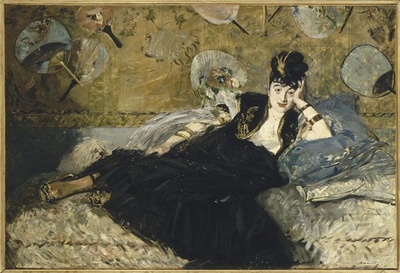
Nina de Villard by Édouard Manet (“La dame aux éventails”, 1873)
The following is Villiers de L’isle-Adam’s article that appeared in the August 24, 1888 issue of Gil Blas.
An Evening at Nina de Villard’s
.
After a Venetian soirée at Nina de Villard’s exquisite mansion on the Rue des Moines, our garden dinner party had acquired an unexpected observer. From the very first course, this hapless social climber had been watching us with wide-eyed fascination, his sombre attire perfectly matching his earnest expression. We rather savoured the delicious contempt radiating from this sparkling personality.
Over coffee, a shared glance amongst us sealed his fate. Marras, with magnificent solemnity, presented the poor fellow with an enormous paradox. Our charming newcomer, his face brightening with an adhesive grin, pounced on it immediately:
“But gentlemen, when one actually listens to your words, your poetry simply dissolves into nonsense.”
“Ah!” Jean Richepin’s tone could have frozen the evening air solid. “Sense is merely a parasitic growth that happens to thrive on the trombone of sonority.”
“Sonority?” The dandy’s eyes betrayed a hint of wildness. “But noise means nothing. There are subtle verses, their charm—” He faltered, then rallied: “In the end, do you write for the eye or the ear?”
“For the nose, sir,” Léon Dierx replied, his gloom utterly flawless.
“Surely you’re joking? Very well then. But what about feeling?” the unfortunate fellow tried again, turning desperately to Stéphane Mallarmé. “The elegy, whatever our customs may be, still has guaranteed appeal for the ladies… Why deny oneself that pleasure? Don’t you ever shed tears in verse, sir?”
“No more than I blow my nose there!” Mallarmé shot back, his voice didactic and flute-like, raising his Buddhist index finger in a spiralling gesture to eye level.
Nina and her female guests, rather than succumb to unseemly laughter at this fascinating specimen, executed a tactical retreat indoors.
“So gentlemen, you belong to no particular school?” he persisted.
“We’re disciples of the No-Preface School,” Catulle Mendès replied with surgical precision.
“Indeed! I assumed you were followers of Monsieur Leconte de Lisle,” the bewildered dandy murmured, then turned to me: “Does he intend to produce anything… serious?”
“No, sir,” I replied with a courteous bow. “He leaves that burden entirely to you.”
Finally grasping that he’d stumbled amongst unsociable, enigmatic individuals whom he hadn’t the slightest hope of converting, our novice consulted his timepiece, rose, and declared:
“Before I take my leave, I should pay my respects… Where might I find the ladies?”
“Why, in the drawing room… I should think!” Marras’s response—perfectly ordinary words delivered in such an eccentric tone they nearly toppled our visitor—proved the final stroke.
With an English-style salute, our dazzling transient guest retreated indoors, made his swift escape, and is doubtless still running—quite perfectly.
Marras, to dispel the intruder’s lingering shadow, offered us a peculiar antidote: excerpts from a fairy tale where electric epithets waged hopeless war against mutinous adverbs, and lovers spoke in the sterile tongue of medical journals. When our laughter finally subsided, it gave way to an autumn evening that had been waiting patiently in its soft blue radiance.
Nina ruled her corner of the garden like a benevolent empress, her Japanese-patterned dressing gown catching the evening light as she swayed in her American armchair beneath the magnolia’s shelter. A cigarette graced her lips with studied indifference whilst Marras, just steps away, drew Henri La Luberne and that gentle scholar Charles Cros—whose Christian departure has summoned this starlit evening back from time’s keeping—into a maze of arcane secrets.
Through branches that seemed to conspire with the evening shadows, Jean Richepin watched with his “trapper’s silent smile” as de Polignac—our elegant firebrand, an anarchist in perfectly tailored clothes—shared whispered confidences with Henri Delaage, a medium who occasionally forsook his spirits for the earthly pleasure of a Brahmin’s cigar in our sanctuary.
The fountain murmured its endless monologue whilst Miss Augusta Holmës, that celebrated musician, reclined in her hammock as though listening to harmonies beyond our hearing. Even now, twilight brings back the portrait of Lucius Verus by young Franc Lami who, though absent from our circle, had commanded recent attention at the Salons with works—his Narcisa above all—that held light captive in their delicate tones and assured lines.
The statuesque Manoëlle de Grandfort, her height nearly challenging the small arbour she leaned against, seemed lost in one of those whimsical tales she penned for Vie Parisienne or Gil Blas. In a nearby alley silvered by moonlight, Catulle Mendès and Stéphane Mallarmé pursued their eternal dialogue.
Then came the incident at the candlelit table. Auguste de Châtillon, whose “À la Grand-Pinte” had earned him considerable fame, adjusted his golden spectacles to share his latest “Moutonnet” with Toupier-Béziers of the Roses remontantes. Their debate over rhyme grew heated until the playwright’s passionate gesture sent the poet’s spectacles on an unplanned astronomical expedition. They found unlikely harbour in a branch—”hanging damocleanly,” as de Polignac noted with swift wit. Whilst others moved to prevent imminent duelling, Toupier-Béziers, his 1830s breeding rising to the occasion, crafted an apology of such elaborate grace it might have graced any stage. His old friend accepted with visible reluctance, maintaining thereafter a distance that only death would finally resolve.
The evening deepened. We gathered at a green-clothed table in the shade, champagne catching starlight in our glasses. Yesterday’s excesses had left us contemplative, whilst September’s wind, conducting its choir of surrendering leaves, painted the darkness in melancholy hues.
Nina turned then to Léon Dierx beside me. At thirty, he had already carved out his territory in poetry’s realm. His verse drama La Rencontre had demonstrated how bitterness might serve as the foundation for pure poetry. We’d first encountered him in Leconte de Lisle’s circle—a serious young man whose eyes held perpetual nostalgia for his native Bourbon island.
His early verses mapped his homeland with such precision of heart that we found ourselves transported there—the beefwood’s whispers, the vast horizons where his country dreamed, the intoxicating blooms that perfumed memory itself. From these tangible paradises, his poetry ventured into forests of the mind, distances measured only in yearning, and women whose eyes—like Nyssia’s, immortalised in crystalline stanzas—held mysteries beyond telling.
As his art deepened, it might have descended into pure sensuality if not for the mystical disquiet threading through each line. His collections—Les Lèvres closes, La Messe du vaincu, Les Amants, Poèmes et Poésies—published by the discerning Lemerre, remained treasures known only to the initiated, a circumstance that seemed to please rather than trouble their creator.
His poetry demands a particular sensitivity, as though some truths were inherited rather than learned. Even in his most transparent rhythms, this rare poet, who regards publicity with distant courtesy, touches chambers of the heart that prefer shadow to light. His verses carry something lingering and indefinable, like secrets that disdain to trouble casual passersby.
The farewells in his poetry possess an almost overwhelming weight; the darkness pervading his Ruins, his Trees, his Women, and especially his Skies speaks of a soul conversing with hidden truths. His verses, like diamonds glimpsed through mist, suggest such profound detachment that one might fear complete renunciation—if clear souls weren’t inevitably drawn towards Hope.
One sees in Dierx a child of Dream, content to wake only beyond reality’s borders. All his noble poetry seems touched by that same celestial light that marked his brow—a ray from that Evening Star sung in Harz valleys by Wolfram von Eschenbach.
That night, he shared this jewel, which I have preserved in his hand with devoted care:
Evening sets the garden swaying soft and slow
Round a seated circle where languid women glow,
Their gowns like ample blossoms spread in white array
That silvers all the lawns with harmony's display.
Shadows come by degrees to bathe these shapes half-seen,
And on the bracelets, necklaces between
That weight the wrists and breasts and fingers bare
With all the heavy luxury women used to wear,
From high within a sky of pale blue, deep and clear,
The star that lights itself makes a thousand appear.
The fountain in its basin murmurs soft and low,
Falls back as gentle mist along the rim's bright glow—
As if to catch the city's rumours as they pass,
The trees grown tall draw close their leafy mass
To gather echoes of a sea that sleeps afar,
Deep in a gulf where once a harbour's lights would star.
They've let their gazes languish, let their poses fall
Into that sacred silence linking them to all,
That makes across their breasts, as breath lifts them high,
A tender, brotherly tremor softly sigh.
Each in her heart lets slip into a gentle dream
The night's pure breath descending stream by stream;
And breathing all together the blue air's caress,
The young soul of the flowers they faintly possess,
They breathe back out their mingled souls as one
In perfumes where the souls of lost flowers run.
Are these verses not exquisite and adorable? Their charm lingers still in memory’s keeping.


This is one of 50+ rare French literary texts translated into English for the first time on this site.
 Léon Hennique Novel