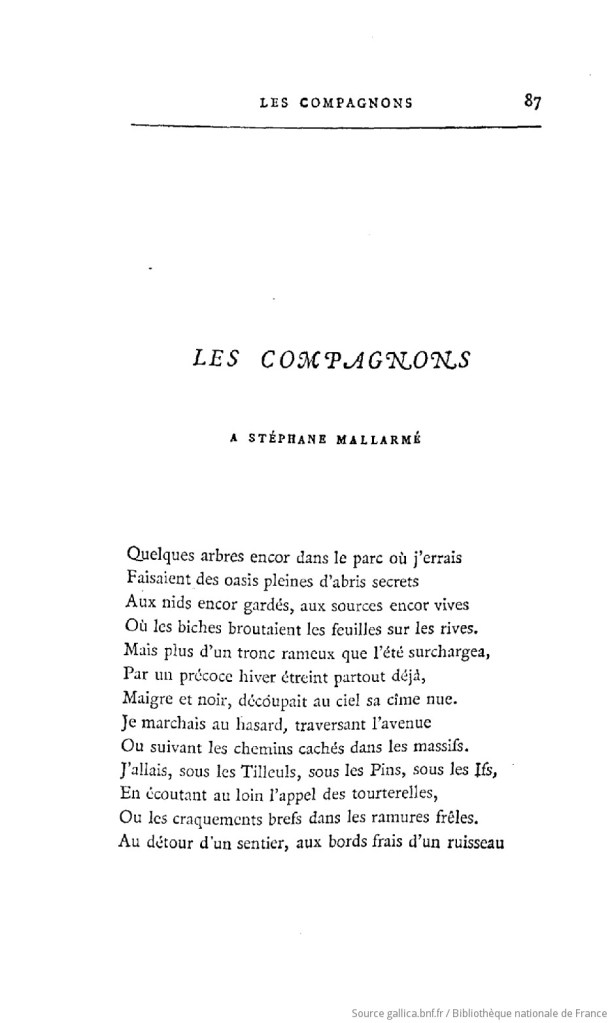
The poem that follows is translated from "Les Compagnons" by Léon Dierx (1838-1912), dedicated to Stéphane Mallarmé(1) and published in Les Amants (Paris: Alphonse Lemerre, 1879). A Parnassian poet and close friend of Mallarmé, Dierx would later succeed Mallarmé as the unofficial "Prince of Poets."
The Companions
     In that remembered park where once I strayed,
     A few proud trees still stood their ancient ground,
     Creating havens, secret and profound,
     Where springs still whispered and deer still grazed.
     Yet many a branch that summer once adorned
     Now stood in winter's early, fierce embrace,
     Its crown stripped bare against the sky’s pewter face
     —lean shadows, blackened and forlorn.
     I wandered purposeless through wooded ways,
     Now crossing broad paths, now through thickets deep,
     'Neath Lime and Pine and ancient Yew did creep,
     While turtledoves called through the gathering haze.
     Each brittle branch spoke with its crackling voice,
     Till at a bend, beside a singing stream
     Where silver stones caught every passing gleam,
     'Mid honeysuckle's wild and sweet rejoice,
     A misty form lay dreaming in soft grass,
     So young—the child I was in days of yore.
     "Since I have roused you from your dreams before,
     Rise up!" I bade, "and let us onwards pass!"
     Wordless he rose, approached with gentle smile,
     And walking at my left, kept steadfast pace.
     Above, the branches swayed with gentler grace,
     Their whispers sweeter than they were erstwhile.
     "O you, whom still I find in this strange hour,
     Speak, child, I pray, and sing along our way!
     All that has fled—your faith of yesterday,
     Your raptures, longings—speak with all their power!
     Shadow of youth, where lies your dwelling place
     Now? Tell me! Speak before death draws me near!"
     Yet mute he stayed. But oh! those days so dear
     Rose one by one, with all their former grace.
     Their simple songs enchanted me anew,
     While childhood's sky of countless bright chimeras
     Filtered like sunlight through forgotten eras,
     Softening my heart like morning's gentle dew.
     Long did we walk thus, side by side, until
     Before a cedar, dead and bramble-bound
     —A sight that makes my very soul resound—
     An ancient figure sat, bent, grey and still.
     As if long years of burdens he had borne,
     This phantom formed of twilight's massive mist—
     Did my future thoughts within his form exist?
     Would my own gaze grow thus in years forlorn?
     Perhaps! Not wishing deeper truths to ken,
     I fled; but vainly. For this spectral sight
     Soon walked beside me on my path's right,
     His footsteps faltering, again and again.
     His eyes like stagnant pools beneath his brow,
     "Well then!" I cried, "from whatever depth you rise,
     Are you, like him, mute beneath evening skies?
     Speak! Since you come as prophet even now,
     Shadow of age, where rests your weary head?
     What wisdom bring you? To what threshold lead?
     What treasure yours? Glory or prayer or deed?
     What profit found you in the life you led?"
     He too kept silence, steadfast at my side
     Like that other shade, while years pressed heavily,
     Till heart and footsteps dragged more wearily.
     Still on I walked. Around us, far and wide,
     Dried vines hung heavy in the whistling wind,
     While countless memories, nebulous and strange,
     Swayed in my mind through time's unceasing change;
     Long did we three pass thus, souls intertwined.
     Triple form of one being, threefold soul!
     Yet these companions, each from his own side,
     Drew forth my essence till it seemed to glide
     Away, till nightfall found me less than whole.
    Through paths where dreams both sweet and solemn
                                                                                          dwell,
     Now drunk on nightingale's ethereal song,
     Now shuddering as dead wood creaked along,
     I moved, a spectre bound by double spell:
     A shadow void, ‘twixt future's fearsome guide
     And past's bright child, suspended in between—
     Held back by youth, while age drew me unseen
     Through twilight paths where all three forms abide.
____________________
(1) When Mallarmé received his copy of Les Amants, he wrote Dierx a thank-you letter that specifically mentions “The Companions,” which we’ve just read in English translation. Here’s what he had to say:
TO LÉON DIERX*
87 rue de Rome
Wednesday, May 7, 1879
          My good friend,

          What absolutely delightful evenings I have spent these past days, reading your book. You remain entirely yourself, yet your writing has achieved a marvellous concision and purity. Your pages exhale a wholly singular atmosphere of reverie and passion; you are still the enchanter who summoned it forth to delight our poets' hearts. The manner in which you embody the poet—with such mastery and sincerity in this noble and authentic enterprise of yours—seems impossible to surpass, particularly in our present moment. I confess I can think of no one else who commands such a universe, and its music.

          When we meet, as I leaf through this volume—which shall not stray far from my summer table before I bear it away for my holiday months—I shall tell you which pieces have particularly enchanted me. Through some delicate prescience, you have placed my name above certain splendid verses that naturally drew me to them, bearing as they do a vision I have struggled for years to render upon the stage. I speak of "Les Compagnons": there we discover, though perhaps perceived differently, one of those aspects of life's drama whose hidden depths summon forth the light.

          Farewell for now. What an extraordinary surprise you are preparing for posterity—when, maddened by others' failures and struck with horror, it will turn back to discover these treasures, gathered without a moment's hesitation by your cherished hand, which I now clasp firmly in friendship!
Stéphane Mallarmé.
*Stéphane Mallarmé, Correspondance (1854-1898), ed. Bertrand Marchal, dir. Jean-Yves Tadié, nouvelle édition augmentée (Paris: Gallimard, 2019).

This is one of 50+ rare French literary texts translated into English for the first time on this site.
 Léon Hennique Novel