◈–❀–◈
I recall the first time I encountered the title Akëdysséril, one of Auguste Villiers de l’Isle-Adam’s tales. It appeared whilst I was reading Stéphane Mallarmé’s correspondence, at the close of his letter to Édouard Dujardin, dated Saturday [1st August 1885]. “What a dazzling work Akëdysséril is,” Mallarmé wrote. “I can think of nothing so exquisite and have no desire to read anything else afterwards.” In subsequent letters to other correspondents, there it was again—Akëdysséril—with Mallarmé enquiring whether his friends had read it, singing its praises and urging them to do so. His enthusiasm was unmistakable. Naturally, I read it at once and have been enchanted ever since. It is a work that deserves to be widely known, and here at last is realised a long-cherished wish to see it rendered into English.
That said, I was considerably surprised when, later, whilst reading an excellent biography of Villiers de l’Isle-Adam by the distinguished scholar Alan William Raitt—The Life of Villiers de l’Isle-Adam, which I heartily recommend, particularly given the dearth of English works devoted to Villiers’s life and writings—I discovered on pages 284-286 the following:
As for the Revue contemporaine, where the débâcle over Axël took place, Remacle was particularly anxious to have something substantial by Villiers, and begged him to write a novel, although the poet was thought to have prejudices against the genre. Villiers’s response was favourable:
Well, I promise you this: I’ll write a half-volume for the Contemporaine, not a volume, and I think it will produce a certain effect (…) You see, I’m haunted by a vision… Why? For some time past, a vanished ancient city, Benares, has been presenting itself, urgent and demanding, like a unique and flamboyant character from the past, a living mirage. In spite of myself, I could take a photograph of that city which has risen up inside me, without any reason of previous reading or dreams, with its palaces, street scenes, shops, fully-armed royal processions and their elephants. And, do you hear, I’ll give you Benares as it was, I’m certain of it, not a learned reconstitution like Salammbô. It will produce a certain effect.
The product of this lengthy preparation was Akëdysséril, which appeared in the Revue contemporaine on 25 July 1885. It is a prolix and pretentious piece, in the vein of L’Annonciateur (otherwise Azraël), in which Villiers has transposed a variation on the Wagnerian idea of the Liebestod into an elaborately described Indian setting. The theme itself elsewhere appears as one of his richest, notably in Axël, but in Akëdysséril he completely swamps it in a deluge of verbiage, so that most modern critics have been more keenly aware of its defects than its qualities. Yet Villiers’s contemporaries were absolutely dazzled by it. Édouard Dujardin, to whom Villiers had read it before publication, wrote to him ecstatically about this “marvel of marvels, as beautiful as a vision” and extolled it in the Revue wagnérienne; the young critic Camille Mauclair declared that “the first fifty pages of Akëdysséril surpass anything Flaubert wrote; Paul Valéry preferred to Salammbô this tale “of an entirely free and fabulous antiquity; Maurice Barrès too put Villiers “above Flaubert in a piece like Akëdysséril; Léon Bloy affirmed that it was “one of the most beautiful and grandly beautiful things in this century; Stéphane Mallarmé wrote: “What resplendence in Akëdysséril: I know of nothing so fine and wish to read no more after that; Maurice Maeterlinck found in it “the most brilliant, the most sonorous French prose that has been written since Bossuet’s Oraisons funèbres and the great pages of Chateaubriand. So, whatever later readers may think, the men of Villiers’s time were unanimous: Akëdysséril was a masterpiece. [Raitt, A. W. The Life of Villiers De l’Isle–Adam. Oxford UP, 1981, pp. 284-286.]
Evidently, two camps exist, or have existed, and the battle for Akëdysséril‘s soul and glory rages on. I unhesitatingly place myself amongst those for whom Akëdysséril is a masterpiece. It draws one in immediately (provided one doesn’t resist), quite simply. And it unveils before one’s eyes a true, living vision—a coherent, shimmering reality, at once brutal and beautiful, into which we are masterfully transported, part of us lingering in that dreamscape long after we close the book, perhaps never to return entirely. If Villiers, as he himself declared, sought a certain “effect”, he has achieved that effect in fullest measure.

AKEDYSSERIL
Whatever exists is wrought from its own nothingness.
Hindu Books.
Violet against golden mists, the holy city showed itself. It was a dusk from times long past. As Surya perished, that stellar phoenix of the world, it ripped ten thousand jewels from the domes of Benares.
On the heights toward the western horizon, vast groves of palmyra trees swayed the golden blue of their shadows across the valleys of Habad, while on the farther slopes mystical palaces rose in succession through the blazing dusk, each divided from the next by seas of roses, their corollas by the thousands undulating beneath the heavy, breathless air. There, within these gardens, fountains thrust themselves aloft, their sprays returning earthward as flakes of fiery snow.
In the heart of the Sécrole quarter, the temple of Vishnu the Eternal, with its massive columns, towered over the city—its gateways, widely laminated in gold, scattered the celestial brightness—whilst, spreading about its surroundings, the one hundred and ninety-six shrines of the Devas sank the whiteness of their marble bases, washing the steps of their outer courts in the flashing waters of the Ganges. The pierced stonework of their crenellations plunged into the crimson of the slowly drifting clouds.
The radiant water slept beneath the sacred quays; distant sails hung, shimmering with light, over the river’s splendour, and the immense riverside city unrolled itself in oriental disorder, tiering its avenues, multiplying its numberless dwellings with white cupolas, its monuments, extending to the Parsi quarters where the pyramidion of Shiva’s lingam, the ardent Wissikhor, seemed to burn in the conflagration of the azure.
In the uttermost depths of distance, the circular avenue of the Wells, the endless military quarters, the bazaars of the Exchange district, and finally the citadel towers built during Visvamitra’s reign all dissolved into opaline hues so pure that starlight already glimmered within them. And towering into the very heavens above these furthest reaches of the horizon, colossal figures of divine beings, carved upon the rocky crests of the Habad mountains, sat enthroned, their knees splayed wide into the immensity: these were peaks hewn into the forms of gods; most of these silhouettes raised, above the abyss, at the end of a vertiginous arm, a lotus of stone—and the stillness of these presences disturbed the very space itself, struck terror into life.
Yet, as this day waned, throughout Benares a clamour of glory and festivity broke the customary silence of evening’s fall. The multitude filled the streets, public squares, avenues, crossroads and sandy slopes of both riverbanks with solemn rejoicing, for the watchers of the Holy Towers had just struck their bronze gongs with their mallets, making the very thunder seem to sing within them. This signal, which sounded only at sublime hours, proclaimed the return of Akedysseril, the young conqueror of the two kings of Agra—the lissom widow with pearl-like complexion and brilliant eyes—the sovereign who, wearing mourning in her cloth-of-gold robes, had distinguished herself at the assault on Elephanta through feats of heroism that had kindled a thousand hearts to courage around her.
Akedysseril was the daughter of a herdsman, Gwalior. One day, in a deep valley near Benares, on an autumn noon, the benevolent Devas had led through various chances to the edge of a spring where the young maiden was bathing her feet, a hunter of aurochs—Sinjab, the royal heir, son of Seur the Clement who then reigned over the vast dominion of Habad. And in that very instant, the charm of the predestined child had awakened throughout the young prince’s entire being a divine love! To see her again soon inflamed Sinjab’s senses so violently that he chose her, with dazzled heart, for his sole bride—and thus it was that the daughter of the keeper of flocks became herself the keeper of peoples.
Now, thus it was: shortly after the wondrous union, the prince—whom she too had loved for ever—had died. And upon the old monarch, despair had cast so deeply the shadow from which one perishes that all heard, twice over, in Benares, the baying of Yama’s funeral hounds, the god who summons—and the peoples had been forced to raise, in haste, a double tomb.
Henceforth, was it not to Sinjab’s young brother—to Sedjnour, the prince scarcely more than a child—that the dynastic succession to Seur’s throne, under Akedysseril’s august regency, must be transmitted?
Perhaps: none shall demarcate the justice of any right amongst mortals.
During the swift days of her ascending fortune—whilst Sinjab yet lived, in short—Gwalior’s daughter, moved already by secret presentiments and with a heart tormented by the future, had conducted herself as a brilliant mocker of all rights save those alone consecrated by strength, courage, and love. Ah! how skilfully she had known, through politic largesse of dignities and gold, to create for herself at Seur’s court, in the army, in the capital, at the viziers’ council, in the State, in the provinces, amongst the Brahmin chiefs, a faction of such power that hour by hour, time had only consolidated it! … Anxious now about the morrows of a new accession whose very nature was unknown to her—for Seur had desired that Sedjnour’s youth be instructed far away, amongst the sages of Nepal—Akedysseril, as soon as the council had ordered the young prince’s recall, resolved to free herself in advance from whatever adversities the new master’s caprice might hold in store for her. She conceived the design of seizing, in defiance of all debatable duties, the royal power itself.
During the night of sovereign mourning, she who slept not had therefore sent forth, to intercept Sedjnour, detachments of sowaris well-proven in their interests and faith to her cause, to herself and to the extremities of her fortune. The prince was taken captive, abruptly, along with his escort—as was the daughter of the king of Sogdiana, Princess Yelka, his beloved betrothed, who had hastened to meet him with but a meagre guard.
And this befell at the very moment when the two beheld each other for the first time, upon the road, in the night’s luminescence.
Since that hour, prisoners of Akedysseril, the two adolescents lived cast down from the throne, isolated one from the other in two palaces separated by the vast Ganges, and watched unceasingly by a severe guard.
This double isolation was motivated by a reason of State: should one of them succeed in escaping, the other would remain as hostage; and, fulfilling the law of predestination promised to betrothed lovers in ancient India, having glimpsed each other but once, they had become each other’s every thought and loved with an eternal ardour.
Nearly a year of reign had secured power in the hands of the dominatrix who, faithful to the melancholies of her widowhood and perhaps ambitious only to die illustrious, beautiful and all-powerful, dealt as an adventurous conqueror with the Hindu kings, threatening them! Had not her lucid spirit known how to increase the prosperity of her States? The Devas favoured the fortunes of her arms. The entire region admired her, submitting with love to the magic of this warrior’s gaze—so delicious that to receive death from her was a favour she did not lavish freely.
And then, a legend of glory had spread concerning her strange valour in battles: often, the Hindu legions had seen her, in the thick of the most ardent melées, rise up, all radiant and intrepid, bedecked with drops of blood, upon the jewel-laden howdah of her war elephant, and, heedless beneath the rains of javelins and arrows, indicate victory with a proud blaze of her scimitar.
This was why Akedysseril’s return to her capital, after a warring exile of several moons, was greeted by transports of joy from her people.
Couriers had alerted the city when the queen was but a very few hours distant. Now, one could already distinguish in the distance the scouts with red turbans, and troops with iron sandals descending the hills: the queen would come, doubtless, by the Surat road; she would enter by the principal gate of the citadels, leaving her armies to encamp in the surrounding villages.
Already, in Benares, in the depths of the Pyram-vada avenue, torches ran beneath the terebinth trees; the royal slaves hastily illuminated with lamps the immense palace of Seur.
The populace gathered triumphal branches and the women strewed broad flowers along the palace avenue, which crossed the Avenue of the Rishis and opened onto the Square of Kama; crowds bowed at frequent intervals, listening to the earth trembling beneath the irruption of war chariots, marching infantry, and surging waves of cavalry.
Suddenly, one heard the muffled rustlings of kettledrums mingled with the clatter of weapons and chains—and, broken by the sonorous clash of cymbals, the melodies of brass flutes. And behold, from every quarter, vanguard cohorts entered the city, standards high, executing in disorder the commands bellowed by their sowaris.
On the Square of Kama, the esplanade of the Surat gate was covered with those tawny carpets of Irmensul—and of distant Ipsamboul manufacture—fabrics of faded motley, imported by the annual caravans of Turanian merchants who exchanged them for eunuchs.
Between the branches of the areca palms, the palmyra palms, the mangroves and sycamores, along the Ganges avenue, rich fabrics from Baghdad floated as signs of happiness. Beneath the canopies of the Western gate, at both angles of the fortress’s enormous porch, a dazzling cortège of courtiers in long embroidered robes, of Brahmins, of palace officers, waited, surrounding the vizier-governor beside whom sat the three vizier-guikwars of Habad. There would be festivities, the spoils of Elephanta would be distributed to the people—gold dust, too—and, above all, they would stage, by the gleam of a solitary torch in the vast circus enclosure, those nocturnal rhinoceros combats so idolised by the Hindus. The inhabitants feared only that wounds might have marred the queen’s beauty; they questioned the panting scouts; with great difficulty, they were reassured.
In a space left clear, between tall and heavy bronze tripods from which bluish vapours of incense escaped, writhed in garlands whole processions of bayadères clad in brilliant gauzes; they played with strings of pearls, made dagger curves flash and glitter, simulated movements of voluptuousness—quarrels, too, to lend animation to their features—this was at the entrance to the Avenue of the Rishis, on the way to the palace. At the other extremity of the Square of Kama opened, silently, the longest avenue. That one, for centuries, had been avoided by the gaze. It extended, deserted, darkening along its deep abandoned course the vaults of its black foliage. Before the entrance, a long line of snake-charmers, girt with greyish loincloths, made serpents dance upright on the tips of their tails to the sounds of a shrill music.
This was the avenue that led to the temple of Siva. No Hindu would have ventured beneath the thickness of its horrible foliage. Children were accustomed never to speak of it—not even in whispers. And, as joy oppressed hearts today, no one paid any attention to this avenue. One might have said it did not gape there with its darkness, with its dreamlike aspect. According to an old tradition, on certain nights, a drop of blood oozed from each leaf, and this rain of red tears fell, mournfully, upon the earth, soaking the ground of the lugubrious avenue whose entire expanse was penetrated by the very shadow of Siva.
At the moment when the divine globe wavered at the edge of space, ready to plunge, long streams of fire ran, undulating, across the western vapours—and behold, at this very instant, emerging from the defiles of those distant hills between which the Surat road levelled out, there appeared, in sparklings of thick dust, clouds of horsemen, then thousands of lances, chariots—and from all sides, crowning the heights, surged the fronts of phalanxes in darkened caftans, with tawny soles, with brass knee-guards from which protruded deadly central spikes: a bristling of pikes whose extremities, nearly all thrust through severed heads, knocked these together in fierce kisses at the hazard of each step. Then, escorting the rolling apparatus of siege engines, and the numberless hurdles drawn by sturdy onagers where, upon leafy litters, lay the wounded, other foot troops, javelins or great slings at their belts—finally, the provision wagons. This was nearly the entire vanguard; they descended in haste the slopes of the paths towards the city, penetrating it circularly through all the gates. Shortly after, the blasts of the royal trumpets, still invisible, answered from afar the sacred gongs that rumbled over Benares.
Soon mounted emissaries arrived at a gallop, clearing the road, shouting various orders, and followed by a rumbling of heavy sledges from which overflowed trophies, opulent spoils, riches, plunder, between two legions of captives walking with bowed heads, rattling chains, preceded on their massive striped horses by the two kings of Agra. These the queen brought back in triumph to her capital, though with great honours.
Behind them came war chariots with radiant pediments, mounted by adolescent girls in vermillion armour, some bleeding from wounds loosely bound with strips of cloth, a great bow laid crosswise on their shoulders, bristling with sheaves of arrows: these were the warlike attendants of the terrible mistress.
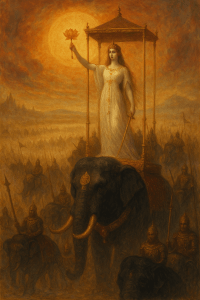
Finally, dominating this glittering disorder, at the centre of a half-orb formed by sixty-three battle elephants all laden with sowaris and elite warriors—followed on all sides, in the distance, by the immense vision of an enveloping host of armies—appeared the black elephant, with gilded tusks, of Akedysseril.
At this sight, the entire city, until then mute and seized at once with pride and terror, exhaled its convulsive transport in a thunderous acclamation; thousands of palm fronds, waved aloft, rose up; it was an enthusiastic fury of joy.
Already, in the high radiance of the air, one could distinguish the form of the queen of Habad who, standing between the four lances of her canopy, stood out mystically, white in her golden robe, against the disc of the sun. One perceived, at her slender waist, the star-studded belt where her scimitar was clasped. She herself moved, between the fingers of her left hand, the chain of her formidable mount. Following the example of the Devas sculpted far off on the summit of the Habad mountains, she raised in her right hand the sceptral flower of India, a golden lotus wet with a dew of rubies.
The evening, which illuminated her, empurpled the grandiose entourage. Between the elephants’ legs hung, distinct against the bright red of space, the various extremities of trunks—and higher up, lateral, the vast lurching ears, like palmyra leaves. The sky cast, in flashes, crimsons upon the points of the ivory tusks, upon the precious stones of the turbans, the iron of the axes.
And the ground resounded dully beneath these approaches.
And still between the steps of these colossi, whose terrifying semicircle masked the space, a monstrous black cloud, moving, seemed to rise from all sides at once, orbicular—and gradually—from the very edge of the horizon: it was the army surging behind them, far off, staging its powerful lines interspersed with a thousand dromedaries. The city reassured itself with the thought that encampments had been prepared in the nearby towns.
When the queen of Habad was no more than an arrow’s flight from the Northern Gate, the cortèges advanced along the road to welcome her.
And all soon recognised the sublime face of Akedysseril.
This snow-white daughter of the solar race was of elevated stature. The mauve purple, interlaced with long diamonds, of a fillet faded in battles, circled, spaced with tall points of gold, the pallor of her brow. The floating of her hair along her lithe and muscled back mingled its bluish shadows, upon the golden tissue of her robe, with the ribbons of her diadem. Her features were of an oppressive charm that at first inspired trouble rather than love. Yet children without number throughout Habad languished in silence from having seen her.
A pale amber radiance, suffused through her flesh, enlivened the contours of her body: like those transparencies with which dawn, veiled by the Himalayan peaks, penetrates their whiteness as if from within. Beneath the horizontal stillness of long eyebrows, two dark blue luminosities in the languid eyelids of a Hindu woman, two magnificent eyes, overladen with dreams, dispensed around her a transfiguring magic upon all things of earth and sky. They saturated with unknown enchantments the fatal strangeness of this face, whose beauty could never be forgotten.
And the prominence of the haughty temples, the subtle oval of the cheeks, the cruel delicate nostrils that trembled in the wind of peril, the mouth touched with a gleam of blood, the chin of a taciturn despoiler, that ever-grave smile where panther’s teeth gleamed, all this ensemble, thus veiled with dark distances, became of the most magnetic seduction when one had undergone the radiance of her starry eyes.
An inaccessible enigma was hidden in her peri’s grace.
Playful with her warrior women, on evenings beneath the tent or in the gardens of her palaces, if one of them, with a charming word, marvelled at the infinite desires raised in her wake by the heroic mistress of Habad, Akedysseril would laugh her mysterious laugh.
Oh! to possess, to drink like a sacred wine the barbarous and delicious melancholies of this woman, the golden sound of her laughter—to bite, to press ideally upon that mouth the dreams of that heart in shared kisses!—to embrace, wordlessly, the fluid and undulating plenitudes of that enchanted body, to breathe its harsh sweetness, to lose oneself—in the abyss of her eyes, above all!… Thoughts to shatter the senses, from which reflected a vertigo that her august widow’s gaze, with its desperate chastities, would not return. Her being, from which issued this desolating certainty, inspired in the young combatants of her legions, in the thick of assaults and clashing armies, thirsts for wounds received there, beneath her pupils.
And then, from all the flowering chalice of her breast, from her entire being, exhaled a subtle, unhoped-for scent! Intoxicating—and such… that—in the animation of melées especially—a spell tortured all around her! exciting her distraught defenders to the unbridled desire to perish in her shadow… a sacrifice she sometimes encouraged with a superhuman gaze, so delirious that she seemed to give herself in it.
These were, in the radiant mist of her victories, memories known to her alone and which arose in her slumbers.
Thus appeared Akedysseril at the entrance, now, of the citadel. For a moment she listened, perhaps, to the words of welcome and love with which the lords greeted her; then, at an imperceptible sign, the chariots of her warrior women, with the crash of thunder, passed through the vaults and radiated across the Square of Kama. The joyful clamours of her people called to her: urging therefore her black elephant beneath the Surat porch and onto the spread carpets, the sovereign of Habad entered Benares.
Suddenly, her gaze fell upon the ill-famed avenue at whose depths loomed, in the distance, the ancient, enormous, crushed façade of the temple of Siva.
Starting—from a memory, doubtless, she halted her mount, threw an order to her elephant-drivers who unfolded the steps of the howdah along the animal’s flanks.
She descended, lightly. And behold, like beings summoned by her desire, three phaodjs in black turbans and tunics—sure and cunning informers—charged, certainly! with some most secret mission during her absence, surged up as if from the earth before her.
All drew back at a wish from her eyes.
Then the phaodjs, bowing around her, whispered one after another, long, long, very low words that none could hear, but whose effect upon the queen appeared so terrible and growing as she listened, that her paling face lit up suddenly with a dreadful, threatening gleam.
She turned away; then, in a brusque voice that vibrated in the silence of the mute square:
“A chariot!” she cried.
Her nearest favourite leapt to the ground and presented her the two silken reins braided with brass threads.
Springing to the vacated place:
“Let none follow me!” she added.
And with fixed eyes she contemplated the deserted avenue. Indifferent to the stupor of her people, to the trembling into which she cast the forbidden city, Akedysseril, spurring her horses to sparks of fire, overturning the terrified snake-charmers, crushing serpents beneath the gleam of wheels, plunged all alone, a luminous arrow, beneath the black shades of Siva that prolonged the horror of their solitude to the fatal temple.
Soon she was seen to diminish in the distance, to become a brightness—then like a star’s scintillation…
Finally all confusedly glimpsed her when, having reached the northern clearing, she halted her horses before the basaltic steps beyond which, on the height, extended the temple courts and its deep colonnades.
Holding back with one hand the fold of her golden robe, she was climbing now, far off, the dreaded steps.
Arriving at the portal, she struck the bronze doors with the pommel of her scimitar, with three blows so terrible that the reverberation, like a sonorous plaint, reached, weakened by distance, even to the Square of Kama.
At the third summons, the mysterious doors opened without any sound.
Akedysseril, like a vision, advanced into the interior of the edifice.
When her person had disappeared, the tall metallic jaws, distended at her summons, closed their dark yawn upon her, pushed by the invisible arms of the sains, servitors of the god’s dwelling.
Gwalior’s daughter, disdaining any backward glance, ventured beneath the extensions of the fatal halls formed by the intervals between pillars—and the cold of the stones multiplied the sonority of her steps.
The last reflections of the sun’s death, through the air-holes—hewn solely on the Western side in the thickest part of the high walls—lit her solitary progress. Her vibrant pupils probed the twilight of the enclosure. Her war buskins, still bloody from the latest mêlée (but this could not displease the god she confronted), rang in the silence. Reddening gleams, fallen obliquely from the air-holes, lengthened upon the flagstones the shadows of the gods. She walked upon these moving shadows, brushing them with her golden robe.
At the far end, upon heaped blocks of red porphyry, surged a formidable vision of stone, the colour of night.
The colossus, seated, widened in the spreading of its legs, configuring an aspect of Siva, the primordial enemy of Universal-Existence. Its proportions were such that the torso alone appeared. The inconceivable face was lost, as if in thought, beneath the night of the vaults. The divine statue crossed its eight arms upon its funereal breast—and its knees, extending across space, touched the sanctuary walls on both sides.
Upon the elevation of three steps, vast purple hangings fell, suspended between pillars. They hid a central cavity hollowed in the monstrous base of the Siva.
There, behind the impenetrable folds, extended, sloping towards the porticoes, the Stone-of-immolations.
Since the obscure ages of India, at the approach of every midnight, the Sivaite Brahmins, at the rumbling of a summoning gong, poured forth from their subterranean retreats, dragging to the sanctuary a human being—who sometimes had rushed to offer himself, transported by disdain for life. In the circular glow of the altar’s embers alone, for no lamp burned in Siva’s dwelling, the priests laid upon the Stone this naked victim—whom brass fetters held by all four limbs.
Soon blazed the torches of the sains, illuminating the gathered circle of Brahmins. At a sign from the High Pontiff, the Sacrificer of Siva, separating each of his steps with a pause, advanced… then, bending slowly towards the Stone, with a single stroke of his broad blade silently opened the breast of the holocaust.
Then, leaving the altar, in blind devotion to the destructive divinity, the High Pontiff approached, cursing the heavens. And plunging his clawed hands into this gash, which he widened with force, he first groped through its horror. Then he withdrew his arms, raised them as high as possible, offering to the divine Reproduction the randomly torn heart, whose bleeding fibres slipped between his fingers spaced according to sacerdotal rites.
The monotonous muttering of the Brahmins, invaded by ecstasy, gasped around him the ancient hymn of Siva (the great Imprecation against Light) known to them alone. At the song’s cessation, the Pontiff let his quivering oblation fall upon the sacred fire that consumed the final palpitations: and the warm vapour thus rose, expiating life, along the appeased belly of the god.
This ceremony, always occult, was so brief that the temple’s echoes never resounded with more than a single great cry.
That evening, standing upon the triple step beyond which spread, thus long-veiled, the Stone of sacrifice, stood the sole visible inhabitant of the temple’s solitudes—and the aspect of this man was as freezing as the aspect of his god.
The giant nakedness of this old man with loins girt in a black rag—and whose fleshless frame, floating in whitish skin with rustling wrinkles, seemed to have become foreign to him—stood out against the blood-stained heaviness of the draperies.
The impassivity of this face, with its powerful uncovered skull, defenceless and bald, which a spot of sunlight brushed at this instant on the fleeting curve of a temple, imposed vertigo. In the hollows of his orbits, beneath their denuded arches, watched two fulgural gleams that seemed able to distinguish only the Invisible.
Between these eyes plunged an ample eagle’s beak above a mouth like some old wound turned white for want of blood—and which mystically closed the squareness of the chin. A will alone burned in this emaciation that could no longer be appreciably changed by death, for the ensemble of what Man calls Life, save animation, seemed destroyed in this spectral ascetic.
This living corpse, several centuries old, was the High Pontiff of Siva, the priest with dreadful hands—the Anchorite whose name was forgotten even by himself—and whose syllables no mortal would doubtless have found again save through the night, in the deserts, by listening attentively to the tiger’s cry. Now, it was towards him that Akedysseril came in anger; it was indeed this man whose aspect transported her with a fury betrayed by the swells of her breast, the flaring of her nostrils, the palpitation of her lips!
Arrived at last before him, the queen halted, considered him for an instant without a word, then—in a voice that rang firm, young, vibrant in the terrifying isolation of the measureless tomb:
“Brahmin, I know that you have freed yourself from our joys, our desires, our sorrows, and that your gaze has become heavy as the centuries. You walk surrounded by the mists of a divine legend. A herdsman, Kordofan merchants, hunters of lynx and wild oxen have seen you by night in the mountain paths, plunging your brow into the immense clarities of the storm, and all illuminated with lightning whose burning virtue was blunted against you, deaf to the crash of the heavens, you refracted peacefully in the depths of your pupils the vision of the god you bear within. In contempt of the elements of our abysses, you projected yourself in spirit towards the sacred Nothingness of your ancient hope.
“How then to threaten you, inaccessible figure? My torturers would exhaust in vain upon your living remains their ancient science, and my most beautiful virgins their enchantments! Your insensibility neutralises my power. I wish therefore to complain to your god.”
She set foot upon the first flagstone of the sanctuary, then, raising her gaze towards the great face of shadow lost in the high darkness of the temple:
“Siva!” she cried, “God whose invisible flight clothes even sunlight with terror—God who, before the Unrevealed, rose up disapproving and condemning this lie of universes… which you shall know how to destroy!—if I have ever felt around me in combat your exterminating presence, you will hear, O Father of fatal Wisdom, the daughter of a day who dares trouble the silence of your dwelling by denouncing to you your priest.
“Remember—since it is the attribute of Gods to interest themselves so strangely in human complaints!—Few dawns had shone upon my reign, Siva, when forced to cross with my armies the Jaxartes and the Oxus, I had to enter, victorious, the burning cities of Sogdiana—whose king demanded his only daughter, my prisoner Yelka. I knew that the peoples of Nepal would profit here from this distant war to proclaim as king of Habad him… whom I could not resolve to have perish, Sedjnour, in short, their prince, the brother, alas! of Sinjab, my unforgotten spouse. If I was a conqueror, was not Sedjnour descended from the race of Ebbahar, the most ancient of kings?
“I conquered in Sogdiana! And I had to subdue upon my return the rebels—who have since declared me valorous and magnanimous in lasting inscriptions.
“It was then that, to prevent new seditions and other wars, the Council of my State viziers in Benares ruled to annihilate the very object of these troubles, in the name of all’s salvation. A death decree was therefore issued against Sedjnour and also my captive, his betrothed—and India adjured me to hasten its execution to ensure, at last, the stability of my throne and of peace.
“In this alternative, my trembling pride refused to diminish itself by braving the remorse of such a crime. That they were my captives, I granted myself with sadness—O God of desperate meditations!—this inevitable iniquity!… But that they should become my victims… cowardice of an ungrateful heart, whose mere memory would have forever withered all the prides of my being! And then, O God of victories! I am not cruel like the daughters of rich Parsis whose ennui delights in watching death; the great audacious women, well-proven in combat, are made of clemency—and like one of my sisters in glory, Siva, I was raised by doves.
“Yet the existence of these children was a constant peril. I had to choose between their death and all the generous blood that their cause would doubtless still cause to flow!
“Had I the right to let them live, I, a queen?”
“Ah! I resolved at least to see them once with my own eyes—to judge if they were worthy of the anxiety that tormented my soul. One day, at the first rays of dawn, I donned my clothes of former times, when in our valleys I kept my father Gwalior’s flocks. And I ventured, an unknown woman, into their dwellings lost among the rose fields on opposite banks of the Ganges.
“O Siva! I returned dazzled that evening!… And when I found myself alone again in that hall of Seur’s palace where I became, where I remain a widow, a melancholy of living overwhelmed me: I felt more troubled than I would have thought possible!
“O pure couple of charming beings who wondered without hating me! Their existence pulsed with but one hope: their union of love!… free or captive!… even in exile!… This royal adolescent with limpid gaze, whose features recalled Sinjab to me! This chaste child, so loving, and so beautiful!… their souls separated but not disunited, called to each other and knew themselves one to the other! Is this not how our race has conceived and felt, through the ages, in our sublime India, the sentiment of love? Faithful, immortally!
“They, a danger, Siva? But Sedjnour, raised by sages, gave thanks to the Destinies for seeing himself lightened of the care of kings! He pitied me, smiling, for having so passionately wearied myself with it! A prince careless of glory, he judged frivolous these ideal laurels whose brilliance alone makes me pale!… To love each other! Such was—as for his beloved Yelka—the only kingdom! And, they said, they were quite assured that I would reunite them soon—since I had been loved and was faithful.”
Akedysseril, having for an instant hidden her widow’s face between her radiant hands, continued:
“To answer these children by sending them executioners? No! Never. Yet what to resolve, since death alone can put an end, irreversibly, to the obstinate perseverance of a prince’s partisans—and India demanded peace of me?… Already other rebellions threatened: I still had to arm myself against Indo-Scythia… Suddenly, a strange thought illuminated me! It was the eve of the day when I would march against the aborigines of the Arachosian mountains. It was of you alone that I thought, Siva! Leaving my palace by night, I hastened here alone—remember! morose divinity!—And I came to ask for help before your sanctuary from your black pontiff.”
“Brahmin,’ I said to him, ‘I know that—neither my throne whose whiteness gleams with so many jewels, nor armies, nor the admiration of peoples, nor treasures, nor the power of this inviolate lotus—no, nothing can equal in joy the first delights of Love nor its voluptuous tortures. If one could die of nuptial ravishment, my breast would beat no more since the hour when, pale and radiant, Sinjab captivated me beneath his kisses, forever, as beneath chains!”
“Yet, if by some enchantment it were possible—that these condemned children might die of a joy so vivid, so penetrating, so yet untasted, that this death would seem to them more desirable than life? Yes, through one of those magics that dissipate us like shadows, if you could augment their very love—exalt it, through some virtue of Siva!—with a conflagration of desires… perhaps the fire of their first transports would suffice to consume the bonds of their senses in a swoon without awakening! Ah! if this celestial death were achievable, would it not be a conciliator, since they would give it to themselves? Alone, it seemed to me worthy of their gentleness and their beauty.”
“It was to these words that this mouth of night, engaging your divine promise, answered me with tranquillity:
“Queen, I will accomplish your desire.”
“Upon this assurance from your priest, free access was granted him, by my orders, to the palaces of my captives. Consoled in advance by the beauty of my crime, I departed in arms the following dawn towards Arachosia—whence I return, victorious still, Siva! thanks to your shadow and my warriors, this evening.
“Now, just earlier, upon crossing the citadels, I had concern for the fatal marvel, doubtless accomplished during my absence. Already thoughtful of sacred offerings, I was contemplating the exterior of this temple when my phaodjs, appearing, revealed to me what was, towards me, the duplicity of this very old man here.”
The sovereign widow looked at the fakir: her voice scarcely betrayed, in slight tremors, the fury she dominated.
“Deny me!” she continued; “tell us with what delights you chose to flower, for these ideal adolescents, the slope of promised death? beneath the tears of what ecstasies you knew how to veil their ravished eyes? in what unknown tremors of love you made their senses vibrate to that mortal languor wherein I dreamed their two beings would extinguish? No! be silent.
“My phaodjs, listening within the walls, observed you—and I have reason to esteem their faithful clear-sightedness… Go, you may raise your eyes to me! To him who casts me the gaze that tames, I return the one that oppresses, not being of those who undergo enchantments.
“O pure prince, Sedjnour, ingenuous shade—and you, pale Yelka, so gentle, o virgin!—Children, children!… here he is, this man of torments whom one must, where you are, incriminate before the merciless divinities who have not loved.
“I wish to know why this son of a forgotten woman hid from me this hatred he bore, doubtless, to some sovereign of the race from which they sprang, and what vengeance he planned to exercise upon this innocent posterity!…
“For by what other motive to explain your work, Brahmin? unless your ferocious natal instincts, having in the long run maddened your sterile old age, you acted in unconsciousness… and, before the perfection of their double torture, how to believe it?
“Thus, it was only with words, was it not? nothing but words, that you made their souls undergo a mysterious agony, until at last this voluntary death, wherein you persuaded them to take refuge against their sufferings, came to deliver them… from having heard you!
“Yes, the whole ensemble of this subtle crime, I divine it, priest—and it is from disdain, know it, that I do not send, this very instant, your head to ring and bound upon these flagstones profaned by your perjury.”
Akedysseril, who had just let her eyes flash, resumed with bitter accents:
“As soon as the austerity of your aspect had seduced the faith of these clear souls, you began this accursed work. And it was the simplicity of their mutual tenderness that you first took upon yourself to destroy. With the breath of what obscure suggestions did you dry up the sap of love in these young stems, which, paling, began thenceforth to wither for your joy—I will tell you!
“Old man, you needed each of them to feel solitary! Well then—according to what you let them understand—was not each of them to survive the forgotten one, and reign, thanks to my wishes, in distant lands—at the side of a royal being full of love, today already preferred?… How was it possible for you to persuade them? But you knew how to offer a thousand proofs!… Isolated, could these children exchange that single glance which would have pierced the nebulous smoke of your vengeances like a ray of sunlight? No! No. You triumphed—and presently I will teach you, I tell you, by what terrible artifice! And the chaste fire of their veins, kindled ceaselessly by the ravage of jealousies, by the melancholy of abandonment, you knew how to irritate its desires until rendering them madly carnal—because of this belief wherein you plunged their hearts, the impossibility of any possession of one another. Between their dwellings, each day, crossing the Ganges, you made yourself upon the sacred waters a sort of frightful messenger of tears, of terror, of mortal illusions and farewells.
“Ah! the denunciations of my phaodjs are profound: they have enlightened me about a certain detestable power at your disposal! They have attested, in an oath by the Devas of Eternal Expiations, that no weapon is fearsome compared to the use to which your black genius knows how to bend the speech of the living. Upon your tongue, they affirm, there cross at your will lightning-flashes more fallacious, more dazzling and more murderous than those that spring in battles from the feints of our scimitars. And when a fatal spirit waves its torch in the depths of your designs, this art, this power rather, resolves itself first into…”
The queen here, half-closing her eyelids, seemed to follow with a gleam between her lashes, in the vague darkness of the temple, an invisible thread, lost, floating: and thus symbolising the analysis into which her thoughts ventured, she smoothed with two of her fine pale fingers the tip of one of her eyebrows, extending her other hand towards the Brahmin:
“…into distant suppositions, subtly motivated, and followed by dreadful silences… Then—most singular inflections of your voice awaken… one knows not what anguishes—whose shadow passing over brows you spy upon without respite. Then—mystery of all reason vanquished!—strange consonances, yes, almost null of meaning—and whose magical secrets are familiar to you—suffice for you to graze our spirits with ungraspable, freezing disquiets! with such troubled suspicions that an unknown anxiety soon oppresses even those whose wakened defiance had begun to regard you fixedly. It is too late. The word of your lips then assumes the blue and cold reflections of blades, of dragon scales, of jewels. It enlaces, fascinates, tears, dazzles, envenoms, suffocates… and it has wings! Its occult bites make love bleed beyond all healing. You know the art of arousing—only to forever disappoint—supreme hopes! You scarcely suppose… yet you convince more than if you attested. If you feign to reassure, your threatening solicitude makes one pale. And according to your will, the mortal malice that animates your hissing thought never praises save to dissemble the oblique arrows of your reservations, which alone matter!—you know this, for you are like a wicked corpse. With a shifty, cold instinct, you know how to proportion their attacks to the presence that listens to you. Finally, once you have vanished, you leave in the spirit you thus proposed to penetrate with a fluid venom the germ of a corrosive sadness that time aggravates, that even sleep nourishes—and which soon becomes so heavy, so acrid and so dark—that life loses all savour, that the brow bends, overwhelmed, that the azure seems soiled since your gaze, that the heart tightens forever—and that simple beings can die of it. It is therefore beneath the energy of this murderous language—your privilege, Brahmin!—that you delighted and persisted, day by day, in crushing—as between the bones of your hands—the double chalice of these young candid souls, O spectre suffocating two roses in the night!”
“And when their lips were mute, their eyes fixed and tearless, their smiles quite extinguished; when the weight of their anguish exceeded what their hearts could bear without ceasing to beat, when they had even ceased to curse me as well as the sacred gods, you knew how to augment in each of them, suddenly, this thirst to lose even the memory of their being, to escape the torture of existing without fidelity, without beliefs, and without hope, prey to the constant torment of their too insatiable desires for one another. And this night, this night, you let them cast themselves into the vast river—telling yourself, perhaps, that you would know well how to deceive me about their death.”
There was a moment of great silence in the temple at this word.
“Priest,” Akedysseril resumed, “I held to my dream that you engaged yourself, freely, to realise. You were here the sacrilegious interpreter of your god, whose eternal integrity you have compromised by your treachery, for every perjury diminishes, to the measure of the promise betrayed, the very being of him who accomplishes or inspires it. I wish therefore to know why you have defied me: for what motive this long attack did not weary your perseverance!… You will answer me.” She turned away, like a long gleam of gold, towards the depths buried in obscurity. And her voice, becoming immediately strident, awakened as if by force, in bounding starts, the echoes of the immense halls around her:
“And now, veiled fakirs, spectres wandering between the pillars of this dwelling and who, hiding your cruel hands, appear at intervals—revealed only by the rapid shadow you project upon the walls—hear the threatening voice of a woman who—servant yesterday still of those who understand the symbols and hold the word of the gods—this evening speaks to you as dominatrix, for her words are not vain: I have coldly weighed their imprudence—and it is not for me to tremble.
“If in this instant this taciturn ascetic, your sovereign, evades my demand with imprecise answers—within an hour, I swear it! Akedysseril!—leading my military virgins, we shall pass, standing at the front of our vermillion chariots with laughter, through smoke, dispersing the fire of our flaming torches into the depths of the black foliage of your ancient avenue! My powerful army, still drunk with triumph, and which is at the gates of Benares, will enter the city at my call. It will encircle this edifice henceforth deserted by its god! And this night, all night, beneath the multiplied blows of my bronze battering-rams, I will collapse its stones, its doors, its colonnades! I swear it will crumble in the dawn and that I will crush the monstrous empty simulacrum where for centuries watched the very spirit of Siva! My militias, whose number is terrible, with their heavy brass clubs, will have ground them, pell-mell, these rocky blocks, before tomorrow’s sun—if tomorrow illuminates us—has reached the height of the sky! And in the evening, when the wind come from distant mountains—before which the others of earth humble themselves—has dispersed all this vast cloud of vain dust across the plains, valleys and woods of Habad, I shall return, I! avenger! with my warrior women, on our black elephants, to trample the ground where rose the old temple!… Crowned with fresh lotuses and roses, they and I, upon these ruins, will clash together our golden cups, crying to the stars, with songs of victory and love, the names of two avenged shades! And this, while my executioners send, one after another, from the height of the heaps that may still subsist of the devastated courts, your heads and your souls to roll into that Original-Nothingness which your hope imagines!… I have spoken.”
Queen Akedysseril, her breast palpitating, her mouth trembling, lowering her eyelids over her great blue eyes all aflame, fell silent. Then the Servant of Siva, turning towards her his pallid face of granite, answered her in a toneless voice:
“Young queen, before the use we make of life, do you think to make death a threat to us? You sent us treasures—disdainfully scattered by our sains upon the steps of this temple—where no beggar of India dares come to gather them! You speak of destroying this holy dwelling? Fine leisure—and worthy of your destinies—to exhort thoughtless soldiers to pulverise vain stones! The Spirit that animates and penetrates these stones is the sole temple they represent: once it is revoked, the temple, in reality, is no more. You forget that it is this sacred Spirit alone that clothes you yourself with the authority of which your arms are but the sensible extension… And that it would be to it alone, always, that you would owe the power to abolish the veils beneath whose accident it incorporates itself here. When therefore did sacrilege reach any other god… than the very being of him who was unfortunate enough to consummate its madness!
“You came to me, thinking that the Wisdom of the Devas visits more specially those who, like us, through fasts, bloody sacrifices and prayers, preserve the clairvoyance of their own reason from depending on the fumes of a draught, a food, a terror or a desire. I welcomed your wishes because they were beautiful and dark, even in their feminine frivolity—engaging myself to realise them, out of deference—for the blood that covers you. And behold, from the first steps of your return, your lucid spirit relies upon the intelligences of informers—whom I have not even deigned to see—to judge, to accuse and to curse my work, in preference to addressing yourself simply to me, first of all, to know of it.
“You see, your tongue has formed, quite in vain, the sounds with which the echoes of this edifice still vibrate—and if it pleased me to hear to the end your harmonious and already so forgotten outrages, it is because—be it without base and without cause—the anger of young killers, whose eyes are full of glory, fires and dreams, is always agreeable to Siva.
“Thus, Queen Akedysseril, you desire—and know not what realises! You look at a goal and care not for the unique means of attaining it. You asked if it was in the power of Holy Science to induce two beings into that passionate state of the senses where such sudden violence of Love would destroy in them, in the gleam of a single instant, the forces of life?… Truly, what enchantments other than a quite natural reflection should I have put to work to satisfy the imaginary nature of this design? Listen: and deign to remember.
“When you granted the flower of yourself to the young spouse, when Sinjab gathered you in radiant embraces, never had any virgin, you cried, trembled with more ardent delights, and your stupor, according to what you attested to me, was to have survived this grave ravishment.
“This is because—remember—already favoured with a sceptre, your spirit troubled with ambitious reveries, your soul disseminated in a thousand cares of the future, it was no longer in your power to give yourself entirely. Each of these things retained, in the depths of your memory, a little of your being, and no longer belonging to yourself in totality, you obscurely reclaimed yourself despite yourself—even in this conjugal charm of embrace—to the attractions of these things foreign to Love.
“Why then be astonished, Akedysseril, to survive the peril you have not run?
“Already you knew, too, from the edges of this cup where ferments the intoxication of the heavens, precursor perfumes of kisses whose ideal had grazed your lips, blunting the future divine sensation. Consider your widowhood, O beautiful widow of love, who knows how to survive so distractedly your sorrow! How would possession have killed you, of a being—whose very loss sees you live?
“This is because, young woman, your nuptial night was only starlit. Its sparkling pallor was quite like that of a thousand blue twilights, united in the firmament, and scarcely veiling one another. The lightning of Kamadeva, the Lord of love, traversed them only with a pallor a little more luminous, but fugitive! And it is not in these gentle nights that human hearts can undergo the shock of his powerful thunderbolt.
“No!… It is only in desperate nights, black and desolating, with airs that inspire death, where no regret for things lost, no desire for things dreamed palpitates any longer in the being, save love alone—it is only in these sorts of nights that so red a lightning can gleam, furrow the expanse and annihilate those it strikes! It is in this void alone that Love, at last, can freely penetrate hearts and senses and thoughts, to the point of dissolving them in itself with a single mortal commotion! For a law of the gods has willed that the intensity of a joy be measured by the greatness of the despair suffered for it: only then can this joy, seizing at once the entire soul, set it ablaze, consume it and deliver it.
“This is why I accumulated much night in the being of these two children: I made it even more profound and more devastated than the phaodjs could tell!… Now, queen, as for the enchantments at the disposal of ancient Brahmins, do you suppose that your so clear-sighted spies know, for example, the interior of those great rocks from whose summit your young condemned ones wished, yesterday evening, to cast themselves into the Ganges?”
Here Akedysseril, tearing from its sheath her scimitar which continued the gleam of her eyes, cried out, no longer mastering her wrath:
“Mad barbarian! While you pronounce all these vain sentences that killed my dear victims, ah! the river rolls beneath the stars, through the reeds, their innocent bodies!… Well then, Nirvana calls you. Be therefore annihilated!”
Her weapon described a blaze in the darkness. An instant more, and the ascetic, severed at the waist beneath the robust blow of the young arm—would be no more.
Suddenly, she cast her weapon far from her, and the resounding noise of its fall made the temple shadows shudder still.
For—without even raising his eyelids to his accuser—the sombre pontiff had murmured, without disdain, without terror and without pride, this single word:
“Look.”
At this word the folds of the great veil of Siva’s altar parted, revealing the interior of the cavern over which the god loomed.
Two ascetics, their eyelids lowered according to sacerdotal rites, supported at the lateral extremities of the sanctuary the vast bloody folds.
In the depths of this place of horror, the tripods were lit as at the hour of sacrifice. The Spirit of Siva opposing, in the symbols, the free elevation of their flames, these great flames, reversed by the curves of tall golden plates, reverberated disquieting clarities upon the Stone of victims. At the head of this Stone stood, motionless and with lowered eyes, two sains, torches held high.
And there, upon this marble bed, appeared, extended, pale with a pallor of sky, two charming young beings. The snow-white folds of their transparent nuptial tunics revealed the sacred lines of their bodies; the light of their smile announced in them the dawn of a sunrise blooming in the invisible and vermillion spaces of the soul; and this secret aurora transfigured their immobility into an eternal ecstasy.
Certainly, some transport of supernatural felicity, surpassing the forces of sensation that the gods have measured to humans—must have delivered them from living, for the lightning of Death had frozen its expressive reflection upon their faces! Yes, both bore the imprint of the ideal joy whose suddenness had struck them down.
And there, upon this couch where the Brahmins of Siva had placed them, they kept still the attitude where Death—which surely they had not noticed—had come to surprise them, grazing their beings with its shadow. They had vanished, lost in it, uncommonly, leaving the duality of their essences in fusion to founder in this unique instant of a love—that no other living couple will have ever known.
And these two mystical statues thus incarnated the dream of a voluptuousness accessible only to immortal hearts.
The youthful beauty of Sedjnour, in his radiant whiteness, seemed to defy the darkness. He held, bent in his arms, the being of his being, the soul of his desire—and she, whose white head was thrown back upon the movement of an arm cast around her beloved’s neck, appeared asleep in a distracted ravishment. Yelka’s august hand fell upon Sedjnour’s brow: her beautiful hair, darkening, unrolled over her and over him its black waves, and her lips, half-opened towards his, offered him, in a first kiss, the candour of her last sigh. She had wished, doubtless, to draw in a gentle effort her lover’s mouth towards the flower of her lips, thus making him undergo at the same time the subtle and dear perfume of her virginal breast that she still pressed against that adored chest!… And it was at the very moment when all weaknesses, when all farewells, all tortures of soul were scarcely effacing themselves beneath the mutual transport of their sudden union!…
Yes, the resurrection, too suddenly delicious, of so many unhoped-for and pure intoxications, the recoil of this enchanted effusion, the intimate shock of this lightning kiss that both believed forever unrealisable, had carried them away with a single wing-beat out of this life into the heaven of their own dream. And certainly, the torture would have been for them to survive this peerless instant!
Akedysseril contemplated in silence the marvellous work of the High Priest of Siva.
“Do you think that if the Devas conferred upon you the power to awaken them, these delivered ones would deign to accept Life again?” said the impenetrable fakir in an accent whose austere irony triumphed: “See, queen, here you are their envier!”
She did not answer: a sublime emotion veiled her eyes. She admired, joining her hands upon a shoulder, the accomplishment of her unheard-of dream.
Suddenly, an immense murmur, the roaring surge of a multitude, and long rustlings of weapons, troubling her contemplation, made themselves heard from outside the temple—whose portals rolled heavily upon the interior flagstones.
On the threshold, not daring to enter upon perceiving the queen of Benares still illuminated, in the depths of the temple, by the flames of the sanctuary and who had turned away—the three viziers, bowing, watched her, their weapons in hand, with murderous air.
Behind them, the warrior women showed their young heads of threatening Apsaras, eyes lit by anxiety about what had become of their mistress: they barely contained themselves from invading the dwelling of the god.
Around them, in the distance, the army, in the night.
Then all this recall to life, and the melancholy of her power, and the duty to forget the beauty of dreams! and even the farewells to lost love—all the slavery, finally, of Glory, swelled with a profound sigh the breast of Akedysseril: and the first two tears, the last as well! of her life, shone like drops of dew upon the lilies of her divine cheeks.
But—soon—it was as if a god had passed!—Drawing up her tall stature upon the supreme step of the altar:
“Vice-kings, viziers and sowaris of Habad,” she cried in that voice known in melées and which all the colonnades of the sombre edifice echoed, “you have decided the death of a prince, heir to Seur’s throne since the death of Sinjab, my royal spouse: you have condemned to perish Sedjnour and also his betrothed Yelka, princess of that rich region, subjected at last by our arms!—Here they are!
“Recite the prayer for generous shades who, in the abyss of Spirit, strive towards the divine Swarga! Sing for them, warrior women, and you, O dear warriors! the hymn of the Yajur-Veda, the word of Happiness! May India, under my reign, alas, at last pacified at this price, reflower in the image of its lotus, the eternal Flower!… But may also the hearts tighten of those whose soul is grave: for a grandeur of Asia has vanished upon this stone!… The sublime race of Ebbahar is no more.”


This book can be read online at the Internet Archive.
 Léon Hennique Novel