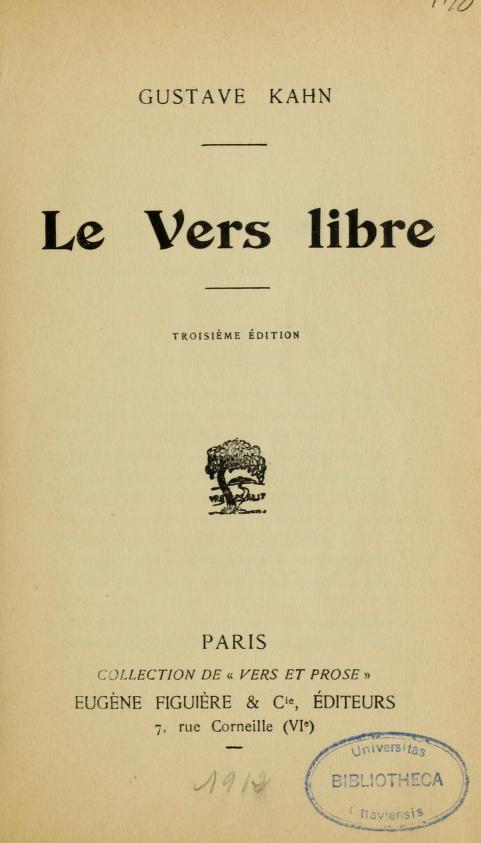
Gustave Kahn, Le Vers libre,
text established by Eugène Figuière & Cie,
Publishers (Collection "Vers et Prose"),
third Edition, 1912, pp. 5-41.
.
.
Free Verse
(A lecture delivered at the Students’ House)
Gentlemen of the University,
What a pleasure it is to find myself amongst you, what a joy to speak with you about a subject that lies very close to my heart: free verse.
I was a student like you, I was your age, when there began to take shape for me—amidst all the literary enthusiasms and disenchantments of one’s twenties—the first outlines of that intimate dream which, for a poet, is poetry itself.
When I first began publishing, it was amongst students that I found my earliest readers.
My review, La Vogue, had sixty-four devoted subscribers—newly launched literary reviews seldom have many more, and one might conceivably know each of one’s readers personally. I regret that this wasn’t the case for me at the time, though I’ve since met most of them.
Amongst them were poets in considerable number, but also orientalists who had our slender fascicle sent all the way to chanceries in the Far East, and young men who relaxed with it after a day spent poring over green ministerial folders. The rest lived at the École Normale or followed our efforts between lectures at the École des Hautes Études or the Sorbonne.
But don’t imagine that our sixty-four copies represented merely sixty-four readers! I could hardly have put on a poster, as certain major dailies do: “La Vogue, one million readers!” But there were certainly several hundred.
The young passed the review around amongst themselves; it was picked up and leafed through under the arcades of the Odéon. I confess that not all our purchasers were minded to send us laurels!
I’ve been told that as soon as each issue appeared—every Saturday—a young Parnassian would seize a copy and bear it off to François Coppée’s, where ten of them would gather, young men and their elders, around this single specimen. First they’d have a good laugh, then they’d take turns lamenting the decline of the French language and the unheard-of cheek of these young barbarians who were dismantling the old alexandrine—so tender in Racine, epic in Victor Hugo, severe in Leconte de Lisle, and now under the bow of our mockers grown so placid and rather valetudinary.
They weren’t alone. Never did a movement provoke such an outcry! You’d have thought that by tampering with the alexandrine we were robbing the stagecoach of respectable French letters and pilfering the postal orders of serial novelists!
The oldest worthies were mobilised against us; thus they secured a written anathema from Gustave Nadaud.
The skirmishers of the popular press found us both dangerous and ridiculous; we suffered written assaults from Henry Fouquier, full of howlers, and pitying censures from Dubrujeaud and others.
Parnassian poets cursed us, exorcised us—and amongst them, those who wrote Parnassian verse least well.
In short, if the vigour and value of a movement can be measured by the injustice of the attacks it attracts, we might have been proud; but a wise modesty reminded us that the Romantics, the Parnassians and the Naturalists had received quite as much… in the way of artistic blows.
Whatever one thinks of our technique and our poems, everyone today agrees that in 1885 French poetry needed a violent shake-up. It was slumbering.
Mind you, I’ve no intention of speaking ill of the Parnasse.
No one admires more than I the beauty of Leconte de Lisle’s evocative frescoes; no one admires as much as I do in Banville a magnificent poet and a storyteller almost unique in all literature—for I know only Edgar Poe, in a different palette of images, to have packed into a few volumes of brief tales so much life and so many ideas.
No one more than I admires our great Léon Dierx and responds to his magnificent verbal music.
Villiers de l’Isle-Adam’s glory dates from the Symbolists. But after all, the bulk of these masters’ work was done; we had no call to imitate them when we came into being (literarily speaking).
Nor do I mean to say that amongst the adherents of Parnassian technique there weren’t, amongst poets still in the fray, some very considerable talents. That would be to ignore the force, fecundity and varied abundance of Catulle Mendès; to forget Heredia and his devotion to style and the beautiful brief vision; to overlook Gabriel Vicaire, who found amongst the sheaves of French folk song some fresh bouquets of cornflowers!
There were also those they called the living: Jean Richepin, that solid rhetorician blessed with such verve and taste, the Theocritus of beggars, the Don César de Bazan of bohemians, raggedly splendid in gold and purple.
But that wasn’t the issue; these fine talents stood isolated in a turbulent, grey mass.
Every day the man with the spade (the one who toils on the covers of Lemerre’s books) was digging up basketfuls of bottle shards cast out from the masters’ palaces, and from these broken bits of glass was making volumes of verse.
There were poets everywhere, and they all wrote the same verse.
I once recounted how a very decent fellow, though hardly a tremendous lyricist—Emmanuel des Essarts—had undertaken a census for the glory of the Parnasse. After listing those in Paris in one lengthy article, he enumerated in an even longer article those in the provinces.
There were poets in every town; thanks to him, one might have revised the Dictionary of French Communes by adding, after each town’s name and industrial specialities, the name of its poet:
Pithiviers, lark pâté: poet Jules Béor
Nevers, pottery works: poet Achille Millien
Morcens, famous buffet: poet Évariste Carrance, etc., etc.
The Parnassians declared they’d banded together around a deliberate, closed technique out of horror for the Lamartinians, whilst still admiring Lamartine.
We had the same reason to detest a technique that had sunk to its worst amongst the uninspired zealots of Hugo, Banville and their friends.
There were Baudelairians who seemed to know nothing of Baudelaire but the carrion and worked exclusively in the nauseating. There were too many Musset-cum-Mendès disciples and breathless Hugo-worshippers. There were too many imitations.
It’s also been said that we hated naturalism, which is excessive. We knew perfectly well what Émile Zola’s genius was; we knew how to make room in our admirations, alongside the unquestioned Flaubert, for those powerful workers, those eminent stylists: the Goncourts. We found merit in the Médan group; we turned away only from dull copyists and scatological writers.
Amongst the novelists of talent, we had cause to complain only of Huysmans, who was nevertheless a friend to us all. But this man of great good faith and perfect goodwill had at one stroke furnished our adversaries, in Against Nature—based on a few amiable dilettantes and above all on his own tormented and magnifying imagination—with material to mock us for ages.
He’d heaped upon a single hero all the extravagances, the dandyisms, the manias, the affectations that would be thrown at us, the so-called decadents—us, the simple souls, the honest toilers or honest idlers who lived quite peacefully after the fashion of most of our Parnassian elders: in the library by day, at the café by night.
They were the same libraries and the same cafés.
We forgave Huysmans; the damage wasn’t as great as it seemed. For if they hadn’t accused us of exasperated necktie-ism, they’d have found something even more disagreeable to avoid serious discussion with us. It’s the nature of artistic novelties, moreover, to unleash incomprehensible storms. This holds true for all the arts. If one can no longer explain the gales of laughter at the old Impressionist exhibitions when looking at Claude Monet or Renoir, still less can one imagine how in 1875 music lovers headed for the Châtelet armed with whistles when the Danse Macabre was to be performed, how Carmen failed, how once upon a time men of real practical intelligence were horrified by Hernani, how Baudelaire scandalised, how Flaubert offended; and I cite only novelties where the artistic element alone was in question, granting that naturalism was first debated simply in the name of morality, and that patriotism alone led Parisians to demonstrate against Lohengrin… In any case, on the day of Tannhäuser they had no other reason than horror of the new.
In short, for the literary historian considering a literary movement of the past, the perspective differs from that of the contemporary observer.
What does the contemporary say about innovators if he’s serious, broad-minded, measured, decorated, employed by the regime, or—which amounts to the same thing—something in the high opposition? He says, he repeats: “Everything’s going to pot, there’s nothing left, no more style, no more taste, no more France, no more tradition.”
The innovator says: “But I’m the one maintaining tradition—let me try to prove it.” Then the open-minded and conciliatory spirits, the benevolent witnesses, the wise souls who cherish the past and feel some tenderness towards the future, say to the innovators: “They’ve been unfair to you, they misunderstand you! But don’t you fear you’re going rather far? Don’t cut off the tail of Alcibiades’ eternal dog, be prudent, moderate yourselves. If you carry on, you’ll be in the wrong… Good Lord, tradition! You can’t just knock it about!”
But the historian who twenty years later takes a comprehensive view, who fits everyone into his categories—the Hugos and the Nisards, the Flauberts and the Pinards, the Berliozes and the Fétises, the Manets and the Albert Wolffs—the historian observes that the new movements were less new, less artistic than they appeared, that they almost always stopped halfway.
The historian struggles to explain why the innovators didn’t go further, and above all he finds it hard to understand the ferocity of resistance against a novelty that from a distance appears as the logical outcome of earlier novelties, already become tradition.
And not only do these quasi-distant historians note this insufficiency of movements that weren’t excessive, but so do those very people who were part of these movements.
Let’s take an example of a historian of poetry and rhythm.
It wasn’t I, the free-verser, who first said that Victor Hugo hadn’t gone far enough in liberating rhythm—it was Banville, the most learned rhythmist to emerge from Romanticism, who begat the Parnasse so it might add some new observances to the liberties decreed by Victor Hugo.
And mark a nuance that has its value: Banville, publishing his Treatise on French Poetry written around 1878 when his best collections of verse had appeared, touches on the rules of his art with infinite caution; his faith keeps his scepticism as its faithful scout. He ends his prosody by giving examples of a metre he’d declared impossible a few pages earlier. No doubt, whilst correcting the proofs, he tried it again and found it satisfactory. It’s with high purpose that he publishes his ephemeral error and the contradiction he gives himself; it’s so that the Parnassian poets (he addresses no others) who read him will know they must obey rules in their spirit and not their letter; it’s to make them understand that there are no immutable rules, that tomorrow can always overturn yesterday.
His book, written in that dappled style which makes reading Banville so delightful to any poet, retains for us, beyond its charm of form, a high value for two reasons: first, for this affirmation of liberty, that a new poet must destroy barriers Victor Hugo left standing; and for a true counsel included in his chapter on inversion, lapidary in its brevity: never use it.
This is the very foundation of our poetic phrase and our system of the stanza. French verse wants no inversion, the stanza refuses it, for the stanza is the sentence, nothing but the sentence, nothing more, nothing less.
If you admit inversion, you destroy the rhythm of the stanza which must, like the sentence, give the reader the order of ideas.
No inversion—there’s a major difference in construction between the ancient stanza and the modern.
There are others.
But I sense I’m becoming rather technical—though it’s necessary—and to be so only briefly this evening, I’m going to ask your permission to be extremely tedious for five or six minutes.
Afterwards, as soon as possible, we’ll move on to hearing the poems.
Though I’m resolved to explain their aesthetics to you, I think only the poems themselves are truly qualified to succeed in this.
So I’ll enter into theoretical detail, and to do so I’ll quote what I published on the question in 1888 in the Revue Indépendante:
“One must accept that, like customs and fashions, poetic forms develop and die, that they evolve from an initial freedom to a desiccation, then to useless virtuosity; and that then they disappear before the efforts of new writers preoccupied with more complex thought, consequently more difficult to render by means of formulae circumscribed and closed in advance.
We know too that forms, once overused, become as if erased; their primitive effect is lost, and writers capable of renewal see no point in submitting to rules whose empirical origins and inherent weaknesses they understand. This holds true for the evolution of all arts in all ages. There’s no reason why this truth should falter in 1888, for our epoch hardly represents the apex of intellectual development. I say this to establish the legitimacy of striving toward a new form of poetry.
How was this effort conceived? Briefly, thus:
First, one had to grasp the profound truth within previous attempts and ask why poets had limited themselves in their reforms. It becomes clear that if poetry has moved so slowly toward emancipation, it’s because we’ve neglected to investigate its principal unity (analogous to the organic element), and even when this elementary unity was sometimes perceived, we failed to pause there or profit from it. Thus the Romantics, seeking to expand the alexandrine’s expressive means—or more generally, verses with even syllable counts—invented enjambment, which amounts to a trompe-l’œil transmuting two lines of twelve syllables into one of fourteen or fifteen and one of nine or ten. Here we find dissonance and indeed resolution of that dissonance. But if they’d sought to analyse classical verse before rushing to any means of varying it, they’d have seen that in the couplet:
Oui, je viens dans son temple adorer l’Éternel,
Je viens selon l’usage antique et solennel
the first verse consists of two verses of six syllables, of which the first is a blank verse:
Oui, je viens dans son temple
and the other:
adorer l’Éternel
would equally be blank, if, by habit, one weren’t sure of finding the rhyme in the following verse, that is to say in the fourth of the verses of six syllables grouped in a couplet.
So on first examination this couplet consists of four verses of six syllables of which only two rhyme. If one pushes the investigation further, one discovers that the verses are scanned thus:
3 3 3 3
Oui je viens — dans son temple — adorer — l’Éternel
2 4 2 4
Je viens — selon l’usage — antique — et solennel
That is, a first verse composed of four ternary elements of three syllables, and a second verse scanned 2, 4, 2, 4. It’s evident that every great poet having perceived in a more or less theoretical way the elementary conditions of verse, Racine empirically or instinctively applied the fundamental and necessary rules of poetry, and that it’s according to our theory that his verses must be scanned. The question of caesura, amongst the masters of classical poetry, doesn’t even arise.
In the verses cited above, the true unity isn’t the conventional number of the verse, but a simultaneous arrest of meaning and rhythm on every organic fraction of verse and thought. This unity consists of a number or rhythm of vowels and consonants that are organic and independent cells. It follows that the Romantic liberties, whose (amusing) exaggeration would be found in verses like these:
les demoiselles chez Ozy
menées
ne doivent plus songer aux hy-
ménées
are false in their intention, because they involve a pause for the ear that no pause in meaning justifies.
The unity of verse can be further defined as: the shortest possible fragment representing a pause of voice and a pause of meaning.
To assemble these unities and give them cohesion so they form a verse, one must relate them. These relationships are called alliterations—that is, union of related consonants—or assonances through similar vowels. Through assonances and alliterations one obtains verses like this:
Des mirages/ de leur visage/ garde/ le lac/ de mes yeux.
Whilst the classical or romantic line exists only in relation to a second line, or by correspondence at brief intervals, the verse we take as example possesses its own autonomous, interior existence. How then to marry it with other verses? Through the logical construction of the stanza, shaped according to the internal measures of whichever line carries the principal thought or the thought’s essential pivot.
What I might say about employing fixed stanzaic forms—whether the most ancient ones—versus free stanzas would merely repeat what I’ve just stated regarding fixed verse: there’s no more need to bind oneself to the traditional sonnet or ballade than to submit to the empirical divisions of the line.
The importance of this new technique, beyond showcasing necessarily neglected harmonies, will be to allow every poet to conceive within himself his verse or rather his original stanza, and to write his own individual rhythm instead of donning a uniform tailored in advance that reduces him to being merely the pupil of some glorious predecessor.
Besides, the resources of traditional prosody remain freely available to us. That prosody retains its value as a special case within the new system—just as our system is destined to become merely a special case within some yet more comprehensive poetics. The old poetry distinguished itself from prose through formal arrangement; the new seeks distinction through music. A free verse poem may well contain alexandrines, even entire alexandrine stanzas—but these appear where they belong, without excluding more complex rhythms…t/n1
French does possess a tonic accent, but a feeble one—the result of Paris amalgamating the provinces’ wildly divergent pronunciations, wearing them smooth to forge a language of moderation, calm, the golden mean. A language neutral in its consonantal resonance and vocalic song, preferring grey to motley. This tonic accent, which one might identify in isolated words lined up as examples, vanishes in conversation and declamation—or rather, it doesn’t vanish but transforms. For there exists a governing accent that directs an entire period or stanza in speech or recitation, determining the duration of auditory values and the timbre of words. This accent, universal in that each passion produces roughly the same phenomenon in everyone—acceleration or deceleration, similar at least in essence—this accent is imparted to words solely by the feeling that moves the speaker or poet, with no regard for tonic accent or any fixed value the words might possess in isolation. This accent d’impulsion governs the harmony of the stanza’s principal verse, or of an opening verse that sets everything in motion; the remaining verses, unless one seeks deliberate contrast, must shape themselves to the values established by this accent d’impulsion. This fundamental law is what Messieurs Mockel and de Souza have independently discovered in their studies of poetic rhythm, though they term it the oratorical accent.
Another distinction between the sonority of regular verse and the new verse stems from our different treatment of mute ‘e’. Regular verse counts the ‘e’ at full value even though it’s barely pronounced, except at line-endings. But we who consider not merely the rhymed ending but all the various elements of assonance and alliteration that constitute the verse—we have no reason not to treat it as the ending of each element, scanning it just as we would at the close of a regular line. Note well that except in cases of elision, this element, the mute ‘e’, never truly vanishes, not even at line’s end; one hears it faintly, but one does hear it. It seems reasonable, then, to scan it as a simple interval between surrounding syllables. In this we accord with the instinctive rhythms of speech—the true foundation of all prosody, indeed its very essence once allied with the accent d’impulsion (that principle of variation) and with poetic intonation subordinate to that impulse. These accents and intonations are what matter, for verse and stanza are wholly or partly sung utterance—they are spoken word before they are written line.
By our definition, all typographical artifices employed to validate verse correspondence (eye-rhymes) are swept away at a stroke. The poet speaks and writes for the ear, not the eye—hence one of our modifications to rhyme, and a principal disagreement with Banville. For our conception of verse as logically yet flexibly vertebrate immediately excludes us, without debate, from his axiom that “in verse one hears only the word that rhymes.” True, Banville possessed an enchanting, fairy-like way of putting things that softens the rigour of his axioms, especially when formulated so neat and brief. When he believes he’s captured scientific law in the brevity of a Decalogue verse, he’s most often given us merely a felicitous phrase. As here. I’ll grant that listeners lulled by grand verse speeches—especially when declaimed by poor actors—cling to rhymes to distinguish verse from prose. This holds for pseudo-classical verse. A Banville disciple might object that free verse merely shifts the difficulty whilst his aphorism stands: perhaps. If pseudo-classical or weak romantic verse distinguishes itself only through rhyme and risks confusion with prose, then free verse, more fluid still, might be mistaken for poetic prose—rhythmic, cadenced, a kind of music. Let’s admit it: that would already be an improvement, better serving our aims.
Besides, we don’t proscribe rhyme; we liberate it. We gladly reduce it sometimes to assonance; we avoid that too-predictable cymbal crash at line’s end, yet we buttress our rhymes with assonances, we place full rhymes within the line to correspond with other internal rhymes—wherever rhythm beckons us to place them. Rhythm faithful to sense, not symmetry—or if you prefer, a more intricate symmetry than the common kind. Rhyme and assonance must therefore be supremely mobile, whether the poem unfolds in closed stanzas, or employs what’s since been called the rhythmic laisse or sometimes analytic strophe (first exemplified in Palais Nomades)—the form closest to classical discourse, most suited to extended emotional exposition—or whether one chooses the brief evocations of lieder.
We’ll distinguish no other strophic models. Free verse is essentially mobile and must not codify its stanzas. The accent d’impulsion and its fit to the weight and duration of the evoked feeling or translated sensation—this alone determines form.
Free verse poets must resist casting each stanza in the mould of those they’ve already created. Similar impulses may certainly produce similar stanzas, but this principle must remain supple, never hardening into rigid lawt/n2.
A final word on technique. Some long lines exceed twelve syllables—and why not? Why should duration be confined to twelve, to fourteen syllables? Without letting verse swell into a complete verset (here taste and ear sufficiently guide the poet), one can gather into a single line three or four elements whose force demands concentrated expression. The line thus gains a summarising power akin to the final verse of terza rima, yet more genuine, more intrinsic to the verse itself—achieved without recourse to typography or to the fermata of a poem’s close. Naturally, numerous fine points would need clarifying, but that would constitute a prosody, and I’ve no intention of constructing one here.
Besides, do we need a prosody?
Yes, no doubt, to conform to usage and cling (it’s our duty) to tradition.
But do we need it right away?
Perhaps not! One couldn’t say “as late as possible,” but one would certainly be tempted. It seems a complete, well-made prosody would be heavy to bear. In any case, let’s not hide from ourselves that it would be very difficult to make, for the cases of rhythm already chosen in the language by free-versers are numerous; some are tenuous, delicate, some ephemeral. Traditional poetry has created a host of constant relationships, which are precisely therefore sometimes exact, sometimes too pronounced, and become brutal and tyrannical. This aspect of art-zinc that’s taken or that one wants to have taken often for marble (“marble, bronze, purity, let’s see?” say Vildrac and Duhamel) stems from this exaggeration of constantly employed means: from this inappropriate use of a resource useful in a particular case, and from this repeated use stems this aspect of literature with outstretched and tired arms that the poem in regular verses and especially in fixed stanzas too often presents. It would be good if we remained for some time still very free, without leading-strings; they’re not needed. So no prosody yet, scarcely a poetics, and better still, simply, personal reflections on technique. I feel well that in the end we’ll have to make a prosody, but won’t it rather be to answer objections, to convince adversaries, for propaganda so to speak!
Not that I don’t grasp the interest and merit of efforts attempted to scientifically explain free verse. From the first days, strong in the truth of lyric instinct, we said that laboratory work would prove our theories right, and one can only be grateful to Robert de Souza for his application in attempting their laborious confirmation. On this very terrain, one will certainly see with time other research produced, other comparisons, other studies of scansion. All these partial efforts attempted scientifically will converge to justify the latest synthesis of poetic rhythm.
Perhaps this will happen quite rapidly! One couldn’t predict. But it’s in everyone’s interest that amongst poets, especially amongst the youngest—those who, having found free verse established and facing it in excellent posture the Parnassian reaction, or the renewed and progressive Parnasse (as you will) that was opposed to it—some of the most gifted have chosen free verse.
They’ve given themselves reasons for it. They’ve done it at their own risk, very consciously, for one doesn’t renounce without motive all the small advantages, all the easy access, all the premiums that benefit poets of obstinately regular verse. These young writers are therefore very interesting to consult on this account, and it’s an excellent initiative that Vildrac and Duhamel have taken to inform us about what they find good in the first free-versers, and to indicate not only how they understand them, but what they add to them and what for them is the logical continuation of the principle.
Naturally, they don’t lay down new rules. They’d take care not to: they’ve too thoroughly grasped our counsel of freedom and frankness towards oneself. They conclude, as we do, that the poet ought to trust his ear more than the phonetics institute, and they finish where we do, and where Banville does too (true tradition is sacred to all right-thinking minds): but first and foremost, one must be a poet. In the particulars, they seem mainly to accentuate our freedoms, and it’s in this sense that their contribution matters.
We have granted the mute ‘e’ a flexible duration, to be deployed at willt/n3. They acknowledge this and add: “This great elasticity has transformed the old obstacle into a precious instrument”—and it’s true. We’ve often rhymed with words consonant in sound but different in their final vowels: “Jules Romains would tend to codify that one must replace rhyme with a fresher, more novel sonorous relationship, more suited to the metrical circumstances.” Which is to say, in essence, that one need only suggest the rhyme for it to exist, and this is true; free poems offer numerous examples.
Our young colleagues, in their quest for a freer rhythmic instrument, rightly declare it pointless to assign gender to rhymes. They demonstrate how one might play against old habits by extending masculine endings into feminine ones, resolving them according to classical alternation yet at moments of the poet’s own choosing—creating delightful surprises of euphony. They invoke alliterations and arabesque patterns of vowels, noting the existence of phonetic equilibriums sometimes more intriguing than pure alliteration or assonance (alliteration that doesn’t announce itself as such)… in short, every means to replace the hard, ponderous symmetry of the metronome with a symmetry of far greater complexity—one that consists not in the regular hammer-blows of repeated sounds, but in ingeniously varied brushstrokes of kindred sonorities at intervals dictated no longer by arithmetic, or rather by mere counting, but by a musician’s instinct, wielding now leitmotifs, now echoes of timbre. When emotion calls, leitmotifs may tumble forth in swift succession. The poet might rhyme at line-endings and carry that same rhyme through an entire stanza, or instead scatter sonic echoes at distant intervals throughout the poem’s body—all according to meaning and taste, but especially to meaning (for echoes that serve sense are essential). Yet the poet may also work in arabesque patterns, playing with timbres, consonances, and alliterations as fancy strikes—always steering clear of mechanical repetition and mere echolaliat/n4.
*
Let us observe that this transformation in rhythmic method springs from something deeper than mere desire for variety in rhythm and timbre. It represents a fundamental shift in how we conceive beauty’s unity in verse—not just its rhythmic unity. Poetry that does not sing is no poetry at all. Its very tissue must be woven from comparisons. For what defines the poet if not this: the one who transposes into thought’s domain every fact and sensation within his ken? And the instrument of transposition is metaphor. Indeed, a poem is nothing but metaphors in succession—logical succession, yes, but logic itself admits many guises. One poet may unfold his metaphor completely, anatomize it, illuminate every facet; another may let it shimmer through multiple perspectives, across shifting planes of meaning.
Théophile Gautier—whom we cherish and understand far better than his Parnassian descendants—once said: “I observe the outer world and set down metaphors in sequence.” We too have striven to perceive that outer world with utmost clarity, whilst capturing what we can of the inner world’s elusive shadings—each poet according to his gifts. But our metaphors seek to generate one another, to proliferate. Rather than exhausting any single metaphor, we prefer to gesture toward it, to summon whole cascading series of metaphors that one sensation pulls in its wake—always within our mortal limits. This manifold evocation creates that aureole of reverie surrounding our poems, lending them (or so we hope) their lingering resonance. Only thus does metaphor achieve completeness—as a struck chord finds completion in its overtones. Always there must be some vibration arising from yet not wholly contained within the text, never quite spent.
Critics have seized upon this, claiming we lack backbone, that we fail to drive our points home. Yet when we do show backbone (and we know perfectly well how), they complain of our monotonous methods. Should we grow too adventurous, they retreat to that old charge: our rhythms limp. “Limping”—because irregular! How telling that they choose “limping” over “free.” That single word-choice reveals the chasm between our poetics. Small wonder we felt no sting when first they hurled this accusation. By now, we’re veterans of such campaigns.
*
Poems were then splendidly recited by Mesdames Marie Marcilly and Cecilia Vellini, and by Messieurs Paul Rameau and Edmond Menaud. Songs were performed by the composer Michel-Maurice Lévy—both poems and melodies accompanied by commentary which need not be reproduced here. Then came the lecture’s conclusion.
And now, ladies and gentlemen, I thank you for the friendly and patient reception you have given my theories, and for the applause you have so kindly bestowed upon my verses—credit for which I must largely transfer to their excellent interpreters.
If I might venture to hope that one impression above all others should remain with you from this talk, it would be this: that the most essential quality of vers libre is its freedom. This is its very principle. Each poet must discover within himself his own rhythmic force.
Life itself is the great master of prosody; its lessons are found in thought and in passion. All may hear them; the learned must find there the means to give strict form to their ideas, whilst the dreamers shape their reveries.
I am certain that vers libre will endure precisely because it is free, and because of that elasticity which has allowed it from the very beginning to enrich itself with every improvement—not merely of beauty, I would say, but of technique—brought to it from the first hour by poets of individual genius: first Jules Laforgue, my brother-in-arms from our youth, then Vielé-Griffin, Mockel, Verhaeren, Régnier, Stuart Merrill, Saint-Pol-Roux, Ferdinand Hérold, Henry Bataille, Paul Fort, Marinetti, Fontainas, Edmond Pilon, Klingsor, George Périn, Souza, Albert Saint-Paul, Roinard, and so many others—in short, the earliest members of that splendid constellation of poets from the Mercure de France, that Review which began almost like La Vogue, grew to rival the Revue des Deux-Mondes, and has now made its entrance, albeit modestly, into the Académie Française.
To these poets have been joined—always bringing fresh innovations in rhythm and ideas—that other young constellation: Vildrac, A. Mercereau, Arcos, G.-Ch. Gros, André Spire, Fernand Divoire, Castiaux, Martin-Barzun, Georges Gaudion, Louis Mandin, and their ardent and talented friends who unite fraternally with their elders through the very breadth of our principle.
It is the adherence of these young cohorts that strengthens our confidence in the future, just as it is their words of sympathy for our poems that persuade us our time has not been entirely wasted.
Others will come yet who will bring—who must bring—fresh discoveries, who must serve the cause of aesthetic freedom, and we await them; certainly I shall not be the last to rejoice in their arrival.
Translator’s notes
t/n1 This captures Kahn’s evolutionary view of poetics: each system encompasses rather than destroys its predecessor, and vers libre can incorporate traditional forms when the poem calls for them, just not as exclusive constraints.
t/n2 Here, Kahn is warning against vers libre becoming its own prison—where poets create a pattern and then feel bound to repeat it. He's advocating for organic form that responds to each poem's needs rather than self-imposed templates.

t/n3 The key is conveying that in vers libre, the "e muet" (the unstressed 'e' that can be either pronounced or silent in French poetry) becomes a kind of musical rest or pause that the poet can lengthen or shorten as needed—rather than being bound by classical rules about when it must be counted or elided. "Ad libitum" (in the original; borrowed from musical notation) emphasizes this freedom of timing.
t/n4 The key insight Kahn offers is that vers libre allows poets to deploy sound effects strategically rather than being bound by predetermined patterns—but always with meaning as the guiding principle.

This is one of 50+ rare French literary texts translated into English for the first time on this site.
 Léon Hennique Novel