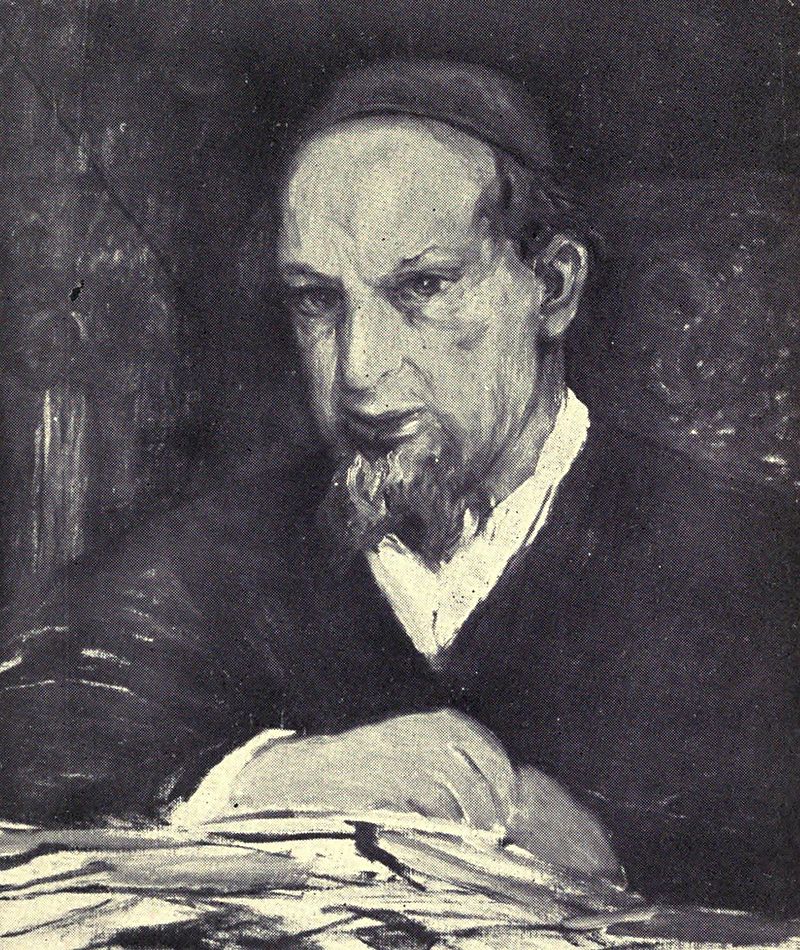
Portrait of Remy de Gourmont
                by Dufau
What follows is an English rendering of Remy de Gourmont’s memoir of Villiers de l’Isle-Adam, drawn from his Promenades littéraires and here translated for the first time. These reminiscences, penned by one of the most perceptive critics of the French symbolist movement, offer an intimate portrait of Villiers in his final years—a figure both magnificent and tragic, whose idealism burnt bright even as poverty ground him down.
Gourmont, writing with characteristic candour, presents not a hagiography but something far more valuable: a collection of anecdotes, observations, and literary gossip that captures Villiers as he truly was. We encounter a man who believed utterly in the conjuring power of words, who could recite entire unwritten books from memory, whose wit sparkled brightest on the staircase after the moment had passed. Here is Villiers the raconteur, spinning elaborate tales he would never commit to paper; Villiers the ironist, heaping false praise upon mediocre writers whilst laughing behind his hand; Villiers the dying visionary, correcting from his deathbed the tiniest editorial errors that might ruin a good page.
These notes, as Gourmont modestly claims, seek to instruct no one. Yet they preserve something essential: the living presence of a writer whose verbal brilliance far exceeded what he managed to set down, and whose proud poverty became, in Gourmont’s telling, almost a form of aristocracy. Written with affection but without sentimentality, this memoir stands as one of the finest contemporary accounts of the author of Axël and the Contes cruels.
This piece can be read online at the Internet Archive.

Perhaps towards 1889 we conceived an inflated idea of Villiers’s genius. But this was our unconscious protest against the literary darlings of the day. The reverent tones that the press reserved for a Dumas or a Daudet stirred our spirit of contradiction—quite rightly, I believe. Yet good sense, taste and measure were rather more on our side than theirs. Convert our enthusiasm into judgement, and we need disown nothing of an admiration grounded in Tribulat Bonhomet and the Contes cruels.
One day, perhaps, someone will write a history of nineteenth-century French literature less naively partisan than M. Faguet’s, less enthralled by success, less wrong-headed too, and Villiers will receive precisely what M. Faguet accords the late M. Cherbuliez: “He was an extraordinarily original writer.” M. Faguet, who lavishes praise on the entire Daudet clan, hasn’t the faintest knowledge of Villiers de l’Isle-Adam. He knows equally little of Barbey d’Aurevilly and Stéphane Mallarmé, whilst his indulgent survey omits neither Eugène Manuel, nor Armand Silvestre, nor any of the Broglies, the Thureau-Dangins and the Sarceys.
These notes will serve neither that future historian nor M. Faguet, should he ever rue his flippancy or sycophancy. They seek to instruct no one. They are reminiscences, remarks, trifling facts that may hold interest only for their collector.
Villiers’s idealism was authentically verbal. He believed absolutely in the conjuring power of words, in their magical properties. “Every verb,” declares Axel, “within its sphere of action, creates what it expresses.” By this principle he once expounded to me the mystery of transubstantiation, which to him was perfectly transparent. He took at face value the formula, Saint Thomas Aquinas’s, I believe: Verba efficiunt quod significant. This enabled him to live, not in happiness, but in pride, amidst those splendours born of dream and cruelties shaped by irony.
Villiers had come to terms with Bailly to bring out, through the Librairie de l’Art indépendant, a collection he titled Chez les passants. Now this Bailly, an intensely esoteric character who delighted in publishing “independent art” at the authors’ expense, was nonetheless eager to turn a profit. For this purpose he’d established a subsidiary called the “Comptoir d’édition”, and the books issuing from there laid no claim whatever to art, independence, or the esoteric.
Villiers, detecting in the phrase “Comptoir d’édition” a certain ironic beauty in its naked commercial candour, demanded this imprint for his book. From this counter he anticipated vast returns.
One day Rosita Mauri, the dancer then in her full glory, swept like lightning into the mezzanine of the Gil-Blas offices on the Boulevard des Italiens, corner of the Place de l’Opéra, and, flourishing an issue of the paper:
“How dare you print all this filth”—she was rattling off titles and names—”when you have Villiers here, when you have a man of genius here, kept waiting?”
I accompanied him to the Gil-Blas. We hoped to offer Guérin—the Guérin-Ginisty of La Fange (such self-knowledge!)—a novel I’d just completed. Villiers endorsed the manuscript in the most dubious terms, assuring them it was worldly, sensual, depraved, brimming with suppers, soirées and courtesans—all quite remote from the truth. Before such men he assumed the most singular posture, showering them with bows and compliments, insinuating himself as a humble contributor, thrilled to circulate amongst so many masters. This was his particular brand of disdain.
At L’Echo de Paris, when I delivered his posthumous tale, Les Filles de Milton, the fee required negotiation. I secured at last what he would have commanded whilst living: three hundred francs. Newspapers paid in those days.
His wit, like that of nearly all witty men, was an afterthought on the stairs. Only then would he raise his finger and deliver the mot juste—discovered too late. M. M…, though his junior, quite terrified him, and he could never muster anything particularly sharp in reply. He profoundly admired in him that gift for making money, for toying with life itself, that mastery of business, and he recounted with relish the story of how the L’E… de P… was founded: M. M… extending his arm towards the banknotes spread before them, extracting a few, and pronouncing simply
“Ten per cent, I take it?”
One evening we were sitting outside a café near the Passage des Princes. M. M… chanced to pass by. In his eagerness to greet him, Villiers upset and shattered two or three glasses. Returning, he told me:
“There goes an astonishing man. Capable of absolutely anything!”
Sometimes, when he held a writer or fashionable poet in particular contempt, should their name arise, he would feign wild enthusiasm, launch into passionate praise, then—having savoured the bewildered faces of his audience—explode with laughter. He performed this comedy for me one evening, just the two of us, concerning a poet already celebrated, or nearly so, whom it’s not yet time to name. I confess he had me for a moment, my opinion of this poet being still unformed. One might well be deceived. The man retains his admirers.
In Isis, he had sought to create the ideal portrait of Napoleon’s mother, Letizia Bonaparte.
He was fiercely romantic. “There are romantics,” he would say, “and there are imbeciles.”
Villiers had converted—in thought alone—during his last years. From that moment, this man who had devoured German philosophy would shrug at the sight of any stout octavo from Alcan’s and declare: “The catechism costs twopence! The catechism costs twopence!”
The notion seemed to delight him immensely.
It has been said—absurdly—that “he belonged neither to his country nor his time.” Quite the reverse. He strikes me as utterly representative of both his race and his century. What chasm separates Candide from Les Demoiselles de Bienfîlâtre? Did he not, exactly like Jules Verne, press contemporary science into the service of romance? In what other age could he have written L’Ève future or La Machine à gloire?
He once remarked to me:
“Remember that phrase in La Princesse de Clèves: ‘Il nous parut un stratagème’? Well, the princess unwittingly employs Mallarmé’s method: ‘Stratagème’ for ‘one who employs stratagems.’”
I’ve never managed to locate the passage, which is what invariably happens when one rereads a book for that express purpose.
A foreigner enquired of him:
“You who knew Wagner intimately—was he pleasant in conversation?”
“Is Etna pleasant in conversation?” Villiers returned.
He delighted in this anecdote:
“Gustave Flaubert died penniless, having given nearly everything to his brother, who’d made a hash of his business affairs. Now one day, this brother, seeing him smoking a rather superior cigar, remarked:
‘By Jove, you do yourself well with cigars!’”
He abhorred Renan, whom he’d gone to hear at the Collège de France and whom he would parody with diabolical brilliance.
His faith, entirely sincere in those last years, in no way prevented him from conjuring, verbally at least, the most magnificent blasphemies. We were discussing one evening (his friend M. Merc… was present, and M. de L…) a sort of house of suicides one might establish, offering the desperate every variety of death imaginable. We were compiling the inventory. Having exhausted our inventions, Villiers proposed crucifixion “for those who, tired of being men, should wish to become gods!”
“Though,” he added, “it would prove frightfully expensive—several fortunes—and would one find such men amongst the wealthy?”
I dined at his flat in the rue de Douai with M. de L…
After dinner, he insisted on sprinkling drops of violet essence on our fingers. “It’s the custom of the house,” he announced, which rather made us smile.
He was taken aback to find that M. B… had written a rather striking and poignant love scene in one of his novels. When he discovered the same scene in Dostoevsky, his mind was put at ease. Of this same B…, he would remark: “He degrades poverty itself.”
18th August ’89. — At the Brothers of Saint John of God. A spotless little room with a great window giving onto a garden brilliant with red blooms. Villiers lies there, bedridden. In a body reduced to terrible emaciation, only the eyes retain some feeble spark of life. In a voice scarcely above a whisper, he manages a few words, and I feel remorse at letting him speak, so painful is each breath. You would think he had lost all his teeth. He is determined to recover, yet knows that tomorrow may well be his last. At his beckoning, I lean close, and he confides (I had just mentioned Le Meilleur Amour, which had appeared in Le Figaro some days before):
“A small literary secret… I hadn’t written ‘the elect air’, but ‘the air of one of the elect’… Quite a different thing… ‘The elect air’—that’s insipid… But ‘the air of one of the elect!’” And again: “The air of one of the elect…”
His gesture, that skeletal arm and hand, still speaks volumes. He continues:
“Then, it wasn’t ‘his dear Yvanic’, but ‘his dear and saintly wife’… Those two witless corrections were Marcade’s work… It’s precisely such trifling changes that ruin good pages…”
Throughout his final illness, M. G… Roden…, who had an article on him, an article, waiting to run in Le Figaro, would call round twice daily to ascertain whether he was still amongst the living.
He read sparingly in those last days. He had precious few books at home in any case, but he seized upon every chance occurrence, every conversation, making his own any happy turn of phrase and pressing it into service for whatever work he had under way. Mendès encountered him one day and quoted, attributing it to Pascal, this maxim: “Such is the vanity, the infirmity of human reason, that man cannot conceive a God in whose likeness he would wish to be made.” Villiers duly placed this putative quotation in the Archdeacon’s mouth, addressing Sara in Act One, Scene Five of Axel, with this gloss: “Repeat to yourself, for your soul’s sake, this profound utterance of a Christian philosopher: «……………………….». Show charity, then, towards your ephemeral reason (La Jeune France, November 1885.).”
In due course, Mendès admitted he’d been pulling his leg: the words were not Pascal’s at all, but his own invention. Whereupon Villiers, in the definitive version of Axel (Quantin, 1890.), recast the passage thus: “Repeat to yourself, for your soul’s sake, this uneasy admission from a pagan rhetorician: «……………………….». Learn to bridle the pride of your laughable reason.” Seventeen lines follow, added to the original version and prompted by this new attribution of the spurious quotation.
Villiers maintained, all the same, that he was a devoted reader of Pascal.
I first encountered Villiers at the Bibliothèque Nationale, where I was then working in public service. He seldom appeared there, preferring as he did to read in his imagination rather than in books, but just then he required certain precise details about Milton’s life for his Filles de Milton, which he would only sketch out years later and which fell to me to publish after his death. Quite agitated, he awaited the requested volumes, and no one showed any sympathy for his impatience, since his name conveyed to the librarians nothing more than a vague echo of historical syllables. I managed to assist him, though too late. Having glimpsed the books, he arranged to have them reserved for the morrow: he returned only three months later.
This anecdote may well be characteristic, at least of his working methods. He carried in his head countless projects in endless profusion. He would recite entire books without a single line being written down, and these recitations varied constantly as he passed from one project to another with remarkable spontaneity. L’Eve future languished for years in the workshop. Manuscript fragments survive whose composition spans ten or twelve years. Only through reciting fragments of a work, noting down phrases and brief chapters, did he gradually achieve clarity, and even then, with certain works like Axël, he remained to the very end, even on his deathbed, in doubt, caught in the painful birth-throes of a new dénouement that would transform its significance.
Despite a life beset by troubles, often to the point of anguish, he laboured valiantly, though his thoughts forever carried him away. Rather than write the drama, he would observe his characters in motion, and when he returned to himself, the scenes he had witnessed would slip away. Hence his love of thinking aloud; spoken as he perceived them, things acquired a more palpable and enduring existence. The audience itself scarcely mattered, so long as he had one. In this he resembled the visionary poet Coleridge, who for twenty years held forth every evening before friends and strangers alike, always with magnificent abundance and astonishing profusion of ideas.
M. Ribot places Coleridge amongst those afflicted by weakness of will, amongst those overwhelmed by the wealth of their own ideas, who cannot or dare not select from this ever-expanding multitude, and who achieve little in proportion to what they have conceived. What singular and precious invalids these are! Yet Villiers, invalid like Coleridge though he was, did create works, if not the entirety of his dreamed œuvre, and what he wrote is sufficient consolation for what he lacked time to write. Besides, only some methodical dullard could boast, approaching his hundredth year, of having realised every project. A truly fertile spirit realises scarcely a thousandth part of his vision. He sees the pyramid to be erected and manages to set but a few stones one atop another!
Five years ago in Finland, whilst preparing for what the Nordic countries term the doctorate in philosophy, and we the doctorate of letters, M. de Kræmer selected Villiers de l’Isle-Adam as his thesis subject (Villiers de l’Isle-Adam. En literaturhistorisk studie af Alexis von Kræmer. Akademisk Afhandling, Helsingfors, décembre 1900, in-80.). This thesis constitutes a work of documentary value all the more precious for being unique. Here one must seek the precise dates of Villiers’s life and works. Regrettably, it is written in Swedish; until the author provides the French edition now in preparation, one must attempt to navigate this text which most will find thoroughly mysterious.
Villiers has had a previous biographer, M. du Pontavice de Heussey, but his book teems with such errors and inconsistencies that M. de Kræmer could employ it only with extreme caution and after checking his account against less dubious sources. He also drew upon—as was essential—the recollections of Villiers’s friends from his youth. One of these, who remained loyal even beyond the grave, M. Charles Marras, has furnished several most curious and hitherto unknown details about Villiers. We learn, for instance, that Villiers wrote a five-act drama, since lost, entitled Les Prétendants. He had even entered negotiations for its production with one M. d’Herssent, as evidenced by a contract dated 1st August 1876. The following year saw him bringing suit against the authors of Perrinet Leclerc, Anicet Bourgeois and Locroy, against Tresse, the publisher of the piece, and against the Châtelet directors, Ritt and Larochelle (Whose son would later stage Axel with such dedication and good taste.). Anicet appears merely pro forma. He had been dead some five or six years; his drama likewise, come to that! A curious lawsuit indeed! Perrinet Leclerc dates from 1832. The play bears a dedication to Mlle Georges, who, splendidly ample of figure, embodied the most regal of Queen Ysabeau.
The cardinal dates in Villiers’s intellectual life, after his beginnings, are these:
1862: Isis.
1865: Elën.
1866: Morgane.
1867: Claire Lenoir (which became Tribulat Bonhomet) and L’Intersigne.
1870: La Révolte.
From that point to 1880 comes disarray, something like a death. Ten years yield only ten tales and a review of Flaubert’s Le Candidat. Through 1871, ’72, and ’73—absolute silence.
1880: Le Nouveau Monde.
1883: Contes cruels, many previously unpublished and certainly of recent vintage.
1885: Akédysséril, five more tales, and Axël.
1886: L’Eve future, whose composition, or its beginnings at least, must date from the year before; L’Evasion; several tales gathered in L’Amour suprême.
1887: Fifteen tales appearing in Histoires insolites, published that year, and in Tribulat Bonhomet, completed at the same time.
1888: The tales forming Nouveaux Contes cruels.
1889: Two tales and the final touches to Axël, which would appear the following year.
Villiers’s period of great fertility thus spans the very end of his life, from 1880 to 1889; and one is compelled to see a clear connection between the writer’s productivity and his opportunities for publication. Still, Villiers might have belonged to that breed of late-flowering spirits whose organising genius only matured after forty or forty-two. There are compelling reasons to favour the first explanation. The man who at twenty-nine wrote Claire Lenoir was neither late-blooming nor precocious. More tardy than Goethe, he precedes Flaubert. He falls, then, within the average and, though we speak of exceptional cases, within the norm. After that magnificent story—which naturally passed unnoticed—had circumstances proved favourable, Villiers would not have faltered. But the times were ghastly. This was the pitch-black horror of the Second Empire (1867), a darkness which, compounded by war, held sway long after 1870. Never perhaps, except during the Revolutionary years, had art been so scorned in France. Whatever wasn’t boulevard fare seemed lunacy. The spirit of the age reached its zenith in Froufrou! La Révolte appeared paltry beside such froth. Yet Dumas, who possessed judgement, defended La Révolte. To his credit, he alone among the boulevardiers didn’t dismiss a play that would, thirty years on, be compared—despite its concision—to Maison de Poupée, of which it is actually the forerunner. Only towards 1885 did minds emerge capable of grasping Villiers.
Contes cruels (1883) stands as a literary watershed. Young men felt themselves shaken by reading it. Around this time, Sagesse had become known and Mallarmé discovered. À Rebours brought in the harvest by supplying the link. A new sheaf was gathered, still reaped annually; a new literature was born. By 1885, Villiers enjoys recognition and admiration; the important newspapers and every literary review welcome him: hence L’Eve future, all his late tales, Axël.
M. de Kræmer treats Villiers’s literary schemes only in passing. Not all were castles in the air. He advertised as in preparation, on the bastard title of the last book he himself published, Nouveaux Contes cruels: Axël (which appeared); L’Adoration des Mages; Le Vieux de la Montagne; Chez les Passants (which appeared); Theatre for Reading: Catherine de Médicis, L’Evasion (which appeared); History: Documents sur les règnes de Charles VI et Charles VII; Metaphysical Works: L’Illusionnisme; De la connaissance de l’Utile; L’Exégèse divine. Chance scattered Villiers’s manuscripts amongst several owners. I’ve examined the lot that fell to me and extracted, besides various fragments, one of his most splendid tales, Les Filles de Milton. In the others, I know, much unpublished material remains. Amongst the most curious pages, I’m told, is the “Tribulat Bonhomet notebook”—that great philosopher’s collected pensées. Why does all this lie buried still?
Villiers appears to have worked in this fashion: scribbling down an idea in hasty phrases, then returning to these pages and transcribing them until the form finally revealed itself. Yet often he would set about copying a draft with steady hand, only to find, by the twentieth line, his imagination sweeping him towards a conception that differed—at least in detail—from his first two or three attempts, which were themselves already markedly unalike. Clearly, only after he had told a tale aloud at length, after he had teased out every possible meaning through repeated rewriting, could he arrive at any clear understanding of it himself. Images and symbols mounted like a tumultuous army storming his mind, and in the heat of battle, wave upon wave of assailants, backed by endless reinforcements, slaughtered one another.
Few possessed so rich a cerebral organisation. Catch Villiers at any hour of day or night—even roused from two or three scant hours of sleep—and “the punch would instantly flare up” (Huysmans’ memorable phrase). What a blaze it was! His published work offers merely a pale reflection. How many tales he told that he never wrote down, would never have written down! Consider that Vieux de la Montagne with which he so often entertained his circle.
Some writing from this oft-heralded but legendary booklet does survive, however, copied here from two crumpled sheets:
(First sheet)
VIEUX DE LA MONTAGNE
To remain always oneself, addressing each person with sincerity, as though speaking to oneself.
Examination of the Hashishin (of the?) with the Fool and the women.
The melancholy of Hassan ben Sabbah, trading on others’ hopes and deaths for something fleeting, and knowing it—recognising his profession as emblem of kings.
The girl concealed in the snow by shepherds, who, ungratefully but not unjustly, finds them foul-smelling and uncouth—once she is free.
The king of Hashish shall be whoever wears the armour, assumes the role, through Hassan, once death has come after the bestowal of the sacred herb…
(Second sheet)
LE VIEUX DE LA MONTAGNE
Scene I.
Oh! the snow!… To die!…
(The wind blows by.)
—Ho!…
—Where are they?
—Save me!… Oh!…
—Farewell!…
—Ho!… in the dark!… in the…
—A rope! Ah! the wood’s giving way… hurry…
—There… help!… Ah!… Help!
—Look up!… my ropes are winding round the pines!…
I likewise heard him discuss a book he never had occasion to announce publicly, which would have borne the title Le Sermon sur la Montagne. In this study he aimed to pioneer new literary effects. From his discourse I retain the vision of a dusky road along which Jesus moves, radiant against the encroaching night… with things revealed not through direct description but through the recording of what surrounds them… nothing precisely delineated… One perceives Jesus passing—but how? Through the influence that flows from him… And then?… Ah! he spoke in hushed tones, weary, Death already tightening its grip…
One day in the spring of 1889, already ill and approaching his end, he sketched for me in brief strokes a tale, here reduced to its barest bones:
“Le Mirage.—Africa. The sands, and no doubt the Red Sea coast. An Arab chieftain fighting the British. He understands perfectly how mirages work, and in retreating from the invaders, arranges his withdrawal so that his army’s image, reflected off the sands whilst the men lie hidden in the dunes, rises up as a phantom force, seemingly real, at just the right distance. The British advance; the Arabs bide their time; the British open fire, the Arabs drop; the British charge forward for the kill: all has vanished. For days on end, across leagues of terrain, the same trick makes fools of the enemy, who grow terrified by this inexplicable sorcery, baffled as to how the Arabs can vanish in an instant, however swift their horses—and spirit away their dead! This battle against phantoms drains the British, who forge ahead, rash and pig-headed, until at last the horsemen encircle them through one final masterstroke and cut them down—still uncomprehending, but with eyes haunted by the dim horror of some terrible, fiendish mockery.”
Villiers de l’Isle-Adam’s earliest verses in print are not, as is generally supposed, the collection printed at Lyon by Scheuring, but rather this pamphlet (thrice rarer than rare itself), which bears the following title:
Deux Essais de Poésie, by Count Villiers de l’Isle-Adam; Paris, printed by L. Tinterlin et Cie, rue Neuve-des-Bons-Enfants, 1858, in-8°, 16 pages.
Two essays: the second, Zaïra, would reappear in the Premières Poésies, with certain emendations towards the close. The first, spurned forever after by the poet, thoroughly deserved its fate. Preceded by a note declaring that English calumnies had roused his patriotic indignation, it is an ode, oddly styled a Ballade. Scattered throughout are lines of quite forceful eloquence—verses worthy of a Tyrtaeus, genuinely superior in this much-disparaged vein to those who hold the patent for such things, alongside curious turns of phrase, like: the cries of cannons all hoarse with rust. Addressing the English about the flag, he writes:
Fouillez ses nobles plis pour y trouver des taches,
Vous n'y trouverez que des trous !—

[Rifle through its noble folds in search of stains,
You'll find nothing but holes!]
Should Napoleon rise “from his great bed of stone,” should the old legions rise with him…
… Puis, que leurs canons verts,
Dans l’ombre illuminés d’une joie effroyable,
Hurlassent, haletants, leur salve formidable,
Leur cri tout enrhumé de rouille et seul capable
D’ébranler les échos tonnants de l’univers !—
[… Then let their green cannons,
Lit in shadow with terrible joy,
Howl out, panting, their tremendous salvo,
Their cry all hoarse with rust, alone able
To shake the universe’s thundering echoes!]
And finally, musings on the fragility of thrones:
Sapin couvert d’hermines blanches,
Il a spectre et lauriers pour branches!…
Il est formé de quatre planches,
Absolument comme un cercueil.
[Pine draped in white ermine,
With spectres and laurels for branches!…
Made from four planks of wood,
Exactly like a coffin.]
Another discovery: a scientific brochure of 4 pages in-4°, lithographed (Paris, lith. Michel, passage du Caire, 1859):
Nouvelle Application de la vapeur à la navigation. Signed: Philippe-Auguste Villiers, Count de l’Isle-Adam.
The signature seems—an extra touch of authenticity—to reproduce Villiers’s own hand, his clear, measured script, but this is deceptive. The brochure is his father’s work.
It describes a system of propulsion meant to replace the screw propeller with far less—indeed, no—wastage of power. Lacking adequate scientific grounding, I confess I found it rather opaque: the language is rigorously technical, betraying serious engineering study.
L’Eve future—a gruelling work which Villiers likened to a descent into hell. Whenever he returned to the abandoned page, recreating that peculiar atmosphere demanded superhuman exertions of will, memory, and logic, constantly reweaving the strands of the supernatural with those of positive science. He sought to give an impression of scientific precision and fretted—we have evidence in an unpublished preface—about the verdict of actual electricians. Yet to keep his volume manageable, he eschewed all figures and chemical notation.
The plot proved equally toilsome. The work passed through various titles, which appear successively in the manuscripts as: 1° L’Andréide paradoxale d’Edison; 2° L’Eve nouvelle; 3° L’Eve future. The characters’ names likewise evolved: Alicia Clary begins as Evelyn Habal, then Miss Hadaly—two names eventually assigned, respectively, to the Woman who occasions the Android’s creation and to the Android herself. Lord Ewald appears variously as Lord Lyonel, Lord Lyonnel, Lord Angel, Lord Angel**, Lord Edward.
In L’Eve future, Villiers neither mocks science nor denies it. Rather than celebrating the material advances of applied science as wonders, he exposes their futility by exposing their boundaries. He purposely overshoots, by an entire infinity, the possible reach of science, whilst never quite violating tomorrow’s conceivable realities. In this connection, Huysmans had devised a far superior dénouement to Villiers’s, affirming life’s eternal dominion, the supremacy of raw flesh over the most “intelligent” automaton: Lord Ewald returns to Scotland with his android, lives with her, grows drunk on artifice; but one evening he catches sight of a farm girl’s naked leg, desires this girl, and shatters his mechanical companion.
Villiers must have featured on the early lists for the Académie Goncourt. One spring evening in 1889, after we had dined together, he took his leave around ten o’clock, having an engagement at Le Figaro with Edmond de Goncourt, who had not yet made his acquaintance.
In the years following the war of 1870, Villiers endured a truly wretched existence. It seems all but certain that he earned his bread as a boxing instructor at some gymnasium. He once made a pointed reference to this when we were discussing his health. The punches he had absorbed in chest and stomach had left their mark—bitter memories and lasting damage alike.
His much-maligned liaison, consecrated by marriage on the eve of his death, had at least afforded him a fixed abode, a home of his own—humble, perhaps, but secure. No longer did he mislay his manuscripts, as when the second volume of Isis was abandoned in a hotel room. Yet after his death, what shameless pillaging! How many friends carried off pages of his handwriting, claiming them as mementoes!


This is one of 50+ rare French literary texts translated into English for the first time on this site.
 Léon Hennique Novel