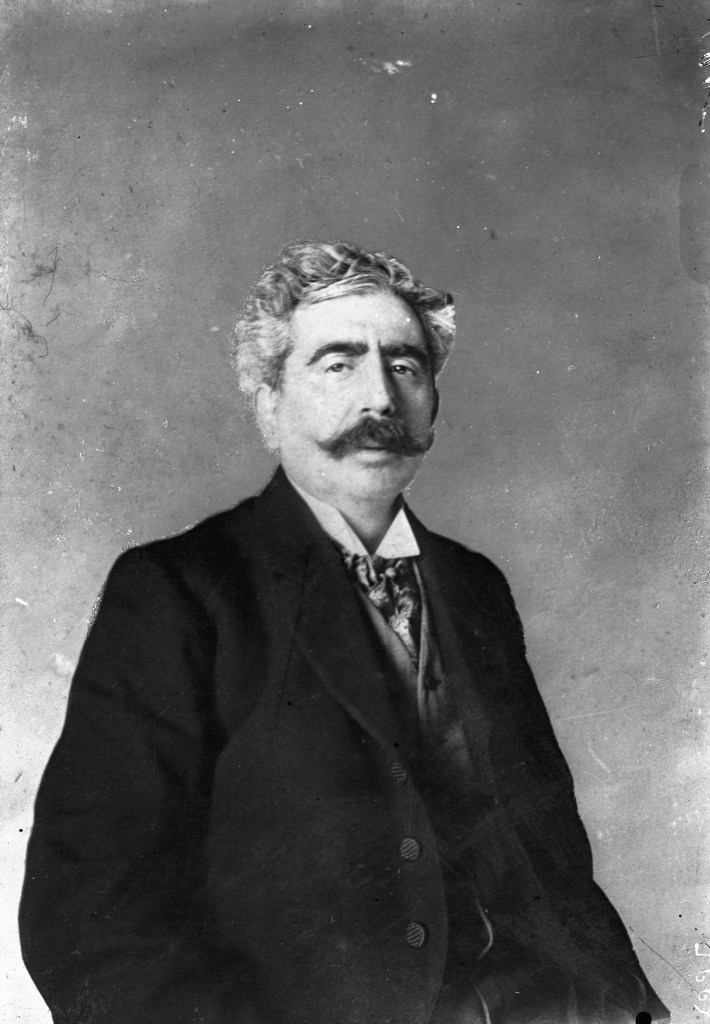
Jean Moréas (1856–1910), French poet.
Photo: Agence de presse Meurisse /
Bibliothèque nationale de France
This preface to Le Pèlerin passionné was published in La Plume in January 1891, in the same issue as Maurice Barrès’s critical essay on Moréas, and serves in many respects as its natural companion piece. Written in Paris on 24 November 1890, it is at once a manifesto, a technical programme, and a declaration of artistic faith. Moréas sets out with characteristic boldness his theory of the symbol, his case for rhythmic innovation, and his vision of a poetic language renewed by deep immersion in medieval and Renaissance French — a language that would be, in his own phrase, worthy to clothe the noblest chimeras of creative thought. The preface is also, unmistakably, a performance of its own argument: the prose is itself archaising, syntactically inverted, and deliberately at odds with the reigning norms of contemporary French literary style, enacting the very programme it describes.
THE PREFACE TO
LE PÈLERIN PASSIONNÉ
To have contemplated, in this work, the mere pageant of its architectures, however magnificent the judgement passed upon them! To have hearkened to its sounds alone, however delectable their savour! — this is to have looked upon its false face, this is to have heard only the discord.
To seek within these pages an Idea that wills itself as its own end, a Sentiment reduced to its immediate signification — this is to hold Art in contempt, in its totality, and mine here in its very essence.
For he alone may call himself legitimately gladdened by my poems who shall have learned to scrutinise in what manner a Sentimental Ideology and Musical Plasticities vivify one another therein by a simultaneous action.
Shall I speak now of my rhythmic innovations — that the praise and fellowship of the most refined young men of this age seal them, to the discomfiture of those who load themselves down with caution? And have I not already furnished proof of some superiority within the regulatory poetic? Who, then, should hold me in suspicion?
Consider: it is the long fixed pause by which the decasyllable and the alexandrine are suspended that distinguishes them rhythmically from all other French verse. To lengthen, then — as far as musical necessity shall determine in each instance — the octosyllable in accordance with its mutable caesura; to accord polyphonies adequate to the thought expressed, by a lacework of unequal lines, following the conception, though enlarged, of La Fontaine; to employ rhyme — now rich in consonants, now languid to the point of assonance — simply as a rhythmic resource without making of it the sum of the verse, to dispense with it altogether even: these are the audacities in which French Poetry will one day glory. I might have dilated upon all of this at length. But wherefore? — since that with which we would enchant Rhythm is the divine Surprise, ever new! And we know too how poorly mere reflection penetrates its mystery.
As for style, there would be much to ratiocinate upon; and I hold that since the close of the sixteenth century “our language has been impoverished, dried out, and cramped.” It is Fénelon who speaks.
It is true that the Romantic revolt did regenerate, with a multitude of proscribed terms, a vocabulary that was fast perishing. But did they not err, those otherwise admirable Romantics — most often through a syntax that is all loose ends — without pedigree, I will say! They omitted likewise many a word, many a precious turn of the old language, whose integrity they could not then have suspected.
For those with eyes to see, a rich inheritance lies concealed in our medieval literature: the graces and tender delicacies of that verdant age, which, heightened by the syntactic vigour of the sixteenth century, will furnish us with — by the ineluctable order and connexion of things — a language worthy to clothe the noblest chimeras of creative thought.
To those who would oppose me with the difficulty of reintegrating an ancient speech, I shall reply that our most unlettered scribblers now understand perfectly — thanks to the obstinacy of certain of our elders — more than one word that was unknown a few decades since. And I shall refer them to that chapter in which La Bruyère deplores the loss of words “which could endure together in equal beauty, and render a language more abundant.” There they will learn that in the time of that writer’s flourishing, the adjectives chaleureux, valeureux, haineux, fructueux, jovial, courtois, and many others we now accept without demur, were struck with ostracism.
In sum:
In these poems, reader, thou shalt find — together with certain of my shorter tales — instated the customs of versification abolished by the reform of Malherbe, timely in its hour perhaps, yet singular, whose high gifts I know well how to prize.
Consequently I pursue therein, by a logical and indubitable evolution, in ideas and sentiments as in prosody and style, the communion of the French Middle Ages and the French Renaissance, fused and transfigured within the principle — which the already obsolete Naturalism sought to debase — of the modern Soul.
And lastly I beg thee, reader, not to take me for some a priori reasoner, for I obey as much as any man, and more than most, the Dæmon that preaches within me. I shall tell thee only — paraphrasing Carlyle — that in matters of serious Art, a transitory flash of intuition will not suffice: what is required is a deliberate illumination of the entire subject.
Paris, 24 November 1890.
Jean Moréas.
This is one of 50+ rare French literary texts translated into English for the first time on this site.
 Léon Hennique Novel