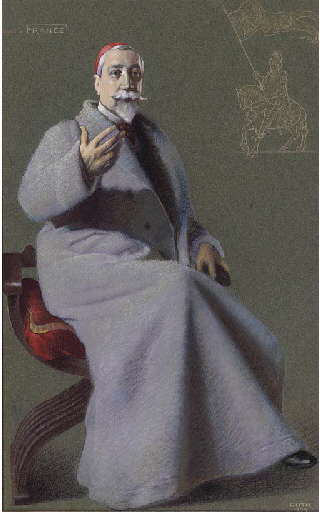
Anatole France, caricature by
Jean Baptiste Guth (1909)
"The Greatest Living Frenchman" —
Vanity Fair, 11 August 1909
Anatole France (1844–1924) — novelist, critic, and eventual Nobel laureate — was among the most celebrated French prose stylists of his age. This short critical essay, published in La Plume (No. 41, 1 January 1891), appeared at a pivotal moment in French literary history: the Symbolist movement was at its height, Le Pèlerin passionné had just been issued by Léon Vanier, and the question of what French verse was, and what it might become, was very much alive. France approaches it with the characteristic equipment of his critical intelligence: classical lucidity, urbane irony, and a generosity of judgement that never quite conceals the sceptic beneath. The essay is offered here in English translation for the first time.
THE NEW POETRY – Jean Moréas
The author of Les Syrtes and Les Cantilènes publishes today, at the house of that “bibliopole1” Léon Vanier2, a new collection of verse whose appearance will be greeted with high celebration in the Latin world, where M. Jean Moréas walks attended, we are told, by fifty poets — a young Homer at the head of his young Homeridae. The café is named where each evening the bard of Symbolism instructs the rhapsodists of the future.
M. Jean Moréas was born in Athens, barely thirty-four years since. He has himself declared, in that singular rhythm so characteristic of him:
Je naquis au bord d'une mer, dont la couleur passe
En douceur le saphir oriental. Des lys
Y poussent dans le sable………….
[I was born on the shore of a sea whose colour surpasses in softness the oriental sapphire. Lilies grow there in the sand.]
He descends, if his biographers are to be trusted, from the Navarch Tombazis3, whose name the sailors of the Archipelago still carry in their songs, and from Papadiamantopoulos4, who died a hero at Missolonghi. Yet by his intellectual formation, by his whole feeling for art, he is entirely French.
He has been nourished on our old romances of chivalry, and he seems willing to know the gods of ancient Greece only in the refined shapes they assumed on the banks of the Seine and the Loire, in the age when the Pléiade shone. He was raised in Marseille, and it is doubtless the first memories of his childhood, reanimated and transformed, that he offers us when he paints, in the opening poem of Le Pèlerin passionné, a Levantine port entirely in the manner of Vernet’s seascapes5, where one glimpses “great old men, working on the feluccas, along the jetties and quays.” But Marseille, Greek colony and Levantine port that she is, was not yet for M. Jean Moréas the adoptive homeland, the land of his election. His true country of the spirit lies further north; it begins where blue slates appear beneath a sky of tender grey and where rise those jewels of stone upon which the Renaissance inscribed its symbolic figures and subtle devices.
M. Jean Moréas is, together with Messrs. Charles Morice, Charles Vignier, and Laurent Tailhade, one of the seven stars of the new Pléiade. I take him for the Ronsard of Symbolism.
He wished, moreover, to play its du Bellay, and in 1885 launched a manifesto6 that recalls, in some degree, the Deffense et illustration de la langue françoise of 1549. It displayed rather more curiosity about art and appetite for form than critical rigour or philosophical reach. The school’s true aesthetician is far more properly M. Charles Morice, in whom I suspect some genuine depth, though I cannot always follow him — he is given to cloudiness. One must, however, endure a measure of obscurity from the Symbolists, or leave their books unread. As for M. Jean Moréas himself, difficult and (to use their own term) abstruse as he can be in passages, he is assuredly a poet, a poet after his own fashion and very decidedly an artist. His new book above all, Le Pèlerin passionné, warrants attention: first, because one encounters throughout it things that are agreeable and even exquisite; and next, because it affords the critic occasion to speak his mind on certain questions that touch the very art of poetry.
M. Jean Moréas and his school have rejected the rules of the old prosody outright. They have freed themselves from the caesura, which the Romantics, even in their broken verse, and the Parnassians after them had still preserved. They repudiate the systematic alternation of feminine and masculine rhymes; and that is not the whole of it. They rhyme richly when it suits them, and rest content, when it suits them, with bare assonance. They permit themselves the hiatus; they sometimes elide the mute e before a consonant; and they compose verse of every conceivable measure — those lines that M. Félix Fénéon has neatly described as “still suspect,” whose six and a half feet unsettle the ear, and those still longer ones in which syntax moves with easy freedom. I trust I may be forgiven for descending into such technicalities: the subject is poetry, and it is far from idle to ask whether these innovations are happy ones, and whether they are admissible.
That they have the inconvenience of disturbing our habits is certain enough. But this inconvenience is common to all change, and one must know how to bear it as occasion requires. To be alive is to consent to see everything altered about one: one survives on no other terms. If the mutability of things sometimes saddens us, it also, one must admit, amuses us. Conservatism run to extremes is as ridiculous in art as in politics, and I confess I cannot decide which is the more futile pursuit at the present moment: to agitate for the restoration of the property qualification in electoral matters, or of the caesura at the heart of the alexandrine.
The ceaseless metamorphosis of all things surprises and alarms no one who thinks clearly. It is simply natural. The forms of art change as the forms of life change. The prosody of Boileau and the Classics is dead. Why, then, should the prosody of Victor Hugo and the Romantics be exempt from mortality? I can imagine no one lamenting what is presently passing in poetry save the old lions of 1830, if indeed any still prowl. Revolutionaries alone are astonished to find that revolutions are made without them.
Now, if our prosody were subject to natural laws, obedience would be obligatory. But it is plainly founded on custom, not on nature. Examine the rules for a moment and their arbitrariness is immediately apparent. We are a moderately musical people, not given to ready song. The origins of our verse are of so rude a barbarity that no poet would dare contemplate them if he had the misfortune of knowing them. Rhyme was originally a crude mnemonic device, and verse a memory-aid for those who could not read. Should anyone find it difficult to believe that a mnemonic device could ripen over time into a genuine artistic effect, he need only reflect that in Greek architecture a beam resting on wooden pillars became the architrave, and that every exposed timber-end of the roof was transmuted into a marble triglyph.
Enter into the detail of versification and one sees that all the prescriptions to which poets submit are both arbitrary and of recent date. They are short-lived: they would be shorter-lived still, were not the instinct of imitation so powerful in men, and above all in artists. In truth, a form of verse rarely outlasts a generation of poets. Study even briefly the changes lately introduced into French verse and one will find sufficient reason, I believe, to make one’s peace with the matter and say: “It was bound to happen.” The suppression of the caesura is but one more step along a path followed since long ago. The broken verse of our old Romantics is today held up as exemplary and admitted by every man of letters. The prosodic reforms of 1830 are accepted by every schoolmaster capable of cobbling together a selection of passages for the classroom, by the most perfunctory anthologist, by the most mechanical gleaner of verse. Yet broken verse was bound to lead to verse with a mobile caesura, which in turn gave way to verse without a caesura at all: the progression was inevitable. And Malherbe reminds us that one ought not to seek a remedy for irremediable ills.
I shall have little to say about the alternation of rhymes. It is a fairly recent requirement, not yet fully in force in the time of Ronsard. I confess to a certain shock when a poet violates it inadvertently; but the discomfort I feel springs less, perhaps, from any delicacy of ear than from the sense of an irregularity that disturbs my settled habits. What I can say is that I no longer feel any discomfort when the non-alternation is deliberate. The effect is, incontestably, capable of being agreeable. So at least thinks M. Théodore de Banville, the most accomplished of poets in the handling of rhythm.
M. Jean Moréas and his friends take certain further liberties with rhyme that may likewise be defended. I once recited devoutly, as a dutiful Parnassian, the litanies of Sainte-Beuve to Our Lady the Rhyme — rhyme the cutting oar, the golden bridle, the clasp of Venus, the diamond ring, the key of the arch. I do not renounce my faith. But I may, without apostasy, acknowledge that the prosody now taking its leave was decidedly bookish in demanding that rhyme be as exact to the eye as to the ear. At that point the poet concedes too much to the scribe. One sees too plainly that he is a man of the study, that he works on paper, that he is more grammarian than singer. It is the besetting misfortune of our poetry to be too literary, too written; but one need not push the matter to excess. If the Symbolists trim something from the graphic symmetry of rhyme, I shall not count it too heavily against them. A further question. Must they be censured for permitting themselves the hiatus wherever the ear permits it? Certainly not: they do there only what good Ronsard did before them. It is, when one thinks of it, a pitiful thing that French poets should have denied themselves for two hundred years the liberty of placing tu as or tu es in their verse. That fact alone is eloquent testimony to this people’s orderliness and its submission to rule.
Shall we cry barbarism because M. Jean Moréas has put into a line of verse:
Dieu ait pitié de mon âme!
[God have mercy on my soul!]
Who does not feel, on the contrary, that certain hiatus are a positive pleasure to the ear? Those crystalline collisions that vowels strike in names such as Nééra or Leuconoé — which are, after all, nothing but charming hiatus within a single word — by what enchantment would they turn inharmonious when sounding at the meeting-point of two neighbouring words in a line of verse? One has only to have read Ronsard to know how the hiatus may enter quite naturally into the melody of verse. All told, the novelties of the Symbolists are rather returns to older practice. Thus, they count nommée Mab, in a line of five feet, as four syllables, as was formerly the custom. An example of this will appear further on. And yet they permit themselves, though rarely and as in popular song, to elide at their pleasure the mute e before a consonant — they write nommé Mab. The licence is considerable, but without it, or without the preceding liberty, the word prie-dieu becomes impossible in verse. I have enumerated, I believe, all the audacities of Le Pèlerin passionné; and not one of them, on reflection, was not summoned, desired, and blessed in advance by Banville — our father in these matters — who declared: “The hiatus, the diphthong making a syllable in verse, all those other things that have been forbidden, and above all the optional use of masculine and feminine rhymes, furnished the poet of genius a thousand means of delicate effects, always varied, unexpected, inexhaustible.”
And Banville, letting the reins lie loose, did he not add:
“I would have wished that the poet, delivered from all empirical conventions, should know no master but his delicate ear, refined by the softest caresses of music. In a word, I would have wished to set science, inspiration, life ever renewed and various, in the place of a mechanical and immovable law.”
The dreams and longings of the most lyrical of our poets — the Symbolists have attempted to make them real. They have done quite enough, and more than enough, to satisfy him. It is said that the master is today astonished and alarmed by the very novelties he was lately calling for. This is entirely natural. One would not be an artist if one did not love, above all else and with a jealous love, the forms in which one has oneself imprisoned beauty. One divines, one half-senses new forms stirring; but the moment they declare themselves, they feel like intruders, and one is moved to say: “I have lived long enough!” Alas, the critic must not surrender to the seductions of regret; he must follow art through all its evolutions and take care not to mistake new refinement and new delicacy for incorrectness and barbarity.
For my own part, the prosody of M. Jean Moréas disconcerts my taste a little without deeply wounding it. It satisfies my reason well enough:
Et mon cœur en secret me dit qu’il y consent7.
[And my heart in secret tells me that it consents.]
But the language — that is another matter, and one that pleases me considerably less. Between ourselves, I find it frighteningly outlandish and terribly insolent. It has an air of laughing the world to scorn, which causes me no little unease. On this point too — and it is the cardinal point — I would not wish to be more conservative than reason warrants, nor to pick a quarrel with the future. Experience shows that language changes as prosody does. It wears out even faster, in fact, since it is put to harder use. In times of intellectual vigour, it makes great gains and great losses every year, and indeed almost every day.
Whether we think well today I cannot say — I have my doubts; but we certainly think a great deal, or at least think about a great many things, and we make a fearful shambles of words in the process. M. Jean Moréas, who is a philologist with a passion for language, invents relatively few new terms; but he restores a great many old ones, so that his verse, crowded with words drawn from the old authors, puts one in mind of the Gallo-Roman house of Garnier8, where one might see shafts of antique columns and fragments of architraves standing shoulder to shoulder. The effect is diverting, but bizarre and confused. Paul Verlaine has called him:
Routier de l'époque insigne,
Violant des villanelles.
[Wayfarer of the signal age, ravishing villanelles.]
And it is true that he belongs to the signal age, and that he seems always to go about dressed in a velvet doublet. I have yet another reproach to make him. He is obscure. And one senses clearly that obscurity does not come naturally to him. On the contrary: he reaches at once for the exact term, the clear image, the precise form. And yet he is obscure. He is so because he chooses to be; and he chooses to be because his aesthetic demands it. Besides, all things are relative; for a Symbolist, he is pellucid.
But let there be no mistake: for all the faults and all the affectations of his school, he is an artist, he is a poet; he has a manner of his own, a style, a taste, a way of seeing and of feeling. Here and there he is exquisite, as for instance in the little poem that follows, which is perfectly intelligible on its own. One need only recall that coulomb was, in the old tongue, the name for the pigeon, and that it has survived in common speech, though somewhat rarely encountered. Here it is:
Que faudra-t-il à ce cœur qui s’obstine;
Cœur sans souci ah, qui le ferait battre?
Il lui faudrait la reine Cléopâtre,
Il lui faudrait Hélie et Mélusine,
Et celle-là nommée Mab, et celle
Que le soudan emporte en sa nacelle.
Puisque Suzon s’en vient, allons
Sous la feuillée où s’aiment les coulombs,
Que faudra-t-il à ce cœur qui se joue;
Ce belliqueur, ah, qui ferait qu’il plie!
Il lui faudrait la princesse Aurélie,
Il lui faudrait Ismène dont la joue
Passe la neige et la couleur rosine
Que le matin laisse sur la colline.
Puisqu’Alison s’en vient, allons
Sous la feuillée où s’aiment les coulombs.
[What will it take to stir this obstinate heart — this careless heart, ah, what would make it beat? It would need Queen Cleopatra, it would need Hélie and Mélusine9, and that one named Mab, and she whom the sultan bears away in his skiff. Since Suzon is coming, let us go beneath the leafy bower where the doves make love,]
[What will it take to catch this playful heart — this quarrelsome heart, ah, what would bring it to heel? It would need the princess Aurélie, it would need Isméne whose cheek surpasses the snow and the rosy hue that morning leaves upon the hillside. Since Alison is coming, let us go beneath the leafy bower where the doves make love.]
A little air for viol — but admit that this is, as Verlaine says, prettily ravished. For the rest, I refer you to Le Pèlerin passionné. There one finds pieces more original in manner and image, of which, truth to tell, I could not cite many lines without gloss, commentary, and lexicon.
For, when all is said, M. Jean Moréas is a decidedly difficult author. He is at least not banal, this dainty Athenian, besotted with archaism and novelty at once, who mingles in his verse, with a strangeness all his own, the elegant pedantry of the Renaissance, the pretty bad taste of the rococo, and the disquieting vagueness of Decadent poetry. They say he goes about the world of Latin letters with fifty poets at his heels, his disciples to a man. I am not in the least surprised. He has, to hold them to his school, the erudition of a seasoned humanist, a mind of genuine subtlety, and a relish for fine and protracted disputes and contests of wit. And if certain parts of his teaching, like certain parts of his work, remain wrapped in cloud, these obscurities are hardly likely to drive away from him a generation of young men hungry for esotericism — a generation which, in art as in science and in morals, gives ear to mystics and mages and dedicates itself to arcana.
ANATOLE FRANCE.
Translator’s notes:
1 a person who buys and sells books, especially rare ones.
2 Léon Vanier (1847–1896): the pre-eminent Paris publisher of the Symbolist and Decadent movements, most closely associated with Verlaine. He marked some of his publications with the device par le Bibliopole Vanier — “by the Bibliophile Vanier” Librairie-le-pas-sage — a conceit that France here gently mocks. His modest premises on the Quai Saint-Michel were a gathering-place for the young poets of the movement.
3 Iakovos Tombazis (c. 1782–1829): a merchant and ship-owner from the Greek island of Hydra who became the first Admiral of the Greek Navy during the Greek War of Independence against the Ottoman Empire.
4 Ioannis Papadiamantopoulos, born in Corinth but of ultimately Epirote ancestry, was executed after the fall of Missolonghi. A three-man committee composed of Ioannis Papadiamantopoulos and two colleagues organised the city’s defence during the Ottoman siege of 1825–26, one of the defining episodes of the Greek War of Independence. Missolonghi had already acquired a romantic lustre in Western Europe as the town where Byron had died in 1824.
5 Claude-Joseph Vernet (1714–1789), a French landscape and marine painter whose finest works, the series of fifteen Ports of France (1754–65), constitute a remarkable record of eighteenth-century life. His port scenes, animated with figures going about their labour on the quays, were among the most celebrated images of maritime France, and would have been immediately familiar to France’s readers as the standard of comparison for a sun-drenched southern harbour.
6 France dates the manifesto to 1885, but Moréas’s celebrated Symbolist Manifesto was published on 18 September 1886 in the Parisian newspaper Le Figaro. It was published partly to redeem the reputation of the new generation of young writers from the charge of decadence that the press had implied. France had himself responded to it at the time, in Le Temps, with characteristic ironic benevolence.
7 Cinna, or the Clemency of Caesar Augustus (1641), Act V, Scene 3, the tragedy written by Pierre Corneille.
8 a reference to the Paris Opéra, designed by Charles Garnier (1825–1898) and completed in 1875.
9 two figures from French medieval romance. Mélusine is the most celebrated — a fairy woman of serpentine nature, foundress of the house of Lusignan, whose legend was fixed in prose by Jean d’Arras around 1393 and remained widely current. Hélie is a less fixed figure, appearing in various chansons de geste as a type of the unattainable enchantress. Both names evoke the world of medieval French fantasy and chivalric longing that Moréas, nourished on old romances, drew on readily.
This is one of 50+ rare French literary texts translated into English for the first time on this site.

→ Browse the complete archive
 Léon Hennique Novel