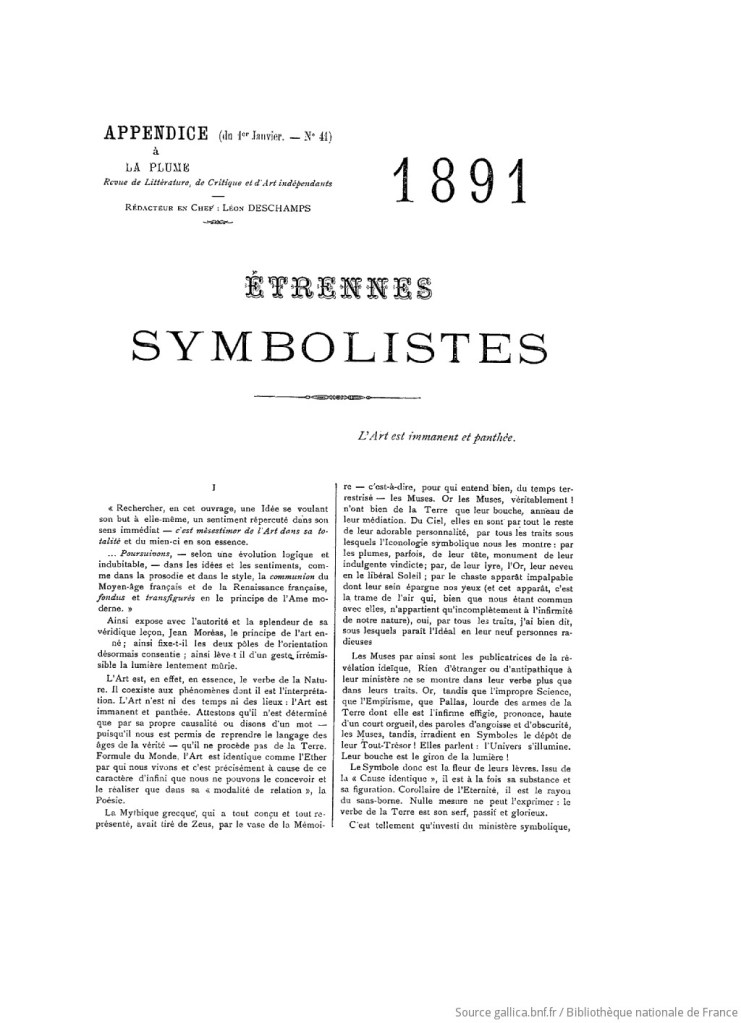
This essay by Maurice du Plessys was published as an appendix to the first January 1891 issue of La Plume — No. 41 — in the same number as Maurice Barrès’s critical appreciation of Moréas and Moréas’s own preface to Le Pèlerin passionné, making it the third element of a remarkable triptych of Symbolist advocacy. Du Plessys, a poet and theorist closely associated with the École Romane, here offers the most ambitious and metaphysically elevated of the three pieces: where Barrès is polemical and ironic, and Moréas technical and programmatic, Du Plessys is frankly oracular. His argument moves from a theory of the Symbol as the essential mode of all true art — immanent, all-pervading, proceeding not from the Earth but from a higher causality — to a vision of Symbolism as nothing less than the restoration of the Gallo-Latin spirit after three centuries of Germanic usurpation. The figure of Moréas, grandson of a hero of the Greek Wars of Independence, is cast in an almost messianic light: a man of election, predestined to the work of literary and philosophical regeneration. The prose enacts its own argument, being itself deliberately hieratic, syntactically contorted, and dense with capitalised abstractions — a performance of the very aesthetic it advocates. Read alongside the Barrès and Moréas texts in this same issue, it completes a defining document of the Symbolist movement at the height of its ambitions. The present translation is the first into English.
SYMBOLIST NEW YEAR’S GIFTS
Art is immanent and all-pervading.
I
“To seek, in this work, an Idea willing itself as its own end, a Sentiment reduced to its immediate signification — this is to hold Art in contempt, in its totality, and mine here in its very essence.
… Let us pursue — according to a logical and indubitable evolution — in ideas and sentiments as in prosody and style, the communion of the French Middle Ages and the French Renaissance, fused and transfigured in the principle of the modern Soul.”
Thus does Jean Moréas, with the authority and splendour of his truthful teaching, set forth the principle of art relinked to its tradition; thus does he fix the two poles of the orientation henceforth accepted; thus does he raise, with an irremissible gesture, the slowly ripened light.
Art is, in its essence, the Word of Nature. It coexists with the phenomena of which it is the interpretation. Art belongs neither to times nor to places: Art is immanent and all-pervading. Let us bear witness that it is determined by its own causality alone — or let us say in a word, since we are permitted to resume the language of the ages of truth, that it does not proceed from the Earth. Formula of the World, Art is as identical as the Ether by which we live; and it is precisely by virtue of this character of infinity that we can conceive and realise it only in its “modality of relation.”
The Greek Mythic, which conceived and represented all things, had drawn from Zeus, through the vessel of Memory — that is to say, for those who rightly understand, from terrestrialised time — the Muses. Now the Muses, truly, have of the Earth only their mouth, that ring of their mediation. Of Heaven they partake in all the rest of their adorable personality, in all the attributes under which symbolic Iconology displays them to us: in the feathers, sometimes, of their head — monument of their indulgent vindictiveness; in the Gold of their lyre, their kinsman in the liberal Sun; in the chaste impalpable apparel with which their breast spares our eyes — and this apparel is the weft of the air which, though shared with us, belongs only incompletely to the infirmity of our nature. Yes, in all these attributes, I say, under which the Ideal appears in their nine radiant persons.
The Muses are thus the proclaimers of the ideic revelation. Nothing foreign or antipathetic to their ministry appears in their word any more than in their aspect. For whilst Science, ever improper to its pretensions, whilst Empiricism, whilst Pallas — burdened with the arms of the Earth of which she is the infirm effigy — pronounces, in the pride of her brief elevation, words of anguish and obscurity, the Muses meanwhile irradiate in Symbols the deposit of their All-Treasure! They speak: the Universe is illumined. Their mouth is the very lap of light!
The Symbol, therefore, is the flower of their lips. Issued from the “identical Cause,” it is at once its substance and its figuration. Corollary of Eternity, it is the ray of the Boundless. No measure can express it: the word of the Earth is its serf, passive and glorious.
So fully is this so that the Poet, invested with the symbolic ministry and freed from time and space, bodies forth both without representing either†. Rich with the Knowledge he holds from unlimited Revelation, the Universe is his panoply. Mark, too, with what sovereign hand he cleaves through the ages; with what torches, darkness notwithstanding, he irradiates his priesthood! And recognise, ye obscure brows, how sacrilegious to his rite, how injurious to his function it would be to bind in sordid fetters a priesthood whose legitimacy resides wholly in its supremacy! Wonder no longer, therefore, that he builds his poems from all the incessant Element; that he gives them, beyond all empirical convention, their necessary architecture; that he assigns to his work the outward conditions harmonious with its essence and its object. Yes, it is to these sovereign ends that the Poet will install his vision in its attendant setting, disdainful of all intruding historicism; that he will free his word from the leading-strings of the Immediate; and that, worker of Gold, he will consent to labour only in a word restored to the nobility of its origin, purified of the seals of misalliance and Senility. For only at this price will he be able to build a durable and truthful work — one that will have been, to speak with Spinoza, emitted under its aspect of eternity.
II
The Symbol being thus the Mode, what instrument shall interpretation adopt — in this instance the Latin interpretation represented, in its present verbal norm, by French syntax?
The Poet, as we have said, will restore to the dignity of its ancestry the truly chosen language of which he is the legatee. In other words, he will break without quarter with the prejudices, conventions, abuses, and pettinesses of the grammar that has held sway for three hundred years. He will restore to exhausted Syntax the noble blood of its green years. He will bring back to light the ancient Gallic chain, buried beneath the prestigious and sterile pomp of the seventeenth and eighteenth centuries, mired beneath the barbarous tread of the Romantic catastrophe.
It is to this work of restoration that Jean Moréas was surely predestined. And it is not without purpose that I underline the word: predestined. Is there not a quality of fatality in this fact of a Hellene whose education has been kept inviolate, working the restoration of the Greco-Latin tradition? And since we are here among poets, none will think me rash to see in this a true election — yes, I mean that word to be taken in its mystical sense — and to hold it as wholly conformable to the logic of events that the grandson of one of the liberators of Greece should have been appointed to a work of precisely the kind that follows as the necessary consequence of all political liberation: a work, that is, of philosophical and literary regeneration.
For it is indeed an essential work of regeneration that present Symbolism undertakes in the footsteps of Jean Moréas. Consider this: the Greco-Latin spirit, blighted by the religious and philosophical Reform of the Teutonic sixteenth century, enervated by three hundred years of uncertain slumber, crushed by a Germanic rescue operation — more rhetorical than critical, it is true — in the fatal event of Romanticism, has nevertheless survived these ordeals. It was destined to reappear in its Gallo-Latin form, by hands kept pure, as I have said, for this resurrection. Allow me therefore, at the risk of profane ironies, to discern in this whole concatenation of circumstances something of the providential, which is no small comfort to us.
A comfort, I say — and a cause for rejoicing, I will add. For the awakening of the Gallo-Latin spirit marks the imminent ruin of Germanic empiricism. It marks, no less truly, the renaissance of authentic poetry. It marks, consequently, the irrecoverable decline of gratuitous philosophy, of illusory experimentation, of criticism without legitimacy, of the Romantic-Naturalist elaboration.
Those minds of enthusiastic intuition — for whom we would poorly disguise our sympathy — are free, in the most legitimate of causes, to see in this literal renaissance the sign of an entire constellation of social phenomena. Whatever the outcome, the spirit of barbarous or anti-Latin reaction — by whatever names it has seen fit to crown itself across three centuries from which it dies, far less of old age, it is true, than of usurpation — this spirit, call it by its most recent literary forms: Romantic, Parnassian, or Naturalist, is irreparably ruined. The rhythmic and syntactic formula of the age of aberration has just collapsed forever upon brows that are, for all that, pardoned. The new Poetry sets forth for the Promised Land. Paying its last honours to Moses, it stirs to the step of Joshua — I mean of a Jean Moréas whom his character of election obliges not to decline this task of salvation.
Maurice Du Plessys.
† The original “les formules sans les représenter” is deliberately ambiguous, operating on two levels at once: the Poet gives time and space their aesthetic form — bodies them forth through the Symbol — while simultaneously defining and articulating what empirical science cannot reach. The Symbol is the form that contains and embodies what cannot be directly depicted, which is the core of Du Plessys’s argument throughout.
This is one of 50+ rare French literary texts translated into English for the first time on this site.
 Léon Hennique Novel