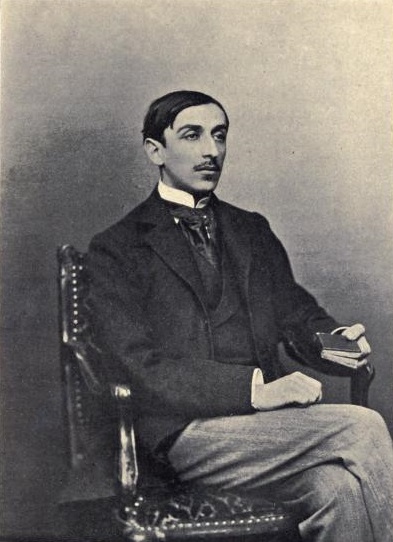
Maurice Barrès
From: French Portraits, 1900
(photographer unknown)
This essay by Maurice Barrès on Jean Moréas was first published in La Plume in January 1891, at a pivotal moment in the history of the French Symbolist movement. Moréas had already scandalised and electrified Parisian literary circles with his Symbolist Manifesto of 1886, staking his claim as the movement’s most theoretically ambitious voice. Barrès, himself at the height of his early celebrity following the Culte du Moi trilogy, brings to his subject both the insider’s familiarity and the born polemicist’s instinct for the decisive formulation. The result is a characteristically energetic piece of advocacy and critical appreciation, combining a defence of the movement against its detractors with a discriminating assessment of Moréas’s Le Pèlerin passionné and a meditation, unmistakably Barrèsian in its terms, on instinct, race, and the sources of artistic vitality. The present translation is the first into English.
JEAN MORÉAS: A SYMBOLIST
Jean Moréas is a Symbolist poet. To the reader who smiles at the word “Symbolist,” I would suggest that every age has had its “schools”, that it is the public which invents them far more than the writers themselves, and that “Symbolist” is no more inherently comic than “Romantic,” “Parnassian,” or “Naturalist” — indeed, it is rather more transparent in its meaning than any of these.
The Symbolists hold that all things are interfused within us. What I think, Jules Tellier once said of one of his friends among them, is coloured by what I do and see; what I do and see is transformed by what I think. If I wish to render my actual life, I must find symbols capacious enough to contain both my thought and my vision entire. For the philosopher of today there is neither matter nor spirit, only phenomena; for the artist of tomorrow there will be neither psychologies nor inventories of fact, only symbols.
I shall not pause to demonstrate that this formula expresses the animating tendency of all art, since I perceive that such an argument would carry us towards the conclusion that the history of Symbolism and the history of art are one and the same thing. This observation, whilst it strengthens the Symbolists’ position in the eyes of some — furnishing them with the most distinguished of ancestors — might, in the eyes of others, serve to diminish the originality of their aesthetic.
To be fair to both parties, one may conclude that they hold of their art precisely the idea which every great artist in every great age has held of it. That, at least, is one reason to allow them a measure of credit.
Much has been written about Symbolism — a great deal too much, and most of it wide of the mark. Our chroniclers never miss an occasion to lament that the “new generation” is ruining the French spirit, and over this catastrophe they put on a fine show of mourning, though to speak plainly, several of them are, by nature, impervious to any literary influence whatever.
Until now, it must be admitted, “Symbolism” has yielded slender fruit. It has permitted a handful of half-formed critics to strike superior attitudes by ridiculing the new manner, as though mockery of it were itself proof that they wrote like Voltaire. It has likewise served as a convenient cloak for a good number of writers as innocent of syntax as of metaphysics, who sought to excuse their gibberish wholesale by proclaiming that they were renewing French literature.
One might reasonably wish that a little light were let into this small but vexed literary question of the “Decadents” and the “Symbolists,” a question smothered at present beneath an accumulation of cheap jibes and outright barbarisms.
In vain have several of these gentlemen published books and reviews of genuine interest. A notable ideological poem by M. Mathias Morhardt, a systematic and richly elaborated programme by M. Charles Morice, verse by Messrs. de Régnier, Gustave Kahn, and Charles Vignier, along with several others whom I hesitate to assign to a school whose boundaries remain so fluid — none of these has found its way to the reading public. Of the Symbolists, the world knows little beyond their pretensions, and it smiles accordingly; but this is precisely what happened to Romanticism, to the Parnasse, and to Naturalism in their own early days. The one charge against the Symbolists that carries any real weight is that they have thus far been somewhat dilatory in the matter of producing a masterpiece. Though is it not, after all, the immemorial privilege of the young to put off that particular formality?
⁂
In my view, Le Pèlerin passionné, recently published by M. Jean Moréas — himself one of the school — is precisely the masterwork whose absence had placed in some difficulty those who, sympathising with the Symbolist world, found themselves at a loss when called upon to defend it before sceptical company.
Here at last is the book that every man of letters has been asking his bookseller for: one in which all the characteristics of the school, its faults and its qualities alike, are realised to their fullest pitch.
I should make clear in what sense I use the word “masterwork.” I do not mean one of those productions which the State patents and duly inscribes in the syllabuses of the Université, the Odéon, and the Comédie-Française, all three subsidised for the purpose. No. What we have here is a work brought to completion after long and patient effort, faithful to its maker’s conception, answering to the intellectual needs of a readership that grows larger by the day, and of a quality that may well serve as a model to his fellow craftsmen.
Le Pèlerin passionné — one of the most enchanting titles I have encountered in the interminable catalogue of literature — has been in our thoughts for a full year past. I have read it with the keenest sympathy, I cannot pretend otherwise, but also with no little caution, for the literature of prefaces and manifestos has furnished us with disappointments enough. I am satisfied, nonetheless, that this slender volume, even after the young poets have abandoned the man who is today their idol, will endure as a document in the libraries of serious readers. To kindle the passion of some thousands of one’s contemporaries, and to stand as a witness before some hundreds in posterity — that is the mark of an exemplary work. It is for this reason that I prize Le Pèlerin passionné.
Should any reader, opening this book, find nothing lucid in it, my estimate will not thereby be disproved; for Jean Moréas holds his authority over these young writers precisely because he gives expression — and expression of remarkable sharpness and definition, to my mind — to what is most distinctive and individual in their sensibility.
There are mathematicians in our day who have specialised to such a degree that their highest work can be followed by no more than six or seven minds in all Europe. Is not something of the kind, with all due allowance for the differences, the natural condition of those who carry the refinements of thought to their furthest extreme? They would remain in the most rarefied isolation, were it not for fashion, which steps in to take our charming salon précieuses by the hand and lead them to the poet’s door. Once they have crossed the threshold, the world makes up its mind — even our professors among them.
A charming recompense! Yet Moréas himself waits upon that day, now fast approaching, with perfect equanimity. Beyond the satisfaction of concentrating and disciplining his native genius, he is so entirely self-contained that no man alive can be more certain of his eternal salvation — if, as I believe, true virtue lies in the ardent cultivation of oneself.
⁂
Moréas first showed his mettle in Les Syrtes and Les Cantilènes, slender volumes of verse that were much debated in friendly chapels and rival ones alike. He himself glossed his work in something approaching a manifesto, whose very fervour of conviction perhaps told against its power to persuade.
The doctrine, none the less, was excellent. Moréas gave vigorous expression to his repugnance for Naturalism, then at the height of its vogue — a movement so utterly destitute of intellectual curiosity that one can only regard it as a degenerate Romanticism, which has retained from its ancestor nothing but the taste for local colour. He pressed further the truth that facts in themselves are nothing; it is the ideas they signify, the analogies they call forth, that are everything.
Reality — whether it be the things of the present day, the matter of history, or the stuff of mythology — yields no artistic interest. It is, indeed, a word without meaning.
Reality, one cannot say it too often, differs from one man to the next; it is the sum of our habitual ways of seeing, feeling, and reasoning. Everything that falls in the course of a life into our consciousness is grafted onto the self, becoming a living part of it. The rest is dust that glides across the surface of our soul without ever entering it; and it is doubtful whether that dust exists at all, for it has vanished before we have had time to distinguish it.
The universe is a fresco we ourselves compose, with a decorator’s genius more or less freely at our command.
When Moréas, for his Agnès or his Galatée, draws upon mythology or history for his personages, he is little concerned with what passes under the indifferent name of truth — the truth of historians or of realists — but occupies himself solely with that higher truth which is beauty. This is the aesthetic of Goethe when he writes: “My Philemon and my Baucis have no connection with the celebrated pair and the tradition attached to them. I have given these names to my two aged spouses solely to heighten their character; and as the personages and situations are of a like nature, the resemblance of the names produces a happy effect.“
To heighten the character of one’s thoughts, to make them yield their fullest effect — that is the whole of art. Before giving expression to anything, one must first transmute it into poetic substance; and it is precisely because he has never fallen short of this demand that the author of Le Pèlerin passionné is an artist.
I am aware that Jean Moréas will be taken to task over his vocabulary; but in all honesty, theoretically speaking, he has too much right on his side. His words and his cadences disconcert some readers? Very well — he may remind them that Fénelon held it as an article of faith that since the sixteenth century “our language has been impoverished, dried out, and cramped.” He may refer them to that chapter in which La Bruyère laments the loss of words “which might have endured together in equal beauty and rendered our language more abundant.” And he may point out, with perfect pertinence, that such adjectives as chaleureux, valeureux, haineux, jovial, courtois, and a good many others we now accept without a second thought, were once struck with a ban. For his part, Moréas has fashioned his poetic style from the Chansons de geste and the Fabliaux† — texts he commands with an intimacy no specialist could surpass — together with Rabelais and the writers of the Renaissance. And what strikes me as no less remarkable than the erudition of this composite style, genuine and richly flavoured as that erudition is, is its coherence, its organic unity.
⁂
The truth is that this poet-grammarian possesses a taste that never errs. And for my own part, even were I unmoved by the sheer force of will that animates this art, and even were I hostile to archaism on principle, I could not help but cherish Jean Moréas for the faculty — which he carries to a prodigious degree — of purging everything vulgar, leaden, or dissonant, and of disposing his metallic and luminous words, his terse and arresting images, with the unerring certainty of a primitive craftsman threading the stones of his ceremonial necklace.
I say “primitive” advisedly; for in the final act of creation, when the artist selects from his accumulated store of beauties in order to forge them into a living whole, he can only be guided by an illumination of instinct that no amount of mere reflection could supply. The gift by which Moréas conceives new rhythms and distributes across his subject those picturesque nuances that would have escaped the rest of us is entirely independent of the aesthetic theories with which he chooses to arm it. Our friend, whom his art has made wholly French, was born in Athens, of that mixed, sensual, elegant, and vigorous race that is modern Greece. I am inclined to believe that it is from this source that he draws that singular taste — always consistent with itself, always unmistakably his own — by which he arrests our spirit, so much given to abstraction as it is, and compels it to admiration. And yet if his grandfather was indeed one of those rough and picturesque corsairs of the Wars of Independence, is it not natural that the grandson’s genius should retain some vital inheritance from the fact? The stamp of those heroic things, and of the open-aired life of adventurers, does not perish so quickly.
I have seen in Paris young women with the beautiful eyes of sailors who have spent long years gazing upon the sea. They lived in Montmartre, simply enough, but that gaze — inherited from a long line of ancestors tossed upon the waves — struck me as something remarkable in the midst of a city. So it is that what one will savour most deeply in the character of Jean Moréas, and in his Pèlerin passionné, is precisely that portion of instinct which his forebears have wrought in him.
In our literature of weary elegists and enervated logicians — and I speak of the best among them — he brings to view that same sensuality and simplicity of concern which mark the great poets of the Renaissance. An ironic circumstance, yet a perfectly rational one on reflection: it is this very primitive constitution that has earned him his place as the most authoritative poet of the Decadents.
And I take my leave of this “new school” with an observation that is in truth too self-evident to require stating: there has never been, and never could be, a literature of decadence. The epithet forced upon these writers was an unreasonable one; for the quality of poet necessarily implies a spontaneity and freshness of impression that are, on the contrary, the birthright of unspoilt races — as the example of Jean Moréas makes abundantly plain.
MAURICE BARRÈS.
† Chansons de geste: medieval French epic poems, composed roughly between the eleventh and fifteenth centuries, celebrating the deeds of legendary heroes such as Roland and the knights of Charlemagne’s court. The most celebrated example is the Chanson de Roland.
Fabliaux: short comic tales in verse, flourishing chiefly in the twelfth and thirteenth centuries, typically earthy and satirical in character, dealing with the everyday lives of merchants, clergymen, and peasants. Rabelais drew heavily on this tradition. Both genres were central to the medievalising and archaising tendencies of certain Symbolist writers, who looked to pre-classical French as a source of freshness and linguistic vigour untainted by the codifying reforms of the seventeenth century.

This is one of 50+ rare French literary texts translated into English for the first time on this site.
 Léon Hennique Novel