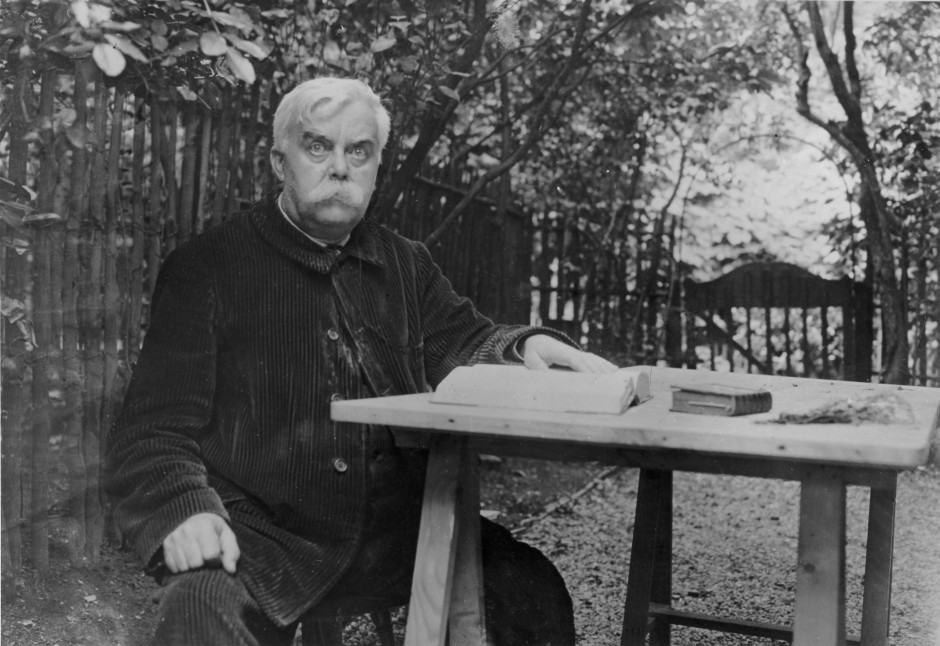
Léon Bloy, photograph by Dornac
(Nos contemporains chez eux)
The two texts presented here — a lecture and a letter — were first published in La Plume (Paris) in 1891 and appear here for the first time in English translation. The lecture, Les Funérailles du Naturalisme (“The Funeral Rites of Naturalism”), was delivered by Léon Bloy in Copenhagen on 31 March 1891 and represents one of the most ferocious and sustained attacks on Émile Zola and the Naturalist school ever committed to print. Written at the precise moment when Naturalism’s dominance over French letters was beginning to crack, it is at once a polemical broadside, a critical manifesto, and a work of literature in its own right — combining theological fury with aesthetic passion in a manner wholly characteristic of its author. The letter that follows was written from Copenhagen on 7 May 1891, in reply to an attack by the self-styled Sar Joséphin Péladan published in La France. It is Bloy unguarded and at full stretch — part literary reminiscence, part savage comedy, part barely veiled threat — and offers an incomparable glimpse into the personal warfare that ran beneath the surface of Parisian literary life in the final decade of the nineteenth century. Together, the two texts display the full range of one of the most distinctive and dangerous prose voices of the age.
THE FUNERAL RITES OF NATURALISM
FIRST LECTURE DELIVERED AT COPENHAGEN, 31 MARCH 1891
In our opening conversation, I declared my intention of recounting to you the agony and obsequies of Naturalism in France.
I spoke of the mortal decline of that formidable power which, for twenty or thirty years, has driven across all Europe so furious a current of literary democracy.
I told you that in France, in Paris itself, men were growing infinitely weary of this abject tyranny, and that at the present moment a vigorous counter-movement of spiritualism was reacting victoriously against the celebrated school of M. Zola.
This blessed reaction is the work of a small number of writers who have already mastered opinion, and whom the very nearest future will assuredly see triumphant.
These writers, gathered and grouped in common effort by the sole compulsion of an identical vocation, have come from widely distant points and have emerged, I assure you, from very different caverns.
Catholics or atheists, sceptics or Platonists, their tacit alliance was born solely of their horror of that dishonourable servitude with which the Naturalist invasion threatened the whole of French thought.
Three of their number — Barbey d’Aurevilly, Ernest Hello, Villiers de l’Isle-Adam — have died in the full blaze of their glory, leaving behind them works which I hold to be enduring, and through which their influence will long continue to be felt.
The rest, impassive, have simply closed ranks; the war has grown only more ardent, more implacable; and we are now at its final phase, for Naturalism has begun to sue for mercy in the person of its sovereign pontiff, M. Zola himself, who for three years past has been imploring the mortuary suffrages of the Académie.
I promised to narrate, as an eyewitness, this war of the Spirit against the Beast — a conflict whose reverberations have been felt throughout intellectual Europe, and which inflamed French minds with so just a passion, touching as it did the living soul of the nation.
I must therefore make known to you, by their names and by their works, those who fought from the first day and who are fighting still for the aesthetic independence of our literature.
The honour of France demands that I reveal to you these things of which the odious venality of certain newspapers, and the despotic monopoly of certain Parisian publishing houses, have conspired to keep you in ignorance.
The lamentable truth is this: that what is sent to you is filth, and what is recommended to you is filth. This is no accident; it is a settled policy.
I do not flatter myself that my isolated protests will have much power to alter that state of affairs. No matter; I shall have spoken the truth, and perhaps my words will not be entirely without effect.
But before I proceed to enumerate the adversaries of Naturalism, it seems to me indispensable to cast some light upon the part it has truly played and to define its tendency with precision.
To this end it will suffice to examine exclusively, in the body of his work, the supreme chief of this singular school — a school which appeared to have received some terrible ordination to transform the whole of French literature into a swamp.
∴
I remarked the other day that M. Zola must, in all justice, be regarded as a writer of very great power. I compared him once to Antaeus — to that famous Antaeus, son of the Earth, whom Hercules alone knew how to strangle. The comparison, I venture to think, was not especially insulting.
(Here follows an enormous eulogy of Zola considered as a “great one of the flesh,” as a colossal evangelist of materialism, despite “the bourgeois flatness of his academic ambitions and the sordid cupidity of his commercial appetites,” despite even his “expressions of a galley-slave, his vocabulary of the sewer-man and the gravedigger” — a eulogy carried to the pitch of the most impassioned lyricism, the better to disconcert those Danish Naturalists who had announced that this lecture would prove nothing but a broadside of ignoble abuse.)
… Zola is an iconographer of decadence. To demand of him a winged metaphysics, a contemplative transcendence, an embarkation of the spirit towards the azure gulfs of heaven, would be to comprehend nothing of his astonishing function as historian. He did, it is true, lately forget himself — in Le Rêve — so far as to suppose himself capable of that manner of navigation; and it was only his invincible carapace that saved him from dissolving in the limpid ether.
He cleaves to the earth like some immensely powerful pachyderm, deep-rooted, massive, perfectly balanced in his formidable solidity; and for all its imprecision, the word Naturalism conveys, in its anarchic ambiguity, something of the crushing aspect of this enemy of the constellations.
… He was manifestly appointed to accomplish a labour whose full significance is hidden from him… He is the implacable historian of the collapse of a world.
Since experiments renewed to satiety since Balzac had demonstrated the inadequacy of analysis applied to the manners of the upper classes, since it was plain that no ground was being gained and there was every reason to fear that literature would not be equal to the inventory of a dying century, M. Zola, overturning everything, took society by the heels and paraded it, head downwards, skirts flung up, through ten novels, for the universal exhibition of its infamy.
… This magnifier of ignoble realities is the unwitting instrument of an infallible injustice. More than any other man, he has laid bare the modern Secret — that compound of stupidity, ferocity and cowardice, amalgamated according to formulas dictated by the squalling pride of the century to come — and it is upon this that his place rests in the terrible reckoning that draws near.
When the bronze doors, padded with wrought iron, of inevitable death close upon him, this man who has never known God will go, perhaps, groping his way along the corridors of eternity; but he will leave behind him the vastest pall of sorrowful light in which fallen humanity can ever behold its own ignominy.
∴
No one will accuse me, I trust, of having stinted on the panegyric. It would indeed be difficult to go further in the defence of a man one has resolved to howl off the stage, and I do not see what more could reasonably be demanded of a mortal antagonism.
I have fairly earned, I think, the right to speak my full mind and to raise, where necessary, the red pennon of the iconoclasts.
I am entitled to believe, therefore, that I shall henceforth be permitted to advance the essential reasons — reasons of the most absolute order — which make it a vital imperative for Christian societies to have done, once and for all, with this school of despair, of nullity and of gutterdom.
I ask, then, invoking the claims of strict justice, that I be heard with attention.
(The speaker first sets aside the accusation of indecency, of which hypocrites and imbeciles have made such abundant use, and proceeds to the great charge, the sweeping and total condemnation in which he holds that the chief of Naturalism must be wrapped from head to foot.)
I have spoken of Zola’s immense rôle. I have endeavoured to show him in his glory as the chosen idol of popularity, enthroned upon his muddy throne as the potentate of democratic intelligences.
It remains to show you the frightful tendencies of that gospel of damnation of which he was the apostle, and of which he would give a great deal today not to be the martyr.
The capital charge against Naturalism has just been laid by a writer of my own generation, in a novel of the most audacious kind, which is at this moment setting the literary world alight.
That writer’s name is Huysmans. Some of you will know him, no doubt. His reputation, very considerable in France, has for some years now crossed the frontier. He is the only one among those of whom I must speak who can claim any semblance of a foreign celebrity, and his testimony here is of the utmost importance — for he entered letters with the greatest brilliance, in the very front rank of the Naturalist army.
The few lines that follow are drawn from the new work: Là-Bas, at present appearing in serial form in L’Écho de Paris.
“What I reproach in Naturalism is not the heavy daubing of its gross style — it is the filth of its ideas; it is having incarnated materialism in literature, having glorified the democracy of art…” etc. (See the volume, first chapter.)
This passage will give you a sufficiently accurate sense of the astonishing disrepute into which Naturalism has fallen.
I say it again: it is one of its own sons who has just spoken in these terms — one of its elder disciples, a follower from the first hour and the most eloquent of them all.
But precisely because his faculties as an artist carried him further than the narrow party line would permit, he broke with it one day, the moment he had caught a glimpse of the cesspool of stupidity and ignominy into which they were all rushing headlong.
(Léon Bloy at this point knew only the first two instalments published in the Écho de Paris. He did not yet know that Huysmans had chosen another cesspool altogether. He will presently give us his own account of his complete disenchantment.)
∴
What, then, does this much-bruited word Naturalism actually signify — this word that serves as a rallying cry for multitudes of indigent brains? All attempts to define it have proved unavailing.
And yet M. Zola, that intransigent enemy of mystery, has constantly maintained that this single vocable ought to illuminate everything.
In famous manifestos, time and again, he declared that by it one must understand simply the experimental method resolutely applied to literary observation — that is to say, the testimony of the senses and nothing more, the sole and exclusive testimony of the senses, to the formal exclusion of imagination, of invention, of intuition, and of all those faculties of the soul which had until then been held indispensable to the flowering of a great book.
The brutal and wholly external observation of the phenomena of physical life, in contempt alike of all synthesis and of all analytical discernment, was solemnly promulgated as sufficient for the procreation of the greatest masterpieces.
It might perhaps have been thought necessary to demonstrate, first, that nature itself is not a profound mystery, and that our gross carnal eyes are instruments equal to penetrating it. And even granted that, it would have been highly instructive to learn what benefit could conceivably be drawn from this pretended system of observation in the consequent bringing-forth of any work of art whatsoever.
But the reformer of our aesthetic disdained to trouble himself with explanations. He was no pedagogue. He was a supreme and infallible Lama, and he spoke accordingly.
“Open the eyes of your head, and then recount exactly, servilely, what those eyes shall have seen, without permitting your soul to intervene; and in this fashion you will always be sublime enough.” Such was the dogmatic commandment of this astonishing legislator.
∴
It was throwing open the gates to the multitude. It was an invitation to the love-feast of egalitarian literature — extended to every mediocrity, every impotence, every aborted ambition that had ever hunched over a writing-desk.
Since talent and even genius no longer descended from heaven, as of old, upon privileged heads, and since these things could henceforth be acquired by the simple effort of gazing instinctively about oneself, everyone was straightway entitled to call himself a writer.
The trade had become so wonderfully easy. One need no longer possess a religious or philosophical criterion, nor even an occasional idea, not so much as a shadow of an idea.
It sufficed to transcribe, with the fidelity of a photographic apparatus, the external images localised and delimited by the cerebral lens of the operator.
Literature became thus a vast bazaar of descriptive and episodic clichés, a colossal emporium of heliographic processes, where the day-labourers of literary decadence provisioned themselves at bargain prices.
Since the old human soul had been definitively dismissed, and since one believed with desperate fervour, in the words of the master, that “thought is the product of the entire body” (L’Œuvre, p. 299), it is plain that nothing remained but to fling oneself, like the possessed, upon carnal visions and ambient sensations.
∴
Imagination having lost all credit with this literary rabble, which would accept nothing further from it, it was replaced by the document. One spoke of nothing but the document.
Human document, bestial document, astronomical document, workers’ document, bourgeois document, aristocratic document — everything that could be seen or heard became material for a document.
One observed, for example, that employees of funeral establishments never venture out without their umbrellas, that pork-butchers ordinarily lack two incisors on the left side, or that omnibus drivers hail almost exclusively from the Midi. These momentous observations were forthwith elevated to the dignity of documents and swelled the private treasury of each investigator.
In the end there were bankers of documents, and a documentary Bourse, which went by the name of the librairie Charpentier.
France and Europe were inundated, saturated, with endless descriptions of wash-houses, workshops, taverns, public dance-halls, prisons and hospitals.
Under the pretext of democracy, nothing was spared — not a nail, not a cast shadow, not a stain, not a dirty petticoat, not an excrement. No ugliness, no carrion, no stench was omitted from these inventories.
The incidents and vicissitudes of the moral life, on the other hand, never appeared — or almost never.
In the novels of M. Zola himself, the human — or so-called human — characters are invariably identical and indistinguishable, like so many puppets. They traverse the drama automatically, without personal life, like marionettes dressed up according to the requirements of the fiction.
It is always, at bottom, the same irresponsible spectre, steeped in unconsciousness, drifting at the whim of the narrator’s fancy, the passive slave of hereditary impulses, never once resisting its bestial appetites.
But the denied human soul takes its revenge, bearing life away with it — the high, luminous life of contemplations and ecstasies — leaving to its negators nothing but the abominable pullulation of the darkness!
∴
It was high time, therefore, that all this came to an end, for this fanaticism of baseness and blockheadedness was becoming a veritable social danger. Human reason itself was in peril, and it is for this reason that the most uncompromising resistance was wholly justified.
Materialism, so plainly visible beneath the imprecise label of Naturalism and, what is more, so frankly avowed by the chief of the school, has as its immediate and invariable effect the paralysing of reason, the distortion of concepts, the abolition of the aesthetic faculties, and finally the degradation of whatever peoples are too craven to resist it.
M. Zola, prodigiously gifted by some miracle of nature, managed until quite recently to hold himself well above his own inept doctrines. Even in his latest book, saturated as it is with the eternal procedures by which he so long brutalised us, one can still detach pages of a sculptural enormity that must give the illusion of grandeur.
He is, before all else, a prodigious decorator — one of the most powerful that has ever existed — and this is the precise and sufficient explanation of his prestige. One must not ask more of him than that.
But this is a matter of his nature, of his exceptional gifts, and he owes absolutely nothing to his street-corner poetics, which could only have sterilised him.
His punishment is to have deserved the title of the novelist of democracy — the most insulting designation that exists for an artist; and his complete dishonour is the infinitely ridiculous school he has founded.
His innumerable disciples, recruited from every quarter, naturally supposed that the master’s theories and procedures ought to suffice; and, incapable of rising to his stature, they have driven his frightful defects to their utmost extreme.
If, even when he was still in the ascendant, their fall had already begun, what will become of them now that he himself is falling — and in what abysses shall we henceforth go looking for them?
What stands perfectly clear today is the necessity of purging literature, and of climbing back, by the luminous ladder of spiritualism, to the unsullied aesthetic of the immortal writers — and this as swiftly as possible. I have told you already: it is precisely this movement that is now under way in France.
Everything that needs to be said about M. Zola has, for some time now, been said. When this Napoleon of the mire carried off his great Austerlitz — the colossal success of L’Assommoir in 1876 — there stood before him a man who embodied, to the highest degree, the literary tradition of the old France.
Jules Barbey d’Aurevilly, one of the noblest artists the nineteenth century has produced, did not shrink from defying this triumphant figure, flinging in his face the cool and devastating critical verdict of which I give you here some extracts. You will find that this judge was even less indulgent than I.
“One emerges from reading L’Assommoir as pigs emerge from the wallow. A wallow indeed — a wallow of things, a wallow of words, an unbreathable wallow!…
“This time, M. Zola has chosen to work exclusively in the disgusting. He has taught us that one may now cut freely into the raw material of human filth, and that a book composed of nothing else may lay claim to beauty!…
“The author of L’Assommoir is a befouled Hercules who stirs the Augean dung-heap and adds to it! If you doubt me, read his book. Plunge into this gulf of excrement, and if you can remain there without suffocating or vomiting, you will discover that the filth aspires to be art — and the very greatest art at that.
“M. Emile Zola believes one may be as great an artist in filth as in marble. Filth is his métier. He believes there may perfectly well be a Michelangelo of the dunghill!…
“His artist’s tongue he has degraded and lost in the most ignominious argots of the tavern. He has seized upon the language of the people. Depraved by his subject, he speaks throughout his novel exactly as the characters who inhabit it speak. He employs a style from which it is impossible to retrieve a single sentence — and this though one had a rag-picker’s hook to lift it and a hod to carry it away. He has no personality left.
“He has forgotten Balzac — he who imitated him too slavishly. The great man of the Comédie Humaine created, and often gave voice to, Auvergnats, Germans, and porters — without thereby becoming Auvergnat, German, or porter. The dialogue done, the novelist resumed his narrative, pouring into it his own style and thought; but M. Zola has neither style nor thought to pour. He has nothing left in his belly but the very consciousness of his characters — their ignoble passions, their horrible modes of feeling and expression. He has at last melted and dissolved into their mud, through too long and too fierce an application to painting it. He has become mud, as they are mud… The merited punishment of a talent that has debased itself!”
∴
I would ask you to note that this was written at the beginning of 1877 — that is to say, at the very height of Naturalism’s triumph.
The school was in its full brilliance, and it was necessary, at the risk of somewhat exceeding due measure, to deploy an exceptional force of reprobation in order to stem the torrent.
I have cited only a few passages of this indictment, and for one reason alone: it made, at the time, a very considerable noise. It is a document — just such a document as Naturalism must adore… a document, and nothing more.
Several of my earlier assertions ought to place me beyond any suspicion of endorsing its full severity. I have shouted myself hoarse in telling you that it was impossible for me not to render homage to the intellectual power of M. Zola.
I did not shrink from admitting, even, that if this illustrious personage is, unhappily, rather often — how shall I put it? — a little… swinish, I am not profoundly scandalised by it.
Nevertheless, I thought it worth establishing, with proper authority, the proof of the insurmountable horror which the contagious materialism of such a novelist had already inspired in France fifteen years ago.
Need I add that the very glorious writer who had given such expression to the indignation of a great number of excellent minds received his reward most punctually? The chivalric generosity and perfect loyalty of the Naturalists is sufficiently well established.
M. Emile Zola himself replied to Barbey d’Aurevilly with a series of articles bearing no relation whatsoever to literary discussion, in which he applied himself to the investigation of his adversary’s private life, reproaching him with his poverty as though it were a disgrace, and accusing him — by natural consequence — of being an atrocious scoundrel, a grotesque blackguard, given over to the most unclean of passions, and in sum an intellectual goitre upon the body of literature.
∴
A few moments ago, speaking of this same Zola, I ventured to invoke the name of Napoleon. It was no doubt excessive. I would hope, nevertheless, that this invocation of the magnificent Name will be readily forgiven in a French citizen.
What would you have? We possess nothing greater than that Name. Whatever our sentiments or our prejudices, we cannot forget that our first Caesar held the globe in his hand, that the tread of his soldiers shook the earth, and that the monarchs of the old world listened for his coming, trembling at the gates of their capitals.
This prodigious Name has so entirely become for us the very sign and synonym of greatness that our lips utter it involuntarily whenever life sets before us some unheard-of triumph, some enormous success, any event whatever that carries with it the idea of victory — though that victory be execrable, perverted, accursed and mired in filth, like the poet of damnation!
And it was thus, I confess, that the analogy forced upon me, just now, this formidable comparison.
∴
But why should I not say it plainly? We are waiting for him still, the great Emperor! We have not truly lived since that man who gave us so much glory departed for his exile of eternity.
For after all, God himself, who has prescribed his laws to our thought, cannot surely require of us that we accept the idea of death when it is a question of this imperishable mortal!
It is therefore certain that he must return one day — as his own legionaries used to say, dying themselves of decrepitude. He will have to return, though it be from the deepest recess of that dark pit where the Almighty lays to rest the Potentates he has reprobated!
This, I say, is an absolute necessity — precisely because the Lord God does nothing in vain, because the works he undertakes must be accomplished, and because the apparition of the most colossal of all great men admits of no explanation, unless this Titan was the most vivid prefiguration of an identical sovereign whom France awaits.
Ah, I know well enough that this hope is vague, and that no one comes forward to give it form! Yet it lives at the very heart of our sorrowful hearts, and it is for this reason that the crowd flings itself upon every adventurer of pen or sword, not knowing in what guise the Awaited One will at last make himself known.
“Who is this newcomer who advances like a conqueror? Is it you? they cry; is it you at last? What if it were He?” And there is a people in delirium!…
∴
It is thus that men threw themselves upon M. Zola, upon General Boulanger, and will throw themselves, tomorrow morning or tomorrow evening, upon whatever ignominious or ridiculous puppet events may cast to the surface. It is not for nothing, believe me, that France has preserved, through everything, her intellectual preponderance. She makes dreadful use of it at times, and the Naturalist school is proof enough of that. But she retains always the vital spring of her invincible spirit; and who knows whether we shall not shortly have a literary Napoleon — luminous this one, radiant and pure as the furnaces of Heaven — who will need only to appear in order to dispel, in an instant, whatever still remains of the woodlice, the reptiles, and the tenebrous swine of Naturalism?
Léon BLOY.
Editorial note:
As we go to press, we receive, in reply to the attacks published against Léon Bloy by J. Péladan in La France, the letter printed below. Our eminent collaborator and friend Léon Bloy being absent from Paris, we had considered it our duty to defend him in these pages (see the Échos column) against his enemies. He now reclaims his rights, and we withdraw from the contest: the master being well able to defend himself unaided. And since we have no further part to play in the quarrel, we beg one of the parties to regard our intervention as if it had never occurred — it being too late to suppress our note — impartiality being the established tradition of La Plume, each contributor remaining solely responsible for his own writings, which in no way commit the Review.
L. D.
To Monsieur Léon Deschamps, Director of La Plume.
Copenhagen, 7 May 1891.
My dear friend,
I must thank you for sending me the number of La France containing the side-splitting letter of the Sar Péladan1. I already knew from other papers that there had been something farcical afoot, but I had no idea that my name had been dragged into this tittle-tattle.
Reading Péladan is always an occasion for merriment. I do not believe there has ever existed a literary grotesque of such perfection and such amplitude. The laughter he provokes is consoling and pacifying.
How, then, could I possibly take offence at the insults with which he honours me for the first time — knowing me to be very far from Paris and consequently quite incapable, even were I willing, of adding a few specimens to the dazzling collection of slaps in the face he accumulated during his radiant youth?
Shall I confess my weakness? I am rather proud to have incurred the contempt of this pavement Assyrian. Pray reassure all my grief-stricken friends on this point.
The quarrel between Salis2 and Péladan, needless to say, leaves me entirely cold. I consider the two dunderheads to be of exactly equal merit, and this little game of mutual advertisement would be merely tedious without the powerful comic emanation that the personality of the pifferaro3 never fails to produce.
The two finest blunders of my life are, first, having helped the first of these worthies to his insolent celebrity, and second, having invented the other — by persuading him that he was Assyrian, and that his name Péladan, which calls to mind nothing so much as the moth-eaten scruff of very old dogs, was a Western corruption of the name of Baladan Merodach, son of Baladan, King of Babylon, mentioned by Isaiah in chapter 39, from whom he was presumably descended. I have already confessed this deplorable hoax in an old piece in Gil Blas.
At that distant time, Péladan, not yet elevated to the dignity of Sar, was an obscure little Nîmois4 without glory or boots, whom I was good enough to take under my protection. He came regularly to my house to inquire about French syntax and to peck at such Latin quotations as I dispensed to him without the least hope of their taking root.
The poor fellow’s brain was so abnormally situated that notions could only have been introduced into it from below, like an enema. This pedagogical pantomime filled me with alarm, and I sent the insect packing, whereupon it went off elsewhere to complete its education.
Alas, however, I had had the imprudence to present him to Barbey d’Aurevilly as a curiosity of the Midi — and this proved a third blunder, and a more bitter one.
The great writer amused himself with the creature for a time. He even carried his good nature so far as to bestow upon this buffoon a demented preface for his first book, Le Vice Suprême — a work puttied together from the scrapings and rinsings of everybody else.
An extraordinary largesse, of which the rogue promptly availed himself to fasten like a sarcopte upon the epidermis of his benefactor — upon the “Connétable5,” as he never ceases to call him, with a ridiculousness that is all his own — parroting with the obstinacy of the congenital idiot a stray expression to be found on page 59 of my Propos d’un Entrepreneur de Démolitions, a book that antedates the earliest lucubrations of the Sar by a considerable margin.
“What would you have? He is a bluestocking who wants me to make his fortune,” remarked, with resigned gaiety, the glorious poet of L’Ensorcelée.
He does wish to insult me, all the same! He cannot digest the reception I gave him two years ago at the door of Barbey d’Aurevilly, who lay stretched upon his deathbed.
When this jackal in a violet waistcoat presented himself, I gave him to understand without delay that there was no call for a horse-coper or a mountebank, that none had been requested, and that he would do well to take himself off in-stan-tan-eous-ly. It appears that this protocol exercised a powerful charm, for it produced the most magical of all disappearances.
I have not set eyes on him since, but I think of him more often than I could wish, whenever I recall the unhappy and admirable artist whom I watched die — murdered — and whose slow agony I shall one day recount.
When that day comes there will be some surprises, I warrant you; and it is for this reason that the temerity of Péladan, who attacks me in the full knowledge that I can say everything and prove everything, and plaster him with infamy up to and above his fins, strikes me as somewhat remarkable.
The apparent long-suffering of my silence ought in any case to make him uneasy — even granting that he is foolish enough to suppose I have finished settling accounts with the old titled trollop who was his accomplice.
He no doubt also forgets Chatillon, the passage des Beaux-Arts, the letters of Mme H. M. which he so obligingly conveyed to M. J.-K. H., the price paid for the etchings of Rops, and the dexterity with which I am able to stir up such filth when it seems expedient to do so.
And finally, above all, he very probably does not know that I have long since discovered the great magical Arcanum in Petronius and in the ninth satire of Juvenal, and that I am well aware how rudimentary a matter it is to penetrate the most hermetic of the Rosicrucians!…6
With that, my dear Deschamps, I shake you most affectionately by the hand.
LÉON BLOY.
Notes:
1 Joséphin Péladan (1858–1918), famously known as Sâr Péladan, was a flamboyant French novelist, art critic, and occultist who became a central figure in the Symbolist movement. He is best known for founding the Salon de la Rose + Croix, a series of mystical art exhibitions in Paris during the 1890s that rejected realism in favour of spiritual and “ideal” art.
2 Rodolphe Salis (1851–1897) was a prominent 19th-century French impresario, writer, and cabaret owner who founded the famous Le Chat Noir in Montmartre, Paris, in 1881.
3 A pifferaro (plural: pifferari) is an Italian itinerant musician or shepherd who plays the piffero, a traditional rustic Italian woodwind instrument similar to a small oboe or shawm. The term is often associated with shepherds from the mountains who traveled to cities like Rome during Christmas to play traditional melodies.
4 a native of Nîmes — the city in the south of France, in the Languedoc region. But the word is doing more work than mere geography. Péladan was indeed born in Nîmes, and by calling him “a little Nîmois” Bloy is invoking the whole complex of attitudes that a Parisian literary man of the period would attach to the provincial southerner: the garrulous, boastful, fantastical creature of the Midi, all gesture and self-invention, more heat than substance. It is a dismissal dressed as a description — the implication being that Péladan’s entire elaborate self-mythology, his Assyrian kingship, his Rosicrucian grandeur, his occult magnificence, is precisely what you would expect from a little nobody who came up from the south with nothing but an overheated imagination and an empty pair of boots. The contrast Bloy draws is quietly devastating: here is this grand Sar, this self-proclaimed magus and heir to the kings of Babylon — and what was he really? A small, bootless, penniless young man from Nîmes who used to come round to Bloy’s house to be taught French grammar and cadge Latin quotations.
5 “Connétable” is the ancient French title of the Constable of France — the highest military office of the kingdom, the supreme commander, effectively the king’s right hand in matters of war. It is a title of the most exalted feudal grandeur.
6 Petronius’s Satyricon and Juvenal’s ninth satire share one very specific subject matter: both deal explicitly and graphically with male homosexuality and sexual degradation. The ninth satire of Juvenal is entirely devoted to a dialogue with a male prostitute. The Satyricon is, among other things, a panorama of sexual licence of every variety. These were among the most notorious texts of classical antiquity on this score, and any educated man of the 1890s would have known precisely what Bloy was pointing to. So when Bloy says he has “discovered the great magical Arcanum” in these two texts and knows “how rudimentary it is to penetrate the most hermetic of the Rosicrucians” — the wordplay on “penetrate” is entirely deliberate and the meaning is unmistakable. He is telling Péladan, in the most elaborately coded yet perfectly transparent language, that he possesses evidence of his sexual conduct, and specifically of a homosexual nature. The Rosicrucian reference adds a further layer: Péladan was famously the self-appointed head of the Ordre de la Rose-Croix Catholique, draping himself in occult mysticism and ceremonial grandeur. Bloy is saying: your great hermetic mysteries, your impenetrable arcana — I have found the key to all of it in the most scandalous texts of antiquity, and what I found there is rather simpler and rather filthier than your posturing suggests. It is a threat of the most lethal precision, delivered with a smile.

This is one of 50+ rare French literary texts translated into English for the first time on this site.

→ Browse the complete archive
 Léon Hennique Novel