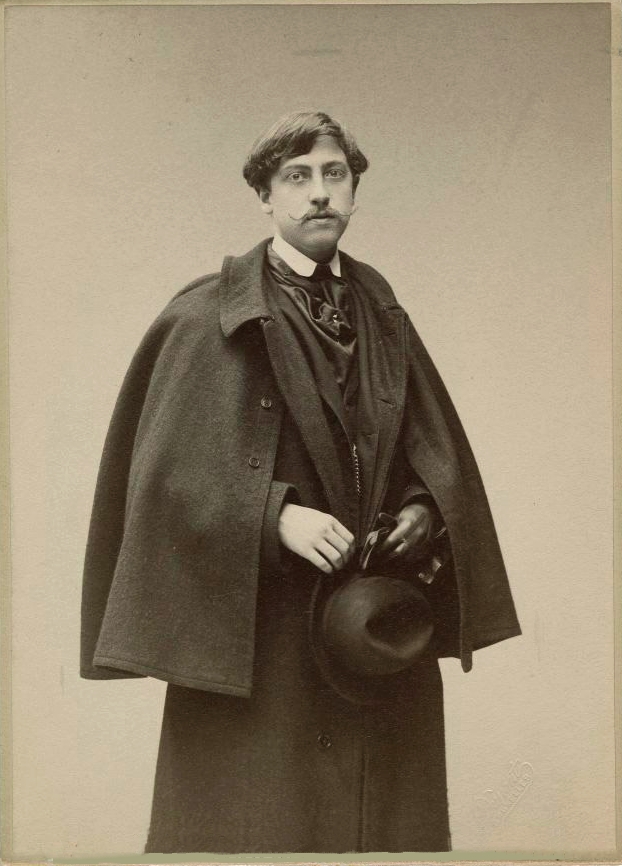
Camille Mauclair, photograph attr. to Dupont (1896)
Collection: Fondation Catherine Gide
This essay by Camille Mauclair — one of the most gifted and combative critical voices of the French Symbolist generation — was first published in La Revue Indépendante in July 1891, at a precise and electrifying moment in French literary history. Moréas had just published Le Pèlerin passionné and proclaimed himself, amid considerable fanfare, the leader of a new poetic school. Mauclair, then barely twenty years old, was having none of it. With a rigour, an honesty, and an occasional ferocity remarkable in so young a writer, he set about dismantling Moréas’s claims one by one — examining his theories of language, his rhythmic innovations, his use of assonance, and finally, most devastatingly, the ideas, or rather the absence of them, at the heart of his work. The result is not merely a review but a critical document of the first order: a portrait of a movement at the height of its self-confidence, seen from the inside by someone who understood it intimately and refused to be dazzled. Time has largely vindicated Mauclair’s judgements. Moréas faded; the École Romane he founded that same year is today a footnote; Mallarmé, Verlaine, and Baudelaire — the figures Mauclair points to as the true touchstones — remain. This is the first English translation of the essay, presented here in full.

THE MODERN ATHENIANS1
JEAN MORÉAS
I do not say to these men of the Renaissance:
Return to antiquity or to the sixteenth century!
I cry out to them: Set sail for the Future!
SAINT-POL-ROUX.
M. Jean Moréas had been resident in Paris for some eight years, pursuing his literary vocation in relative obscurity, known only to a narrow circle of artists and connoisseurs, when the publication of his latest volume, Le Pèlerin passionné, together with notices from fashionable critics, a succession of interviews, and the various claims advanced on his behalf, conspired to bring him, in January of 1891, to something very near celebrity. The reforming theories which Moréas set forth in his work — touching aesthetics, the craft of verse, and the very foundations of our language — bore so directly upon the concerns of art that his sudden elevation into public prominence was not without justification.
Yet it appears to me, rightly or wrongly, that in this advent of M. Moréas to popular favour, enthusiasm outran genuine discernment, and that the praise lavished upon him addressed too little what is, after all, the true substance and essential interest of his work: his theories. A reaction duly followed, marked in some quarters by conspicuous injustice, in others by motives entirely legitimate. I have thought it worthwhile, therefore, to examine his ideas more thoroughly and at greater depth than a journalist writing against the clock is able to do — the newspaper reporter being, by the very nature of his calling, more a man of the moment than a man of taste — in order to establish precisely what those ideas are, what measure of originality may justly be claimed for them, and what future they may reasonably expect within our literature. What follows is what I have found, and what I believe, in all honesty, I may say.
I
A careful reading of M. Moréas’s poems — Le Pèlerin passionné above all, together with its preface — will reveal to the attentive aesthete, once he has accustomed himself to the author’s characteristic manner and native Hellenism, a reforming impulse that operates on three distinct fronts, and may be stated fairly precisely in three propositions: the rejuvenation of the language, the renewal of rhythmic forms, and the liberation of verse from the prosodic constraints of rhyme in favour of a freer use of assonance. No artist of any serious standing will fail to grasp the exceptional importance of the first of these propositions, and it is with that one, accordingly, that I shall begin — as at once the most consequential and the most fundamental in its influence upon all that follows.
From the preface to Le Pèlerin passionné, and from the various articles gathered in the manifesto issue of La Plume for the 22nd of January 1891, there emerges an unmistakable claim: that the seventeenth, eighteenth and nineteenth centuries have each in turn proved faithless to the true genius of the French language. I say unmistakable, even though the precise terms of the indictment vary between the principals — M. Moréas himself declaring that “since the close of the sixteenth century, our language has been impoverished,” whilst his most ardent disciple, M. Maurice du Plessys, writes in a special appendix2 of “the Greco-Latin spirit, deflowered by the religious and philosophical reform of the Teutonic sixteenth century, enervated by three hundred years of uncertain slumber.” I shall not press this divergence, and am quite content to take M. Moréas’s date as my point of departure — firstly, because he is the originator of the theory, and secondly, because it affords me the satisfaction of sparing Montaigne, Mathurin Régnier, and certain others whom I hold dear from the charge of being “Teutonic,” a charge which I confess leaves me somewhat at a loss.
It is established, then, that the last two centuries have been, no less than the present one, unequal in their language to the French genius. Upon this foundation the theory erects its demand “for a return to the authentic Greco-Latin spirit, which must reassert itself in what M. du Plessys calls its Gallo-Latin form.” I shall pass over, without dwelling on it unduly, the somewhat casual synonymy which M. du Plessys establishes between the Greco-Latin spirit and the Gallo-Latin language — two terms which ordinarily carry quite distinct meanings, and designate two separate tendencies long known respectively as the Alexandrine and the Romane. Every manifesto, after all, leaves something out, and it would be ungenerous not to lay the unfortunate vagueness of certain affirmations at the door of polemical enthusiasm, so long as the animating idea emerges with sufficient clarity.
One is bound to ask whether M. Moréas has not advanced a postulate in the guise of a principle — and I am very much afraid that this is precisely what he has done. I confess to having read and reread, to no avail, his preface, his manifestos in Le XIXe Siècle (11th August 1885) and Le Figaro (18th September 1886), the Annales du Symbolisme of M. Delaroche, and M. du Plessys’s Appendix in La Plume of 1st January 1891, without finding in any of them anything beyond a repeated assertion — which is a poor substitute for demonstration, and indeed often serves only to make the impossibility of such demonstration the more glaring. I cannot, therefore, until better evidence is forthcoming, accept this fundamental proposition as established truth, and I can only regret that so important a problem has not been examined with greater rigour by either party. I shall not attempt — the task would require a substantial volume — to demonstrate here that writers such as La Bruyère, Pascal, Bossuet, Molière, Beaumarchais, Diderot, and Flaubert seem far more reasonably derived from the essential genius of the French language than from the Byzantinism or Germanism to which M. Moréas would consign them. Others before me have made that case, and with more formidable arguments than I could bring to bear. But I perceive that to challenge this assertion is to challenge nothing less than the alleged legitimacy of the proposed renovation of the language — and I am alarmed to find that this strikes at the very foundations of the doctrine. For it does not seem to me in the least proved that the French language strayed from its true course at the close of the sixteenth century, nor that it fell under any very considerable foreign influence; and I fancy I am far from alone in my scepticism. I do not deny — as La Bruyère says, and M. Moréas himself cites him in support of his thesis — that the language was “impoverished and constrained.” But I am inclined to read that very constraint rather differently: as the instinctive resistance to foreign intrusion, the effort to forge a genuinely national tongue, even at the cost of a certain impoverishment. I do not for a moment commend this aesthetic; but might not its very narrowness — through its exclusion of popular elements — point to a conception of art that we have perhaps merely transformed rather than abandoned, the aspiration towards a language of cultivated minds?
If so, the constraint that marks all the literature of the seventeenth century is precisely what we call classicism: the systematic, excessive, and rigid organisation of a national literary language — a tendency, one might note, not without precedent in the traditions of other great literary nations. The language, on this reading, did not deviate from its course; it maintained itself, rather, with a rigourism, an injustice, at the price of notorious sacrifices, unhappy lapses into disuse, and prejudices as foolish as one pleases — yet all of this served only to consolidate it. It reduced itself to a bare foundation; it abdicated, through its very narrowness, the capacity to express anything beyond a circumscribed circle of ideas, wholly at the mercy of the first great intellectual upheaval; it wished only to serve certain cerebral games conducted under fixed and unalterable conditions — and therein, in embryo, lay its death. Grant all of this; proclaim, if you will, your detestation of it; how then can one deny that the language achieved precisely what it willed?
And if the language did not deviate from its path — however narrow that path may have been — what exactly is M. Moréas proposing, and to what does he invite us? To nothing less than denying that this classical foundation served, over three centuries, the progressive enrichment and enlargement of artistic expression. It goes without saying that I am concerned here solely with language, as indeed is M. Moréas himself. And yet are ideas not implicated as well? In the Appendix I find M. du Plessys discoursing upon “a work of philosophical and literary regeneration“, upon “an awakening of the Gallo-Latin spirit heralding the ruin of Germanic empiricism” — and all of this, if you please, in a paragraph ostensibly devoted to syntax. The terms are precise enough; but what business have they there3? Here is a third inconsistency that quite bewilders me. I recall, however, the remark of M. Anatole France: that one must suffer a certain obscurity in the Symbolists, or give them up entirely — and I resign myself accordingly, even in matters of criticism, where clarity is rather more than a luxury. The more so since, were one to press this error to its conclusion, the thesis would become so untenable as to touch upon the absurd — as much in its dismissal of three centuries of intellectual evolution as in its ambition to regenerate philosophy through a revival of Ronsard. I shall therefore let the matter pass, and content myself with asking M. Moréas whether he truly proposes to annul two hundred and eighty years of literary history — years that have, after all, left some small trace — without courting inevitable failure.
I would further invite M. Moréas to consider, upon mature reflection, whether a deviation of such extraordinary duration could plausibly have occurred, and whether the negation upon which his entire edifice rests is truly as serviceable as he supposes. I do not know whether the author of Le Pèlerin passionné subscribes to any theory of literary evolution, and I shall not presume to enquire; he would no doubt reply that he is a great lyric poet — in which he would perhaps be right, and that this is sufficient for him — in which he would assuredly be wrong. For one could, I think, establish across these three centuries ample evidence of a linguistic evolution running parallel to the evolution of ideas in art and philosophy — and this would raise, in its turn, a question of some weight: the futility of denying what has already been accomplished. The further I pursue this enquiry, the more convinced I am that I was right to suspect that M. Moréas, captivated by the fifteenth and sixteenth centuries, has sacrificed to them his sense of the modern age, and that his longing to revive those delicate graces and studied affectations for the systematic construction of an aesthetic has led him to follow the promptings of his nature as a charming Athenian, whilst showing himself singularly deficient in the rigorous reckoning with facts that any serious innovator must be prepared to make.
And I fear, increasingly, that this dream — pretty and agreeable enough in its way — is nothing more than a dream; that M. Moréas’s ideas are, at bottom, chimeras; that his proposed innovation carries within it the very seed of its own inglorious failure. I distrust, for my part, any aesthetic founded upon a negation of the past. It seems to me that a more prudent course — and, above all, a simpler one — would be to restore to active life certain expressions from vanished ages, and to enrich the living language with them, whilst preserving its essential character and leaving its syntax undisturbed. I should be very willing to welcome those elements of suppleness and grace which the language currently lacks, stiffened as it has been by the long dominion of Naturalism; and I should be untrue to every artistic conviction I hold were I to reject what is genuinely original and genuinely French. But between this and the wish to transport us wholesale to the language of four centuries past, between this and the proclamation of a Gallo-Latin renovation, between this and the declaration that three centuries have strayed from the French genius — the distance is very great, greater by far than either likelihood or literary equity can allow. It is my settled conviction that one cannot turn back the current of a literature without reducing oneself to the role of an archaeologist piecing together agreeable forgotten customs, without forfeiting all power to act upon the soul of a people that has no wish to suppress its memories, but equally no wish to resurrect what is dead. Material reconstructions of the instrument are not the future, and it is simply illogical to suppose that the language of the fifteenth century, however beautiful one may find it, would suffice to articulate even a fraction of a modern man’s aspirations — still less those of the master of quintessences, the mover of ideas, the poet. This return, this repudiation of glorious ages sacrificed to a factitious love of things long past — no artist would accept it, no popular instinct could be roused by it, no intelligent mind would abandon for its sake the pursuit of the future and the glory that remains to be achieved. But here I am touching upon the writer’s conception of his art, entering the domain of ideas proper — and of those I shall speak at greater length when I endeavour to take the full measure of M. Moréas’s thought across the whole of his work.
II
M. Jean Moréas’s second idea has been the renovation of rhythms in French poetics. To those amiably sceptical persons who might ask me how far this constitutes an idea at all, I would simply reply that words carry different meanings in different minds, and that this particular word takes on, in M. Moréas’s usage, a very special significance. Were I pressed, I would confess — without wishing to give offence — that it strikes me rather as the modest intention of a tinkerer than as anything more ambitious. These preliminary quibbles disposed of, I come to M. Moréas’s desire to renovate our rhythms; and I trust I shall be forgiven for pausing first to consider how far any such renovation is actually needed at the present time.
In working out the plan of this study, it occurred to me to examine the various transformations that French verse has undergone over the past fifteen years or so. Memory supplied me with several names of poets who today enjoy a well-deserved reputation, and who interested me particularly from this point of view, their broader aesthetic conceptions aside. I shall confine myself to citing above all others Messrs. Paul Verlaine and Henri de Régnier. Between them, these two poets have secured real and substantial advances in French metrics; and on rereading the magnificent Crimen Amoris in Jadis et Naguère, and then Les Lendemains and Les Sites, I was struck by the sheer variety of verse-movements, the richness and flexibility of the rhyming, to such a degree that I found myself asking — recalled abruptly to the work that had prompted me to open these volumes — what new modifications M. Moréas could possibly find it necessary to demand. For these two poets, and others besides them4 who brought innovations happy if somewhat less far-reaching, seemed to me to have so thoroughly liberated the Parnassian line, rendered it so musical, so supple, so marvellously fitted — the one to the expression of sensations barely within the grasp of language, the other to his magnificent romanesquet/n1 evocations — that, short of mere eccentricity or gratuitous complication, no truly original addition appeared to remain. I noted the dates as well; and if Jadis et Naguère belonged to 1884, I recalled, among other instances, the sonnet Mon Rêve familier in the Poèmes saturniens of 1867, which already contained ternary caesurast/n2 — “the inflection of dear voices that have fallen silent” — with mute feminine endingst/n3 at the close of the third divisions. I noted too, as in M. Henri de Régnier, the use of poems in feminine rhymes — a practice which had, moreover, already appeared in Banville’s Les Exilés, though tentatively, as a Renaissance flourish rather than a sustained principle. It became clear to me that the revolution in prosody had been Paul Verlaine’s doing, accomplished at the very period when M. Moréas, newly arrived in Paris, was writing the first pieces of Les Syrtes in forms still entirely Parnassian.
The conclusion of my enquiry was that since 1880 — and I am being generous — French metrics had already been renewed, that the younger poets were already freeing themselves from Parnassian rhythms, and that M. Moréas was perhaps not, at least not entirely, the innovator he proclaimed himself to be. This led me to reflect that in declaring his intervention necessary — and in what terms he declared it! — he was making rather too free with the claims of his fellow poets, and would need to be very original indeed to justify the fanfare that accompanied his arrival. I was, moreover, disposed to accept any genuinely happy novelty; and yet I could not help feeling that an excessive liberty granted to poets may prove inimical to the very principle of the poem, which is to construct itself in an architecture as intricate as one pleases, but firm and sculptural in its outlines — and that too strong a tendency towards pure music risks compromising the poem’s distinctive purpose and its individual aesthetic character. Reserving this point for later consideration, I turned to the works of M. Moréas to study the versification at first hand.
Of Les Syrtes and Les Cantilènes I shall say nothing: the first volume is Parnassian, or at most confined to the innovations of Verlaine; the second indicates tendencies which find their full realisation in Le Pèlerin passionné.
What struck me as remarkable in this volume was the arrangement of the strophes and the variable length of the lines. Being naturally disposed, as I am, to examine any question of art with the closest attention — and all the more so in the presence of a claimed novelty — I undertook to analyse first the strophe, then the individual line of M. Moréas, in order to establish precisely what to make of them. I did not think the task beyond me, given sufficient care; I reckoned, moreover, that whatever originality the verse possessed would reveal itself without undue effort, and I brought to the enquiry such modest technical knowledge as several years of practising verse had afforded me — for, though my own efforts in that direction were and remain at the experimental stage, they had not left me entirely without competence.
I took therefore, from the poem of Agnès — which is in my view the most musical and most beautiful thing M. Moréas has written — the strophe reproduced below, composed, like the others, of eight lines in alternating rhymes, with 11, 19, 9, 9, 12, 7, 13 and 7 syllables respectively, all but one of them odd-numbered.
Sœur, douce amie, lui disais-tu, douce amie,
Les étoiles peuvent s'obscurcir et les amarantes avoir été,
Que ma raison ne cessera mie
De radoter de votre beauté:
Car Cupidon ravive sa torche endormie
A vos yeux, à leur clarté,
Et votre regarder, lui disais-tu, est seul mire
De mon cœur atramenté.
[Sister, sweet friend, didst thou say to her, sweet friend,
The stars may darken and the amaranths have been and gone,
And yet my reason shall not cease its doting
Upon your beauty:
For Cupid rekindles his slumbering torch
At your eyes, at their brightness,
And your gaze, didst thou say to her, is the sole mirror*
Of my ink-darkened heart.**]
*mire: archaic French for mirror or object of contemplation. **atramenté: from atrament, the Latin for ink; hence ink-stained, darkened — an archaic and deliberately recondite coinage by Moréas.
The first line carries two tonic accents, on “mie” and on “dou.” It can, in effect, be resolved into two four-syllable lines and one of three syllables, plainly set end to end. (I do not, of course, count the mute syllables — the e of “amie,” for instance — this suppression seeming to me entirely legitimate and logical, and the prejudice that would retain them frankly foolish.) The second line has three stressed syllables5 — “toi,” “cir,” “ran” — and may be read as the juxtaposition of a nine-syllable line with a ten-syllable line; that is to say, one could perfectly well write:
Les étoiles peuvent s’obscurcir
[The stars may darken]
Et les amarantes avoir été,
[And the amaranths have been and gone,]
without displacing a single accent or altering the auditory effect in the slightest — and in a poem that aspires above all to musicality, the auditory effect is paramount. What possible necessity was there, then, to set these two perfectly distinct lines end to end? And in what respect does the longer line say anything that the two shorter ones do not?
The third line divides into four and five syllables, with the normal hemistich of the nine-foot line as Verlaine employs it, and carries moreover its two tonic accents — “son” and “mie” — placed at the close of each hemistich. It therefore produces no impression of an odd-numbered line, and is to that extent defective. The same holds for the line that follows.
The fifth line has “vi,” “tor” and “mie” as its stressed syllables and scans in three parts: “Car Cupidon | ravive sa torche endormie” — whilst being naturally pronounced “Car Cupidon ravi | ve sa torche | endormie.” The accents being unequally distributed between these two readings, the result is a thoroughly bizarre ambiguity. The sixth line falls into the ordinary division of three and four.
The seventh line carries three accents — “der,” “tu” and “mi” — and resolves, on examination, into a six-foot line, a four-foot line, and a three-foot line set end to end, with two normal caesuras. But by that very fact it defeats its own purpose: it gives no impression whatever of a thirteen-foot line — that unusual, arresting impression, so richly polyphonic in Verlaine’s Amour (Un Conte) — and the alexandrine is therefore deformed here to no purpose.
Of the final line, which is entirely regular, there is nothing to say.
I could demonstrate in the same fashion that in the following strophe the line “Vos cheveux traî |nent, et vos yeux | portent d’azur | à la fasce” is a ternary alexandrine to which three toneless syllables have been appended without any discernible artistic reason, prolonging the line beyond its natural close by nothing more than a typographical arrangement. And that the line “Ah! prenons gar | de que le dé | sir ne se farde” is likewise a ternary alexandrine — “gar,” “dé” and “far” being the stressed syllables — into which a superfluous syllable has been clumsily inserted in the second member, destroying the harmonic balance and impeding the natural flow of the line.
Examples of this kind could be multiplied throughout the whole volume, and one would find nothing beyond: firstly, lines judiciously divided; secondly, thirteen-foot lines, generally of considerable clumsiness — M. Moréas appearing to have little instinct for the odd-numbered line; thirdly, alexandrines extended to fourteen, fifteen, or seventeen feet, without any compensating curiosity of sonority. The whole produces a music genuinely charming to a cultivated ear, but achieved by somewhat puerile means — the repetition of consonants, for instance, and, too often where it has no business, the old device of imitative harmony, developed and deflected from its original purpose and utility; or even the repetition of entire syllables, a tendency already felt in Les Cantilènes:
Les cerfs s’en sont allés la flèche emmi les cornes;
[The stags have gone, the arrow through† their antlers;]
Aux durs accords des cors les cerfs s’en sont allés.
[To the harsh baying of the horns the stags have gone.]
One may find, finally, in Le Pèlerin passionné lines without caesura — the only truly original ones in the volume — but these are comprehensible only when delivered by the author himself, with that singing Oriental voice of his that heightens sonorities, glides over consonants and hiatuses, and scans to the rhythm of a cantilena. I had the good fortune of hearing M. Moréas recite Agnès; the poem appeared superb, its harmony untroubled and entire; yet I confess that on the page I could recover barely half of those polyphonic correspondences between sound and idea, and I find myself wondering whether readers who do not even have the memory of a performance to guide them would be able to seize and savour the writing of this symphony. Whereas a small poem in alexandrines with normal caesuras — Mallarmé’s Apparition — by the felicitous choice of its words alone and the intense relief of their melodic design, will always conjure a suggestion at once magnificent and almost universally comprehensible.
It even happens that M. Moréas produces lines that are nothing but rugged prose — and it was not the least of my surprises to encounter so much harshness in a poet so ardently devoted to music. Consider these lines from the curious poem of Galatée:
…Si la mare au roseau, si l’onde pure au peuplier il faut…
…Vos bouches parleront selon leur nature de bouches, et non,t/n4
How disagreeably those r’s grind and roll. The same holds for the whole series of lines spoken by Mélibée and Cotytoris, divided moreover according to the rhythms of the fabliaux. These lines have a freshness and a pastoral feeling that M. Moréas rarely attains elsewhere; but they make for almost painful reading. That in his own mouth they acquire a harmonious resonance I do not dispute; but does he write to be read?
I am well aware that M. Moréas may reply that he proceeds by strophes rather than by individual lines, and that the idea — the impression, if one prefers — emerges from the whole. This would explain, very adroitly though without justifying them, his unequal lines and his loose correspondences in the rhythms of the phrase; but can it still be called a strophe if he declares himself entirely freed from all such obligations? He will say that he recognises no fixed form in the strophe, and wishes to express his thought in a lacework of words woven according to modes that shift with each fresh aspect of his feeling.
This leads directly to rhythmic prose, and we shall presently see M. Moréas arrive there through his use of assonances. But what are we to make of a poet who discards every structural virtue of the strophe, reducing it to nothing more than the pliable instrument of his passing whim? Will he end by discarding every structural virtue of the poem itself, reducing it to a mere contributing section of a book? As it stands, however, that is not even the case: no discernible bond coordinates his poems. What purpose, then, is served by this subordination of the line to the strophe, and of the strophe to the whole, in a collection of scattered and unrelated pieces? I can regard this imprecision, this degeneration of the line, this contempt for its immense inherent force, as nothing other than illusory and regrettable — and the more so in a work where the musical tendencies already introduce a vagueness quite sufficient in itself. For however attentively I listen to the most subtle music — the mazurkas of Chopin, the songs of Schumann, the prelude to Wagner’s Parsifal — I find that the various orchestral parts and themes, though each contributing logically to the whole, lose nothing of their individual character; on the contrary, they draw from that whole the very energy that makes their contribution effective. Does M. Moréas claim to be more fluid than music itself? That is sufficiently chimerical; and, as a literary principle, it is pernicious and detestable. I might say merely convenient, were I not afraid of being impertinent.
What remains, in sum, of the supposed rhythmic innovations of M. Jean Moréas? Lines judiciously divided; lines with abnormal caesuras that sit uneasily with the play of stressed and mute syllables; lines of various lengths set end to end, typographically eccentric but in no way generous in sonority; a few lines without caesura, designed to be delivered in a single breath; and, if one adds the repetition of identical syllables — generally happy enough, though without any great merit, the thing being well within the reach of a delicate ear — that, I believe, is the full account of what Le Pèlerin passionné has to offer. All of this, save the unusual disposition of the longer lines, is it not fully and already realised in Paul Verlaine and in M. de Régnier? Where, in truth, can M. Moréas claim to have brought anything new? Where above all — and I confess the point still surprises me — has he made good this phrase from his preface: “To lengthen, as far as musical necessity shall decide in each instance, the octosyllable in conformity with its mutable caesura…?” In what way has he transformed the octosyllable in conformity with its mutable caesura in his lines of nineteen and twenty feet, when one can observe throughout them, on the contrary, repeated combinations of odd-numbered lines with fixed caesura? A mystery. And how, in writing these lines, was M. Moréas not brought up short by the reflection that a work composed of words — words whose precise meaning may be stretched, but cannot be annulled without tumbling into the absurd — cannot dispense with a certain regularity of construction, and cannot have as its sole criterion the mere accident of the moment? How did he not feel the illogicality of a claim that leads to nothing less than the elimination of all sustained thought from verse?
But do we not see, in fact, that this is precisely his secret intention? For having declared that rhythm is the divine surprise, always new — and yet some permanence of form must exist, surely? — he adds, in a somewhat oracular tone, as though disclosing a great artistic truth: “And we know how poorly reflection penetrates its mystery.” Upon what, then, does M. Moréas found any criticism of his own aesthetic? He calls himself an innovator; by what right? What point of reference does he leave us by which to study him? The rhythms? They are “a surprise always new” — unstable, therefore, and without norm save the author’s caprice. How are we to judge them? Is this tantamount to saying that M. Moréas does not admit the necessity of criticism of his art — in which case he deals himself the most telling blow imaginable? One is bound to think so; and how else would he proceed, this singular writer who declares reflection injurious to the comprehension of his work, desiring evidently nothing beyond the obscure sympathy of kindred souls drawn towards an uncertain rhythmic? He does not perceive that this reduces him to the expression of vague and rudimentary sensations — that is to say, to the most elementary of all artistic endeavours — or else to being simply not understood. Yet in the same breath he will affirm, in his closing lines, that “in matters of art a transitory flash of intuition will not suffice; it is a deliberate illumination of the entire subject that is needed.” And in order to provide us with this illumination, he begins by eliminating reflection and confining his choices to the accident of the moment! He does all this, and yet fails to see that a transitory intuition of his verse is the only chance that remains to him of being understood at all — and even then only if the reader’s soul happens for a moment to be so precisely disposed that the accident of reading and the dispensing with reflection coincide within it with the author’s own state of mind at the moment of composition. He does not feel that such a coincidence of states can never endure for long, and that to achieve it consistently would require the realisation of a thoroughly derisory utopia: to be, at will, the mirror of any soul whatsoever.
In truth, with the best goodwill in the world, and whatever respect I may have for M. Moréas’s citations — though he seems to me to draw rather too freely upon both Carlyle and Spinoza — I cannot reconcile his propositions, so totally opposed to one another; I cannot extract from this chaos the outline of even a latent idea; I can see in it nothing beyond the childish scaffolding of words erected over a void. I find myself wondering whether this unheard-of theorist, arrived from Athens to renovate the French language, is entirely clear as to the meaning of his own terms; and I think with some unease that his aversion to reflection has hardened into something very like a creed. Such inconsistency, such breezy facility with what he himself calls the fluid and the abstruse, is disconcerting. But for the moment I wish to dwell only upon the weakness of his supposed rhythmic reforms.
It is an audacity of a certain prettiness to write that “the praise and complicity of the most refined young men of this time set their seal upon [his] reforms” — as though Verlaine and M. de Régnier, and others, had been waiting for M. Moréas to renovate French verse, these latter doing so, moreover, with reflection and method! As though Messrs. Vielé-Griffin, Dujardin and other Symbolists of very individual stamp were his pupils; as though, in short, since “the fall from grace of those who burden themselves with prudence” — read: the Parnassians — nothing whatsoever had been attempted! I do not find — and I confess this a gratifying observation, on behalf of all those poets — that the verses of Le Pèlerin passionné are so very new, nor that they answer so perfectly to the theories in accordance with which they were written, which is in any case one inconsistency more. Nor do I see in what respect French poetry “will have cause to congratulate itself, in the Future,” upon aesthetic principles founded upon an author’s private taste and the suppression of reflection — principles whose application is impossible outside the productions of a professional theorist. Wearied, in the end, of so much noise over so little, I would not be far from concluding that, for all its somewhat puerile striving, Le Pèlerin passionné contains inharmonious failures enough to outweigh handsomely the timid ventures of one who was not first in the field, and who appears to burden himself considerably less with prudence than with vanity.
III
To rhythmic innovation it was natural to add innovation in the handling of rhyme, and M. Moréas duly attempted it.
Of Les Syrtes, purely Parnassian, I shall say nothing: that volume stands entirely apart from the ideas M. Moréas has recently put forward, and remains a pretty collection of chastened verse — often graceful, very rarely strong. Les Cantilènes already offered us, alongside pieces in feminine or masculine rhymes disposed in normal alternation, a section of Assonances. Le Pèlerin passionné brings no essential modification to the prosody of Les Cantilènes on this point, only a somewhat greater latitude in the handling of rhyme, of which the principal dispositions are as follows.
In Agnès, the eight-line strophe rhymes normally throughout, save for the seventh line, which carries only an assonance — escortes, portes, porches, déconcerte, cercle, and so forth — obtained by identity of vowel sounds, and in any case superfluous, since the reading of Agnès is not affected in the slightest, however one scans it, by the intrusion of these assonanced lines; one notices them only when one has the book before one’s eyes. The Dit d’un chevalier rhymes normally. In Autant en emporte le vent — that exquisite Epistle — the rhyming is of the most irregular: four blank lines, four rhyming lines, then seven lines of which two are assonanced, three blank, and two rhymed. L’Investiture likewise rhymes only at hazard — two lines here and there, or, in the Verlainean manner, on the same word; the same holds for the three songs; the chorus is a normal sonnet; the adorable Une jeune fille parle rhymes in the ordinary fashion. L’Historiette employs identical rhymes and assonances. Le Judicieux conseil, save two assonances, is normal, as is Parodie. A Jeanne offers a play of rhymes interspersed with blank lines. Les Etrennes de Doulce, assonances aside, are almost entirely normal. Jonchée is rhymed in the fabliau manner; the same holds for Discours and Les Trois Elégies; Cartel, Passetemps, Epigramme are assonanced; Mon mal j’enchante is normal, and contains this horrible line — if line it can be called:
Toi, mauvais œil, ou stellaire
Malignité, toujours de travers sonnée heure, ou qui que tu sois…
[Thou, evil eye, or stellar / Malignity, ever awry-struck hour, or whosoever thou art…]
The incomprehensible Trophée mingles rhymes with assonances. Les Allégories pastorales interweave masculine and feminine rhymes in the classical manner. The seven-line strophe of Franciné is quite simply Hugo’s ode strophe in alternating rhymes. The same holds for the Eglogue à Verlaine. Galatée has long iambic strophes, with assonanced series alternating with rhymed series. Le Bocage offers the same dispositions — see Je naquis… and Que faudra-t-il… — and so on to the end of the volume.
The preponderance of normal rhyming is plain enough for all to see. For my own part, I am not entirely displeased with M. Moréas on this score, since his finest pieces are, in my view, precisely those which rhyme normally. But this very fact undermines his methods: are we not to suppose that the poet was seeking special combinations of sound with a view to heightened effect, the better perhaps to clothe more profound thoughts? And I am quite obliged to say, in common with many others, that he has scarcely succeeded. I do not believe that in any of his shorter poems of variable form the music derives from the assonances or the absence of rhyme; on the contrary, I observe there sometimes an imbalance that makes the strophe limp, sometimes a flaccidity of phrase that renders it wearisome. The mixture of blank and rhymed lines produces almost invariably this effect in French, and one might say that M. Moréas is aware of it himself — being more a musician by instinct than by theory — for he frequently follows his blank lines or vague assonances with lines of rich and weighty rhyme, in order to restore the phrase to its proper sonority. The Epistle affords a clear example.
What purpose, then, does assonance serve as a substitute for rhyme? It adds nothing to the music of the strophe; it satisfies neither the visual sense — which is a trivial matter — nor the ear, which is a rather more serious one. Are we to desire harmonies deliberately effaced? How much superior is the feminine rhyme! As for blank lines, their utility — if they have any — lies in the breathing-space they create between two rhymes, an effect more readily achieved by the feminine rhyme, which is as sculptural as the masculine and more whispering in its harmony than assonance in its disorder.
What, then, is this reform that serves no purpose? What can one see in it but a puerile and affected ingenuity, one that costs M. Moréas perhaps more effort than the rich rhyme — which he manages very well — and serves only to lend his lines the air of unfinished sketches, at a moment when the poet lays claim to perfection of form? Can it be that, having admired this device in Verlaine, the poet of Les Cantilènes wishes to transplant it into his own verse? He forgets only one thing: the spontaneity of that master — a spontaneity which he himself, a man entirely of artifice, will never attain. Verlaine, in those parts of his books devoted to intimate confession, where he recounts his own life, speaks a language at once imagistic, simple, and familiar; he rhymes as the spirit moves him, and always with happy effect, because poetry is, in this extraordinary man, a thing in the blood. He repeats the same word at the rhyme — sometimes by design, which I find trying in an artist of his stature; sometimes from sheer unconcern with the business of making verse, in which he entirely charms me. But Verlaine… is Verlaine. And M. Moréas is nothing more than an adroit rhetorician: in his hands, these lines rhymed by design upon the same word are positively hair-raising, so palpable is the discord between the affectation and the meagre result. A deliberate naivety. With a touch of malice, I might ask M. Jean Moréas whether he cannot claim, amongst his princely forebears, some kinship with that Duke of Maine who composed these memorable lines:
Quand j’iray en Touraine,
Je passerai par Tours,
Acheter en Touraine
De bons pruneaux de Tours.
[When I go to Touraine,
I shall pass through Tours,
To purchase there in Touraine
Good prunes of Tours.]
But M. Moréas would no doubt reply that the Duke of Maine probably had no theory to underpin this manner of rhyming, and that he himself reads into it a wealth of mysterious significance that this ignoramus never suspected. I might retort that the good duke was not, for his part, practising deliberate naivety — but that would truly be pressing the point too far, and I prefer to hold my tongue6.
Is there not, moreover — and this seems to me the conclusion that this examination forces upon us — something deeply puerile in these purely formal researches? No path leads more fatally, to my mind, towards enslavement to rhyme and the worst excesses of Parnassianism than these preoccupations with assonances and rhymes of one variety or another — preoccupations which, in a mind of genuine distinction, ought to yield place entirely to spontaneous choice.
M. Moréas declares that he uses rhyme only “as a rhythmic means of rendering form more adequate to thought,” and by the phrase “without making it the whole of the verse” he appears to set himself against the paradoxical axiom that “rhyme is everything.” I do not hesitate to say that in theory he is a hundred times right; but does he realise his theory in practice? That is the whole question. If the idea truly allies its uncertainties to assonance and its affirmations to rich rhyme, so much the better; if on the contrary the idea forms no such alliance, or is articulated only across the poem as a whole rather than concentrated in a single line that gathers up all the others — as the final line of a sonnet draws together all that precedes it — then one is justified in concluding that the play of assonances and rhymes answers to nothing beyond the author’s private fancy, is incapable of hardening into a theory, and lapses into mere virtuosity quite as much as the millionaire rhyme extolled by the Parnassians. I shall endeavour to show that this is precisely the case, by examining M. Moréas’s poems for the third time, now from the point of view of the ideas they clothe. And I may as well say at once that his failure does not surprise me, given the immense difficulty of encircling an impalpable idea within a mesh of syllables, and of notating the fluid language of the soul with diphthongs. The greatest poets — Baudelaire, for example — have been able only to approach this ideal, and then only from a considerable distance; there are limits that even the most exacting formal art cannot transgress. Baudelaire, moreover, presented his ideas with a marvellous precision, whereas M. Moréas… but I do not wish to anticipate.
These preoccupations with rhyme and assonance — what are they, at bottom, for all the Symbolist poets’ pretensions to make them serve the adequate expression of ideas, if not vestiges of the Parnassian obsession with form? I would go further: should one accuse me of timidity, I would still confess to preferring the Parnassian ideas to those of M. Moréas. As for rhythms, I have shown the futility of lines above thirteen feet, since they reduce themselves to small lines joined end to end and assonanced; I accept all of Verlaine’s odd-numbered rhythms, though I have rarely seen the younger poets make good use of them. (Were I to study Verlaine’s poetics at length, I should probably distinguish between those rhythms that are available to him alone and those suited to general use — the latter being far the smaller number.) As for assonance, being far from convinced that it can be modelled with any precision upon the fluid movements of thought, I would willingly assign it a place among the very powerful resources available to rhythmic prose — of which Messrs. Vielé-Griffin, in his pseudo-verses of such penetrating quality, and Saint-Pol-Roux above all, in Le Pèlerinage de Sainte-Anne, have given very fine examples. But for verse proper — how unhesitatingly I should prefer the brilliant rhyme extolled by the Parnassians! Verlaine has indeed pronounced his curse upon rhyme in his Art poétique: does he not employ it faithfully, for all that, to render the most intangible nuances? Are we afraid of the excesses to which a preoccupation with rhyme may lead? The time of Sainte-Beuve’s interminable litanies is long past, and no one amuses himself with such trifles any longer. One wants a language musical, supple, and rich; and in what way will assonance furnish all of this, when the division of the line alone is sufficient to the purpose? M. Moréas declares that rhyme is a rhythmic means — and forthwith replaces it with assonance. In truth, this is scarcely serious.
It is worth noting, moreover, that assonance — which reduces verse to rhythmic prose — is far more powerful within the body of the line than at its close. M. Moréas, without being aware of it, uses it far more frequently in the former position, and with noticeably better results. What conclusion are we to draw? I repeat: the formist aesthetic of thirty years ago seems to me, for all its faults, superior to what is now proposed, and more genuinely conformable to the French genius. What does it lack? Nothing beyond a more varied music, to be obtained by greater freedom of rhythm and caesura — which Verlaine achieved, and how beautifully! To lengthen verse henceforth by fusing smaller lines together, to assonance at whim, to rhyme here and there — is this not to diminish by so much the potentiality of the strophe, to strip it of its essential character, which is to be unified, sculptural, and fixed, varied in its intimate internal modelling of caesuras and rhythms, but essentially immutable in its larger outlines? M. Moréas is right only for his slighter pieces — and only because they are, in truth, poems in rhythmic prose. In all else he leads us down a pernicious path: the disaggregation of the strophe, and above all of the line, which his own ideas will cause him to handle with ever diminishing success.
And is not all of this, when one looks squarely at it, the pastime of grammarians? Do we not see modern poets diverting themselves with these pettiness? M. Ernest Raynaud, for instance, who retains the alexandrine with a persistence I entirely approve, but who devotes himself to rhyming his very curious sonnets after the following fashion:
Mousseline
spleen
cristal
Armide
lieds
pétales.
M. Raynaud, who commands a very fine plastic sense — one of the best of this age of accomplished craftsmen — and who is indisputably an artist, must go to considerable trouble to construct these little over-refinements, for his sonnets bear the unmistakable stamp of relentless labour. Yet he achieves nothing beyond a certain astonishment, and without any harmonic justification, giving his so carefully wrought lines the appearance of badly rhymed verse. He persists, it is true, in styling himself a Decadent; does this mean that he has condemned himself to splitting hairs indefinitely? I have conversed with several of his friends, and none has been able to furnish me with a valid reason for these eccentricities. What, then, is the point? One is always brought back to that question. Why, in Agnès, distribute three pairs of regular rhyme and one assonanced line across a strophe of eight, at a fixed position, in every strophe without exception? Does M. Moréas seriously maintain that at precisely these points his thought accommodated itself better to an assonance than to a full rhyme? That would be making rather too free with one’s readers. Can he offer any explanation beyond a cadence felt by himself alone, an intimate predilection for assonance at the close of strophes, a particular disposition of his own ear? Very well; but how are we to feel any of this? The same difficulty recurs at every turn, and the observation of a seed of death within this poetic reform grows steadily more insistent. M. Moréas has mistaken the personal affirmation of his own temperament for the affirmation of a theoretical intelligence capable of generalisable conceptions — and it is this that vitiates everything.
I have shown, then, the injustice and the folly of declaring the language of the last three centuries to have gone astray, and of seeking to harmonise a medieval tongue with the living language of today; I have shown that the harmonies of Le Pèlerin passionné, for all their apparent strangeness, are at bottom nothing more than perfectly normal Verlainean caesuras, or childish fusions of smaller lines run together; and now assonance proves to be of no genuine utility, injurious to clarity of form without adding anything to the music. What remains to the credit of this innovator?
What remains is the freedom of elision and hiatus. That is not enormous — but it is already something. M. Moréas had the courage to write: “Dieu ait pitié de mon âme!”t/n5 That is well done. It is dispiriting to reflect that poets should for so long have denied themselves so convenient a licence out of sheer timidity. I could point to instances of “tu as” in Verlaine already, but I have no wish to quibble over priority. What I do question is the decision to write, in place of the natural “Jolie fée des eaux” — eliding the mute e in the process — “Joli’ fée des eaux.” This is self-contradictory: the two mute e’s each following a stressed syllable, the accent ought either to be doubled or boldly suppressed altogether. And where I find myself unable to follow at all is in such cases as “Ménalqu’ de superbe vêtu” or “comm’ troupe de Satyreaux.” A liberty of this kind, wholly unjustifiable on any artistic ground, cannot be tolerated — unless, good heavens, one is content to rhyme after the fashion of the café-concert; and if inconvenient syllables are to be suppressed, why not restore the vulgar liaisons of common speech while one is about it? This intrusion of Xanroft/n6 into new poetry rather disconcerts me. That criticism made, I am glad to acknowledge that M. Moréas has been entirely right on the matter of elision in general. A grumbling friend suggested to me that this liberty may degenerate in the hands of less skilful practitioners, and that to advance towards the suppression of all the constraints that maintain the outline of the verse is a dangerous course; but I prefer not to play the prophet of doom, and I hold to what I have said.
I am sorry to have to observe, all the same, that this is quite simply to what the clamorous theories of Le Pèlerin passionné reduce themselves. M. Moréas is not original, if one gives that word its proper value; he sets out from a false and illogical premiss to construct his innocent schemes for the renovation of the language; he invents not a single rhythm; he compromises verse through assonance7; he has to his credit nothing beyond a rectification in the matter of elision — and it is in the name of all this that so much noise has been made!
And yet — I find myself beginning to wonder — M. Moréas must have something particular about him, since I myself find in him a very great and altogether special charm. But I try in vain to lay hold of its true cause. Not in the language, not in the form — could it lie, perhaps, in the ideas?
IV
Having reached this point in the present study, the reader will not think it amiss if I change my manner somewhat. For after all, across a good thirty pages, I have been obliged, in the interests of honest conclusions, to extend myself tediously over questions of technique that are exceedingly arid save for the professional versifier. I have treated these points of craft — petty matters at bottom — with a narrowness of view and a word-by-word pedantry worthy of any one of the Sarceys of this world, who are our Sunday institutiont/n7. I have quibbled with M. Moréas with the flatness of a schoolmaster; it ill becomes one to apply such doctoral manners to a poet, or to press an elephantine imprint upon his flowers. I seek the reader’s indulgence therefore in the necessity that drove me to justify my criticism; I seek it also in the humility with which I acknowledge my own bad taste in the matter; and I think it is high time to leave versification in peace — so small a thing, after all — and to speak instead of the essence of the poems, which concerns us infinitely more. What we admire with a shiver of grateful joy in Baudelaire, in Verlaine, in Stéphane Mallarmé — that is what must nobly be seen, for above all technique there is the soul, and above all the quibbles of form, the blossoming of thought.
Ah, thought! What is it? If all writers — the true ones, of that race who gnaw their fists before the blank page — were always to ask themselves this, what fine literature we young ones might produce! But there it is. What does the word mean — thought? Is it sound or colour; is it the why or the how? Let us listen to M. Moréas: “I pursue the communion of the Middle Ages and the French Renaissance, fused and transfigured in the principle of the modern soul.”
You do not understand? You are astonished by this alliance of the soul of Ronsard with the soul of Baudelaire? In truth, you are ill prepared for the new Gospel — for this, as set down here, is the Thought; this is the concept, the great mystery, the reason why M. Moréas believed himself to have invented assonance and free verse, to have renovated poetics, rhythm, and everything besides! This is why he reproduced the rhythms of Henri de Régnier, of Viélé-Griffin, of ten others! You remain unenlightened as to this Middle Ages and this Renaissance fused and transfigured in the modern soul? You must nonetheless come to grips with it, since it is the founding principle — read the books, then.
In search of where the pursuit of the said principle manifested itself, I read the books.
In Les Cantilènes — what is there?
In the prelude and in the Funérailles section, there are fine things — surely the best in the volume. There is not a contemporary poet who has not savoured their exquisite and accomplished music, achieved, that music, without subterfuge and without twenty-foot lines. I shall cite above all the sonnets Voix qui revenez, bercez-nous, berceuses voix…, Ses mains qu’elle crispe comme pour des orgies…, and Pleurer un peu, si je pouvais pleurer un peu… — poems of the purest beauty, of an exquisite and melancholy brilliance, and so simple! And I cannot resist transcribing the following, in which old fatalities vibrate with a poignant and singular accent:
En son orgueil opiniatre
Que d’un sceptre d’or se parát,
Que dans un habit d’apparat
Il eut des poses de théatre,
Que, de sa prestance idolátre,
Mit la perle de maint-carat
Avec un ruban nacarat
Dans sa chevelure folátre,
L’Inéluctable vint à point
Tirer d’une main acharnée
La bride de sa destinée,
Briser son sceptre dans son poing,
Faire de sa pourpre une loque
Que le vent mauvais effiloque.
[In his obstinate pride
That he should adorn himself with a golden sceptre,
That in ceremonial dress
He should strike theatrical poses,
That, idolater of his own bearing,
He should set pearls of many a carat
With a crimson ribbon
In his wilful hair
The Ineluctable came at the appointed hour
To pull with a relentless hand
The bridle of his destiny,
To break his sceptre in his fist,
To make of his purple a rag
That the ill wind shreds to tatters.]
And the whole sequence that follows — Le Ruffian, Sous vos longues chevelures, petites fées…, Par la douce pitié qui s’attendrit au pli…, Et j’irai le long de la mer éternelle… — and other pieces besides, are all very fine in their soft music and their colour. If I have been obliged in this study to criticise M. Moréas’s technique with some severity, I at least sincerely acknowledge the high poetic value of Les Cantilènes — a collection about which he made no claims to renovation, and which stands among the best things he has written.
Only, loving as I do to account to myself for my admirations, I observe that the charm of these sonnets is owing to the musicality of the strophe, to the felicity of the turns of phrase, to a certain perfume of exotic grace that belongs to the author’s origins, and, in the tragic register, to the influence of Baudelaire, which is unmistakable throughout the volume. But the Thought? Music, imagistic impressions. But the symbol? Every image — and I invite the reader to verify this — is concrete.
In the Assonances section there are Greek legends without great savour — Maryó and the rest. Very little that is original, save here and there a line or two of a distinctly brutal cast:
Mouds-la, meunier, et fais de la farine rouge,
Du fard pour la catin et du fard pour la gouge.

[Grind her, miller, and make red flour,
rouge for the harlot and rouge for the strumpet.]
And inevitably, no thought and no symbol in these rhymed Albanian songs and tales.
I prefer the Interlude. Those sonnets — La lune se leva…, almost a twin to Parmi les marronniers les lilas blancs… in Les Syrtes — and this other jewel:
Le gaz pleure dans la brume,
Le gaz pleure, tel un œil:
Ah! prenons, prenons le deuil
De tout cela que nous eûmes.
L’averse bat le bitume,
Telle la lame l’écueil;
Et l’on lève le cercueil
De tout cela que nous fûmes.
Oh! n’allons pas, pauvre sœur,
Comme un enfant qui s’entête,
Dans l’horreur de la tempête.
Rêver encor de douceur.
De douceur et de guirlandes.
— L’hiver fauche sur les landes.
[The gas weeps in the mist,
the gas weeps, like an eye:
Ah! let us mourn, let us mourn
all that we once had.
The shower beats the asphalt
as the wave beats the reef;
and one raises the coffin
of all that we once were.
Oh! let us not go, poor sister,
like a child who will not be turned,
into the horror of the storm,
dreaming still of sweetness,
of sweetness and of garlands.
— Winter scythes across the moors.]
Why did M. Moréas not confine himself to this? He is so incontestably the most exquisite of modern viol players!
But in all of this — what, finally? Images and music, always. The symbol, the thought? Like the refrain of a ballad, the question returns without fail. Come now — you are a Symbolist poet; you even coined the word, inscribed the name upon the banner. Show us the symbol. Might it be found in the section entitled Le Pur Concept? Here at last is a suggestive title; and were there but four pages devoted to the idea among so many decorations and melodies, we should at least be grateful for those four pages.
Alas, there are indeed only four pages — and what pages they are. An Invocation, in sonnet form, to the concept. A sonnet upon an old manor house, symbolising the deserted and ruined Soul of the poet — neither very new nor very profound. And then Les pâles filles de l’argile… — yet another of those pretty pastiches of Baudelaire:
Toi dans qui j’ai constitué
Pour me consoler de la terre
L’amour stérile et solitaire…
[You in whom I have fashioned,
to console myself for the earth,
a sterile and solitary love…]
Does one not feel the resemblance to certain lines of Les Fleurs du Mal? And finally the very fine poem La Détresse dit… — one of the most curious pieces of this time, in which harmonies and images are allied in a marvellous ensemble, without very precise meaning, but charming by its very strangeness.
With this the Pur Concept closes; that is all M. Moréas has been able to find.
He ends his book with marvellous tales — the ballad of Tidogolain and the poem of Mélusine, of a deliberate obscurity, already mingled with archaic French, strange, unsettling, pretty in places, but not original, the subject and even the names of the characters being drawn from an old fabliau — and finally La Chevauchée de la mort, which has become justly celebrated.
Such, then, is the impression left by Les Cantilènes: a volume of accomplished musical verse, prettily detailed, of a learned craftsmanship — the songs of a Hellene in whom harmony is innate. But what emerges from it with an almost frightening clarity is the author’s total inability to express ideas: for this painter-musician, everything is decoration, everything is exterior impression. To turn inward upon himself, to bring forth and render a genuine emotion — never; and let me be understood: not one of his seductive lines yields the particular shiver that Baudelaire gives us in lines such as these:
Ah! ne jamais sortir des Nombres et des Êtres!...
L'amoureux pantelant incliné sur sa belle
A l'air d'un moribond caressant son tombeau...

[Ah! never to escape from Numbers and from Beings!...
The panting lover bent over his beloved
has the air of a man at death's door, caressing his tomb...]
In a word: no depth.
Does Le Pèlerin passionné bring us anything further?
The book opens with the poem Agnès — an admirable descriptive piece, the finest thing M. Moréas has put his name to, in which all his qualities as a sumptuous decorator and musician burst forth together, along with that exotic naivety which gives his verse its particular enchantment. Certain strophes, above all towards the close, are masterpieces of harmony, and one will not go further in that direction.
Le Dit d’un chevalier is a fairly slight fantasy, with pretty details. And we arrive, in Autant en emporte le vent, at the Epistle beginning “Et votre chevelure comme des grappes d’ombre…” — one of the six or seven small marvels that M. Moréas has produced, and which fully justifies Maeterlinck’s cry of “Oh! c’est bien cela!” L’Investiture is its equal: no idea, but something very like a presentiment of rareness, achieved moreover entirely through rhythm.
As for the song Les Courlis dans les roseaux… — some indulgence is called for. And what is one to say of On a marché sur les fleurs…, which is altogether ridiculous, and which universal laughter has duly enshrined? Everyone may err, but that M. Moréas should be so entirely mistaken about a song is curious and regrettable. The remaining song is pleasant enough; the Chorus recalls the sonnets of Les Cantilènes. And we arrive at the delightful Une jeune fille parle — another jewel. I trust I shall not be accused of injustice or bias. L’Historiette and Le Judicieux conseil are of an incontestable nullity. Parodie is a fine sonnet. A Jeanne is again insignificant. Les Etrennes de Doulce offer a series of delicate and gallant verses, among them Pour couronner la tête and J’ai tellement soif, mon amour, de ta bouche — both very pretty. Jonchée opens with a thoroughly mediocre Discours, its rhythm apart. And here are the Elégies: the first, remaining in the register of Mélusine, says very little beneath its gravity. The second is a melancholy madrigal. The third is altogether fine and sumptuous — but the idea is so entirely absent from it that one laughs in the search. Read the piece, and try to discover in it even the semblance of a purpose, if you are prepared to grant that one writes a poem on the strength of an idea one actually possesses. Alas, this poet gives every impression of writing at random, with a “so much the better!” should an idea happen to present itself. Cartel is gallant; Passe-temps contains this strophe of frankly ridiculous effect:
Joncade, coings farcis de frite crème,
Pâté, tarte (ô vous!)
Que vos gros baisers, voire de carême,
Ne sont pas plus doux.

[Joncade†, quinces stuffed with fried cream, / pâté, tart — oh you! / how your fat kisses—even those of Lent— / are no sweeter.]
†Joncade: a period cream dessert, listed here alongside other rich delicacies in a mock-amorous comparison.
Epigramme is a pleasant melody, ending thus:
Et je vous donnai, oh! prodigue,
Et je vous donnai par monceaux
Tous les trésors de ma pensée
Comme des perles aux pourceaux.
[And I gave you, oh prodigal that I was, / and I gave you by the armful / all the treasures of my thought / like pearls before swine.]
This strophe would need to justify itself. Mon mal j’enchante and Le Trophée are insignificant pieces. In the Allégories pastorales, the Eglogue à Emilius is a delicate reminiscence of antiquity. The Eglogue à ma dame is imitated from Theocritus; the Eglogue à Francine is a paraphrase of Ronsard’s Quand vous serez bien vieille… The Eglogue à Verlaine is pastiche of the Pléiade. Galatée is a strange poem — superbly rhythmed at times, painfully laboured at others — with the impassioned and imagistic expression of an ardent and naïve love, a herdsman’s poignant melancholy, in a Theocritean setting shot through with a Virgilian lament.
Le Bocage opens with Un troupeau gracieux — charming. But the rest is nothing beyond a clinking of antique words, all the way to that extravagant epistle to M. Raymond de la Tailhède; the whole of it is a singer’s idle sport.
And then, two notes of the viol: Les feuilles peuvent tomber and Je suis si las, si las — both delightful. The celebrated Je naquis au bord d’une mer and Que faudra-t-il à ce cœur qui s’obstine — a charming ballad. Some fairly insignificant verses, Sauvons-nous du souci d’un jour, pastiche of Horace or Propertius. And the book closes upon Moi que la noble Athènes a nourri… And that is all.
Music, then; strange and subtle harmonies; decorations; love verses; gallant madrigals; eclogues and pastorals imitated from Ronsard and Virgil.
And the symbol — where is it? And the thought — where is it?
And where is the Renaissance fused and transfigured in the principle of the modern soul? Does it manifest itself in a single piece? Not in the slightest, since the greater part of Le Pèlerin passionné consists of descriptions and songs, and the rare passages that translate the author’s inner states are borrowed not from the Middle Ages but from modern feeling, precisely as in Les Cantilènes. How indeed could it be otherwise? How could a contemporary poet place himself, in the act of feeling, in the mental state of a man of the Renaissance? The notion is a nonsense.
And the symbol — where is it, then? All the images are concrete, even more so than in Les Cantilènes. I have gone through every piece in Le Pèlerin passionné. (Why, incidentally, this altogether unjustified title?) Not one treats of a philosophical point. It is the least abstruse book imaginable. Must one say for the twentieth time that it is all music and images? It is genuinely surprising that the poet who invented Symbolism — for which I do not congratulate him — should prove to be the man least fitted to the symbol that has yet been encountered. I do not mean that it consists in simply declaring “My soul is an abandoned palace” as a way of saying I am sad — which is childish. But of this deeper symbolism I have read and reread all of M. Moréas’s books without finding so much as a trace.
And as for the pure idea, the concept — sought with equal futility! Here is a man of letters, an artist, an innovator who wishes to found a school, and who has neither a philosophy of his aesthetic, nor any perception of his time, nor any moral conception of humanity, and who amuses himself, at thirty-five years of age, with rhyming madrigals and pleasantries, with pasticheing Ronsard, Virgil and Theocritus, reflecting nothing whatever of his own epoch! And has he expressed it, this modern soul? It would be folly to claim so. How indeed would he have done it, this rejuvenator of old texts? If there has been in our time a man utterly remote from all the aspirations of youth, that man is M. Jean Moréas. Is he a seeker, a sociologist, a philosopher? Is he an aesthete, a passionate lover of art like Jean Dolent, an abstract thinker like Mallarmé? Does he draw upon his heart and his Christian repentance like Verlaine? Is he a mystic like Villiers de l’Isle-Adam? A scientific socialist like Rosny? A man of mystery like Maeterlinck, a vibrant spirit like Mirbeau? Not one of all those — our hopes and our glories — finds any reflection in M. Moréas: he hums away at his little tunes in his corner, at his own unhurried pace.
What a singular leader of a school!
V
Ah, it would be a splendid thing to express the modern soul — and what a work that would be, for a truly great man! But one would have to think. One would have to read; one would have to leave Ronsard in peace — who is a great dead man — and go in search of what the young who are growing up actually want. That would be worth more than attempting to vivify at one stroke a sentimental idéalogiet/n8 and decorative musical effects — which M. Moréas has not, in any case, achieved.
This musical expression of thought — is it not the most dispiriting error of our time? Is this what one has made of Wagner’s legacy? Disaggregate the individuality of the poem, reduce it to a compromise between prose and verse, sacrifice the idea to music, enervate your forceless souls in a harmonious murmur, cultivate your neuroses, exhaust yourselves in bizarre researches, imitate Swinburne or Poe, seek in Ronsard a naivety long lost to this century without illusions, despise philosophy which is the very foundation of art, pin yourselves to rhythmic innovations — you who are not worth a Baudelaire or a Villiers even in their older poetics — is that what you have understood, you who call yourselves artists, and what you have accepted, you who are young, at this present hour? So you have thought of nothing beyond a lame imitation of music? Is that all you have taken from Verlaine, whilst neglecting his sincerity of impression? You have among you that genius, Mallarmé, and what you have retained is his contempt — perhaps pernicious in itself — for the crowd, rather than his aesthetic and his idealism? You have read Axël and you do not think! You have read Maeterlinck, and you sit coldly chiselling assonances! And you imagine that in your occasional pamphlets — those, books! — beneath whose rhetorical flourishes and pastiches the meagre power of your poor brains conceals itself, you will express this age which is no longer, certainly, a decadence, but a renewal? Very well. But there is a thinker, a scholar — Taine — who has said: “In fifty years poetry will dissolve into music.” And you are remarkably eager to prove him right. Do you think, then, that in amusing yourselves with singing, there is nothing left to say?
You are vain — which would be a small matter — and impotent — which is everything. For you speak of philosophers on the strength of a few borrowed formulas, and content yourselves with a craft and an easy technic; at the age when one ought still to be a pupil, you set yourselves up as masters in a children’s art. You form cenacles and chapels, and you form them without faith; your books are not even properly published — they have the excuse of luxury paper and the mania of bibliophiles to hide behind; you challenge opinion — a bad sign. You are pessimists into the bargain, and you are young! You are blasé about everything save work and the quiet of long solitary research — both of which are entirely unknown to you. You drag out an existence of mutual denigration; your world, which ought to be a model — being, as it is, the refuge of thinkers and intellectuals — is more barren of frank sympathies, of solidarities, and of high emotions than the world of politics or finance. You tear one another apart; you raise to the pedestal people who are hated and mocked behind their backs, figureheads, lucky nonentities, chosen at random — and you follow whoever happens to succeed! Or else you pose as the misunderstood, after one or two unsold pamphlets, and your sole resource is to insult, in your supposedly serious reviews, the builders, the men who have struggled without respite for twenty years — men like Zola! Where are your novelists, your aesthetes, your great poets? Where are your philosophers? Where are your men of the theatre? Maeterlinck? He disavows you, and his ideas are opposed to everything you stand for! And those among the young who have genuine talent, after some time in your company, move away quickly, having neither the time nor the inclination to swing the censer: and yet the years pass, and here we are — after years of uproar, still waiting for the work…
Tranquil and serene in your pride, you are content with a passing notoriety. The sudden celebrity of M. Moréas — what a gift to the literature of banquets, at which Flaubert would have laughed so heartily! And whilst mocking this favoured one among yourselves, you march under his banner. Because it pleased M. Anatole France — that sceptic who delights in deceiving the public and the press — to exalt him for a season, you are satisfied?
That is not very proud, to have so little appetite. A sign of anaemia.
And yet that is what schools are built upon! M. Moréas — charming player of flute and viol, without philosophy, without genuine renovation, without any justification of his form or his language, without modern impression or emotion, without, one might as well say, anything at all — has managed to dazzle people! Extraordinary things have been written about him. His most faithful disciple, M. Maurice du Plessys, has put his name to that manifesto in La Plume which is the most buffoonish and grotesque thing seen for many a year — a piece that reads like the work of a madman or an agreeable comedian, throwing overboard our glories and our great Romantic, Parnassian and Naturalist masters, erasing three centuries at a stroke, and placing alone, facing this great ruin, M. Jean Moréas, predestined! The terms of this manifesto I shall not cite — there are jokes one would be a fool to repeat. But if this page was not written purely for the mystification of provincial subscribers and the exasperation of M. Fouquier, and if one is to believe that M. Moréas admitted it as faithfully reflecting his ideas — if it is indeed a page approved and offered in all seriousness to the scrutiny of artists — then there is nothing to do but shrug one’s shoulders. It is, in a word, sadly ridiculous.
But I ask myself at last, all pretension to founding a school set aside: what is M. Moréas? Of what is this personality composed that charms and interests?
Alas! If it is incontestable that his verse gives an impression of originality, I know now why — and this study has enlightened me rather too thoroughly on the point.
It is because he has adroitly pastichied five or six very dissimilar authors, and from these unexpected rapprochements, combined with the author’s origins and his particular cast of mind, this singular poetry was born.
The deep study of the old fabliaux — and I know well how much M. Moréas read them: when, a humble schoolboy myself, I used to frequent the Sorbonne library, I would often find him there, bent under the lamp, working and taking notes at my table, directly opposite me — gave him the language and the words that surprise us today.
The reading of Charles d’Orléans gave him the prettiness and naivety of the madrigal; the reading of Rémi Belleau, of Ronsard and of the Pléiade gave him his rich epithets, his colour, his more defined grace. The reading of Theocritus and Virgil gave him his Latinate turns of phrase and his pastoral settings; the reminiscences of Albanian legends supplied the exotic note; readings of Poe, the note of strangeness. His sadness expressed itself under the influence of Baudelaire; and the rare aesthetic pronouncements he produced — two articles and a preface — were fashioned from a few sentences of Carlyle and Spinoza applicable to almost anything, and placed in the right positions. It is from all of this that this strange amalgam was composed; add to it the temperament of an indolent and sensual Oriental, and you will readily identify every one of these elements in the books of M. Jean Moréas, once you begin to take his pieces apart. Originality, certainly — this motley of pastiches! But what manner of originality? That of Verlaine — or that of a man who dresses himself as an Assyrian to take a walk in the streets?…
I think there is nothing to add, for these pretensions and these works are truly too dispiriting. The readers who mock the reputations manufactured in cenacles appear, moreover, to have seen through all of this well enough. In the special issue of La Plume — where enormous advertising letters covered a multitude of puffs, that pearl of a manifesto above all, and then those priceless Annales du Symbolisme of M. Delaroche, in which a number of writers who had always disowned the movement found themselves enrolled — M. Barrès had contributed a friendly article on M. Moréas. And yet, for all the ingenuity of that refined intelligence, he could not manage to say very much, produced pretty phrases in a void, and went so far as to transplant bodily into his piece an entire sentence from Un homme libre (“J’ai vu à Paris des filles de marins… etc.”). As for M. France, he reissued his joke from Le Figaro, going so far as to speak of the fifty poets in the train of M. Moréas and of “the café where the bard of Symbolism teaches the rhapsodes of the future” (!). It took a M. France to find amusement in such things.
Another incident occurred. Towards the end of February, a highly spiced comedy unrolled its many acts in L’Echo de Paris. A promising young journalist, M. Jules Huret, amused himself by setting the literary figures of the day at one another’s throats before the public, in the form of the interview. I need not rehearse here the platitudes we were obliged to witness. As concerns our subject, it is easy to observe that all the people of genuine talent, from every school — Messrs. Zola and Huysmans no less than Messrs. de Régnier and de Gourmont, the two most remarkable of the younger writers — refused to concede to M. Moréas the smallest authority, and relegated him to his proper rank: that of a purveyor of pretty, affected trifles, a drawing-room poet. As for M. Moréas himself, he took the pleasure of mystifying M. Huret — and the ridiculousness of supposing he would also delude those of us who live in his proximity and know precisely what he is worth. He indulged in extravagant reflections and swelled to apotheosis. I confess I found this highly entertaining and have no complaints: though perhaps my enjoyment would have been less pure, on reflection, had M. Moréas not placed Zola on a level with Eugène Sue and declared: “Myself and Victor Hugo.” At the moment, this fresh evidence of his vanity saddened me a little — but that quickly passed, and I had only to call to mind the exotic origins of the author of Les Cantilènes to feel entirely reassured. At the present time, the fifty Symbolist poets — I flatter myself I am counting generously — no longer all follow their master, and the desertions are multiplying. Are some not beginning to say that Les Syrtes is M. Moréas’s finest book? Of all this uproar, what will remain?
….. And I find myself thinking, unbidden, of the adventure, ten years ago, of that Della Rocca de Vergallo who declared that “French poetry will be Vergalian or will not be.” Where is this innovator now?
It is time to conclude; and I have already been something of a dupe to my own good intentions, having written far more to refute than M. Moréas ever wrote to defend himself. I believe I have demonstrated, with honesty and sufficient evidence: firstly, that M. Moréas has arrived at nothing in his renovation of the language beyond a mixed and ill-fused jargon, unequal to the complex feeling of modern times, unequal to the naivety of ancient times — like those painters who imagine they are achieving mysticism by copying the feet and hands from the pictures of Mantegna; secondly, that M. Moréas was deceiving us in claiming to have invented rhythms that had already been created; thirdly, that his innovations compromise poetry without enriching it; fourthly, that he possesses no philosophy, no concern for the problems of the present age, no aesthetic, no moral conception; fifthly, that his originality is compounded of skilful pastiches of vanished authors, and that he is nothing beyond pretty and graceful; sixthly, that none of this constitutes in any degree a masterwork, but rather a third-order individuality, which no one, for all the manifestos, has ever seriously taken at its own valuation.
That is enough.
M. Moréas being what he is — at the present time, he is a worthless assett/n9. Whatever its tendency — Symbolist or mystic, idealist or realist — art demands vaster minds and loftier conceptions. M. Moréas must be disregarded and even held in suspicion: for he has attempted a pernicious renovation, and he is an element of trouble and error in the symphony of wills. And the puerile and arrogant group that has displayed itself in his wake, gleaning the remnants of a half-reputation manufactured from M. France’s irony and Le Figaro‘s indulgence — that group will inevitably disappear, if it fails to produce works. Only those who work will remain. To these I address myself openly and in good faith, and I say: if, as we all sense, the threshold of the coming century opens upon mysticism and idealism; if art must soar ever higher and leave behind its contemptible technics to become the noblest expression, the most intense flowering of contemporary intellectual life — so be it! But let there be work; let there be modesty; let the masters be saluted. Let Symbolism — from the nothing it presently is — become something if it can: so much the better, since it will then be Art, and has every right to be so. But let there be thought; let there be depth of vision! And if a leader is absolutely required by those whose own conscience is insufficient to carry them forward, there is — Verlaine being weary — beyond the tombs of Baudelaire and Villiers de l’Isle-Adam, one man at least worthy of inspiring them: a powerful intelligence whose glory rests upon better foundations than a self-promoting manifesto, and beside whom M. Moréas is a very small artist indeed. I have named Stéphane Mallarmé. But, for God’s sake, let those who have the energy and the will to be THEMSELVES draw courage from this, and remind themselves that, whatever the greatness and influence of that noble spirit, to range oneself under a banner is nothing but a sorry last resort, a renunciation — and that one falls only too quickly from great masters to “dear masters“, towards the pettiness of self-advertisement and the servility of cenacles.
CAMILLE MAUCLAIR.
Author’s notes:
1 This article was already in composition when M. Charles Maurras’s pamphlet appeared; its arguments, diametrically opposed to my own, seemed to me to require no modification of what I had written.
2 Étrennes symbolistes — Appendix to La Plume, 1st January 1891. — This had not, however, prevented M. du Plessys from writing, some twenty lines earlier: “The poet will restore to the light of day the ancient Gallic chain, buried beneath the magnificent pomp of the seventeenth and eighteenth centuries” — with no mention, one notes, of the “Teutonic” sixteenth. These inconsistencies are regrettable in a manifesto; unfortunately, they are not the only ones.
3 I would ask M. du Plessys to believe that I have no personal animus in criticising his manifesto. But the Étrennes Symbolistes having appeared in an issue compiled by M. Moréas himself, I am bound to treat them as an integral part of his theories, fully sanctioned by him and issuing from his own authority. I am therefore entitled to draw upon them in discussing the master’s thought as expounded by his disciple.
4 I should consider it entirely unjust to omit, if only for the record, the names of Messrs. Vielé-Griffin, Kahn, and Jules Laforgue — all of them seniors or contemporaries of M. Moréas at the outset of his career — and above all Mme Marie Krysinska, who is being rather too systematically forgotten, and with a persistence that reflects little credit on the candour of the Symbolist critics. I say this in a simple spirit of fair dealing, all further judgements reserved.
5 When I speak of tonic accents or stressed syllables, I am of course making a compromise. I mean that, without scanning the line strictly after the Latin manner — which is impossible in our language — and without confining myself to the conventional rests of ordinary French versification, I designate as tonic accents those syllables which, when the line is sung, appear to dominate the others in harmonic weight, granting to the polyphonic effects intended by the author all the significance that the integrity of meaning will allow. There is here, by reason of the adaptation of foreign musical elements to French poetics, a certain latitude of interpretation in which the author alone can speak with authority. I can only say that I bring to it the greatest possible measure of good faith.
6 I do not touch here upon the assonanced cantilenas, confining myself in this chapter to the prosodic innovations realised and proclaimed in Le Pèlerin passionné.
7 On rereading Poèmes Anciens et Romanesques (1890), I find frequent instances of hiatus and numerous assonances — which are not, I should add, what I regard as the principal merit of that volume, for the reasons set out above. But I am bound to observe that here, as everywhere else, M. Moréas has been anticipated by M. de Régnier, and — shall I say it? — with considerably greater mastery: M. de Régnier knowing how to maintain the line in all its brilliant individuality, never disaggregating the strophe, employing assonance, in short, with a very sure taste, and only in those places where it is genuinely warranted. See the admirable Vigile des Grèves, and certain poems in Le Songe de la Forêt. The difficulty lies not in the use of assonance itself, but in knowing where, why, and above all to what degree it should be employed.
Translator’s notes
t/n1 the French critical term denoting qualities associated with the roman — the novelistic tradition — suggesting narrative amplitude, atmospheric richness, and pictorial sweep. Not to be confused with “Romantic” in the English sense.
t/n2 The traditional alexandrine is a twelve-syllable line divided by a fixed caesura after the sixth syllable, giving a 6+6 pattern. Clean, symmetrical, the backbone of French classical verse. The Romantic innovation (Hugo above all) introduced the “trimètre romantique” — a 4+4+4 pattern, dividing the alexandrine into three equal parts rather than two. This was already considered daring. What Verlaine does in Mon Rêve familier is subtler and more radical. The line Mauclair quotes is: “L’inflexion des voix chères qui se sont tues”. Read it aloud and you feel three unequal rhythmic beats: “l’inflexion” / “des voix chères” / “qui se sont tues” — a 4+4+4 pattern on the surface, but the caesuras are not enforced by syntax in the classical manner; they float, they breathe, they follow the natural movement of feeling rather than the rule of the grammarian. And crucially, “tues” at the line’s end is a mute feminine ending — the “e” is silent, the line dissolves rather than closes with a firm consonant. Henri de Régnier takes this further still, using extended feminine rhyme sequences and a freer disposition of stresses that moves towards what would soon be called vers libéré — liberated verse, distinct from the fully unmetred vers libre that Gustave Kahn and others were simultaneously developing.
t/n3 the softly dissolving line-endings that give Verlaine’s verse that characteristic quality of dying away rather than closing with a firm, masculine thud.
t/n4 The critical point here rests entirely upon the harsh, rolling r sounds in the French, an effect that resists translation. Literally: “…If the reed-pool, if the pure wave to the poplar it needs…” / “…Your mouths will speak according to their nature as mouths, and not,”
t/n5 The phrase “Dieu ait pitié de mon âme” contains a hiatus: “Dieu ait” — two vowel sounds coming into direct contact across a word boundary, “u” and “ai,” without any consonant between them to smooth the transition. Classical French prosody absolutely forbade this. The hiatus was considered an ugly collision of sounds, an offence against the ear, and poets went to considerable lengths to avoid it — restructuring phrases, choosing different words, doing whatever was necessary to eliminate the offending vowel clash. Moréas’s “courage,” then, is the courage to ignore this prohibition and write what the sense and feeling demand, regardless of the academic rule. “Dieu ait pitié” sounds natural, even beautiful — the very slight catch between “Dieu” and “ait” gives it a hesitant, almost pleading quality that is entirely appropriate to the meaning. To have avoided the hiatus would have required an awkward circumlocution that would have drained the line of its feeling. Mauclair, for all his criticisms of Moréas, genuinely approves of this particular liberty — it is one of the few points on which he gives him full credit. The irony, of course, is that this is also one of Verlaine’s liberties, as Mauclair immediately notes with his characteristic scrupulousness — “I could already find in Verlaine instances of ‘tu as’” — quietly suggesting that even here Moréas’s claim to priority is somewhat questionable.
t/n6 French chansonnier and café-concert songwriter, whose popular and often irreverent songs represented, for serious critics of the period, the very antithesis of literary art.
t/n7 Francisque Sarcey: the immensely influential and notoriously conservative theatre critic of Le Temps, whose weekly Sunday column was an institution — beloved of the bourgeois public, regarded by the younger generation with amused contempt.
t/n8 Mauclair’s own coinage, blending “idéal” and “idéologie” — suggesting a vague, sentimental pseudo-idealism rather than any rigorous system of thought.
t/n9 Non-valeur: a financial term for a worthless or unproductive asset — Mauclair’s deliberate resort to the language of the counting-house to deflate Moréas’s literary pretensions.

This is one of 50+ rare French literary texts translated into English for the first time on this site.
 Léon Hennique Novel